
The berimbolo: study the route to the back before the inversion
Quick answer: Study the berimbolo as a sequence of controls: establish the guard relationship, create the seated-opponent position, then learn the rotation and transition with a coach. Inverting is one stage, not the whole technique, and putting an opponent on the floor does not by itself establish top position or back control.
The spin receives most of the attention. It can also hide the part of the berimbolo a learner has not yet understood: how the opponent arrived in a position where that rotation became useful. A moving body looks impressive even when the necessary connection was missing before it began.
A clearer study starts earlier. Follow the guard, the opponent’s posture, and the grips that remain as the angle changes. Then the inversion becomes a specific movement within a sequence, rather than a general instruction to go upside down and hope the back appears.
Begin with the guard relationship
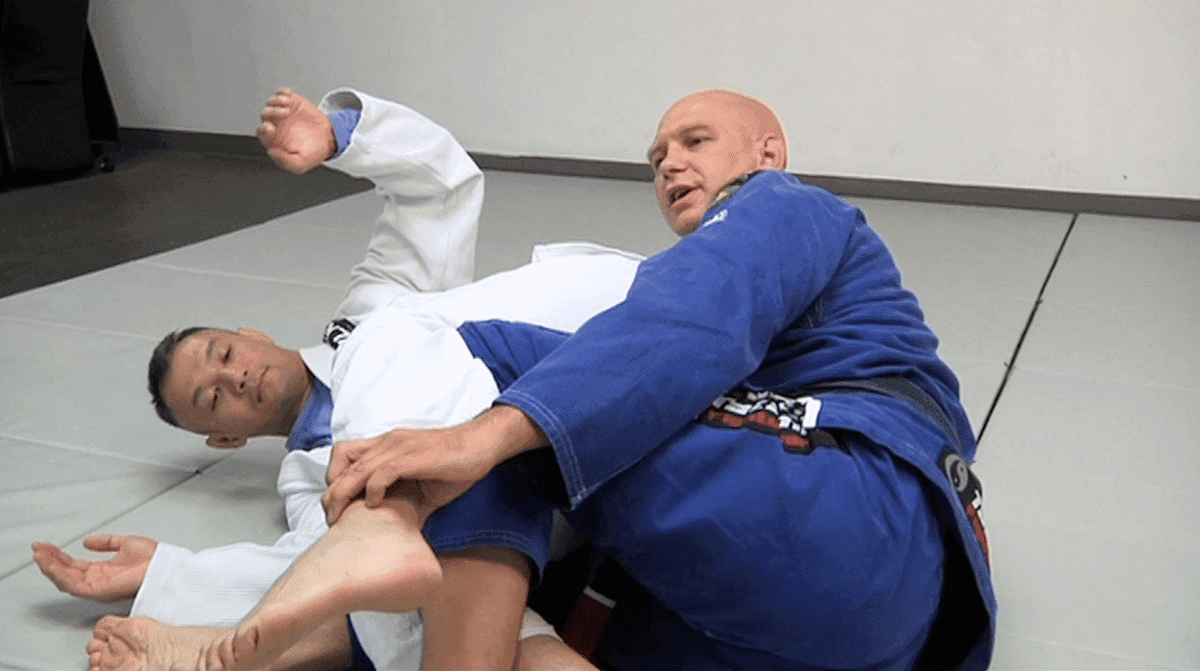
Stephan Kesting’s three-stage berimbolo lesson uses a De la Riva starting relationship. It identifies lower-leg control, the outside hook, and an upper connection such as the lapel or belt before discussing the rotation.
That is a useful order for a coached lesson. Ask the instructor to identify each connection and its role in the version being taught. Do not assume that a familiar-looking hook means the full starting position is present.
Practice the initial relationship cooperatively. The opponent should know whether to remain standing, sit, or provide a specific response. An uncontrolled exchange at this stage can make it difficult to distinguish an entry problem from something that happened much later.
For notes, record the format and side used in class. Gi connections and no-gi adaptations need their own explanations. A general berimbolo label is not enough to describe which grip or hook the next repetition should begin with.
Creating a seated opponent is its own task
The source separates establishing the guard and bringing the opponent toward a seated position from the later rotation. That makes the first stage worth practicing on its own. The learner does not need to complete every subsequent movement to obtain feedback about the entry.
Ask the coach how the opponent should be brought into the relevant position for the version being taught. Rehearse the movement at an appropriate pace, with both people understanding where the repetition ends. Avoid pulling a partner through an improvised fall to create the desired starting image.
The receiving player can report whether the original connections remained useful during the movement. If the hook or lower-leg control disappeared before the opponent sat, investigate that earlier loss rather than trying to rescue the whole sequence with a faster spin.
Kesting also distinguishes this first action from a completed sweep in his explanation. The opponent being on the floor does not automatically mean the guard player has established top position. For competition, check the actual event’s criteria rather than awarding a score based on the visual drama of the initial movement.
Learn the rotation separately from resistance
The inversion is a coached movement to learn, not a flexibility challenge to force. Ask the instructor how to practice the route at a level appropriate to you, and stop if the movement feels wrong or uncomfortable. Medical questions belong with an appropriate clinician.
The purpose of separating the movement is to understand its direction and relationship to the opponent. A learner who is trying to manage the rotation, grips, and an unrestricted defensive reaction at once may not be able to identify which part needs correction.
Use the instructor’s selected preparation and cooperative partner task. Do not treat an online wall drill or highlight as a personalized clearance to invert under resistance. The coach needs to see the student and the actual configuration being practiced.
At a pause, identify where the hips and upper body are relative to the opponent. Completing a rotation in open space is different from following the route inside a connected guard exchange. The second task depends on controls that an isolated movement drill may not include.
Keep the connections through the angle change
Kesting’s lesson emphasizes the connection to the opponent during the rotation, including the role of the upper grip in maintaining a useful distance. Learn the exact arrangement with the instructor rather than reducing it to a general instruction to pull closer.
The useful question is what each connection is doing now. A grip that helped create the seated position may need to remain, change, or be replaced as the bodies move. The coach should show where those handoffs occur in the version being taught.
Pause at one handoff and inspect it cooperatively. If releasing a grip immediately allows the opponent to turn away or stand, identify what was supposed to take over its function. A missing replacement is a different problem from an inability to spin far enough.
This also gives the receiving partner a clear job. They can provide one limited response chosen by the coach, such as the taught change of posture, rather than inventing every possible counter. Repeating a recognizable task makes a small correction easier to evaluate.
The back is a destination to establish
The source presents the back as a standard destination while acknowledging that opponent reactions can lead to other positions. It does not make every inversion a completed back take. The learner still has to understand the final transition and control.
Ask the instructor to define the endpoint. Which connection is added, where should the bodies settle, and what movement ends the repetition? If the task includes a back transition, practice that stage separately before joining it to the entry.
Do not force the original destination when the opponent’s response removes the taught route. A coach may show a different continuation or a return to another controlled position. Learn why that option fits the changed relationship instead of treating it as an accidental consolation prize.
Our guide to IBJJF rules gives context for one scoring framework. Keep technical progress and competition points distinct. Being behind the hips during a transition is not automatically the same as meeting an event’s requirements for a stabilized scoring position.
Use three linked practice questions
A proposed lesson can separate the sequence without turning it into unrelated tricks. Discuss the following questions with your instructor and let them choose the actual configuration and resistance.
Can you establish the taught guard connections and recognize when the entry is available?
Can you perform the coached angle change while maintaining the required relationship?
Can you reach the chosen endpoint and release or reset under control?
Each question can produce a useful repetition by itself. If the first stage remains uncertain, more attempts at the final back take may conceal the problem. If the entry is consistent but the handoff fails, begin the next set at that transition with the coach’s approval.
Switch roles so both partners understand the task. The receiving player needs to know which response is included and when the repetition ends. An exercise intended to examine one connection should not quietly become an open scramble because someone recognizes a familiar counter.
Keep immediate stopping available throughout. A tap or verbal stop ends the movement, including during the entry or rotation. The fact that a technique has not reached a submission does not mean a partner has no reason to stop.
Watch the entry before the highlight moment
For footage study, choose a view that shows enough of the exchange to identify the starting guard and opponent. A clip beginning halfway through the inversion may be entertaining without establishing how the opportunity was created.
On the first viewing, follow the opponent’s posture. On the second, follow the connections. Then note where a grip changes and what position follows. This is a proposed study method, not a claim that every berimbolo uses the same route.
If an important detail is hidden by the camera, leave it uncertain. A coach can demonstrate possible configurations, but an unseen grip should not become a confident factual claim about the match. The distinction keeps the viewing notes useful rather than filling them with plausible guesses.
The related Grapplearts introductory lesson can provide another teaching view. Use public instruction to formulate a focused question for class, rather than collecting variations faster than you can identify the controls in one of them.
Knowing the technique does not require choosing it everywhere
Understanding the berimbolo can help a student recognize a position even if it does not become a central attack. The coach may recommend another route for the learner’s present skills, preferences, or training task. That is compatible with studying how the sequence works.
Avoid turning one technique into a test of whether someone practices modern BJJ. A class needs appropriate material for the people in it, and a competitor needs choices that fit the actual match. A visible rotation is not a measure of the whole sport.
For your own practice, keep the next task small enough to name. Establish one connection, recognize one position, or improve one handoff. That gives the coach something concrete to inspect and prevents the entire sequence from becoming a repeated attempt to arrive at an image you have seen online.
Main photo: Grapplearts.
The takeaway
The berimbolo begins before the inversion. Guard connections and the opponent’s position create the opportunity; the rotation and later transition still require their own control. Study each stage without treating the spin as an explanation for all of them.
Practice cooperatively under a coach’s supervision and identify the handoffs between stages. If the opportunity changes, recognize it and follow the appropriate coached return or continuation. Clear control is a more useful goal than completing a rotation at any cost.
Find a coach to inspect the sequence
Use Let’s Roll’s gym directory to find instruction where you can study the starting guard, angle change, and transition at an appropriate level.
FAQ
Is the berimbolo just an inversion? No. The linked lesson separates guard establishment and creating the relevant opponent position from the rotation and finish. Inverting without the necessary connections does not reproduce the whole sequence.
Does putting the opponent on the floor complete a sweep? Not by itself. The source distinguishes the initial off-balancing stage from establishing top position. For competition, use the actual organizer’s scoring criteria and your coach’s explanation.
Do all berimbolos end on the back? The back is a common intended destination, but reactions can create other continuations. Learn the specific endpoint and alternatives with the instructor rather than forcing one route after its controls disappear.
Should I learn it directly from highlights? Use highlights to identify questions, not as a complete lesson. A coach should inspect the movement, choose suitable preparation and resistance, and explain the connections that short edits may hide.

Nina Okada
Nina Okada explains positions the way a good training partner does: one problem at a time, with the limits of the explanation said out loud. She is careful about the difference between what footage shows and what it only suggests.
Related Posts
Gustavo Batista’s passing reputation needs the next move
Batista submitted three opponents from the back at the 2023 Brasileiros. His later Worlds final shows why the passing label never tells the whole story.
A BJJ gym social should be easy to join and easy to leave
Plan BJJ gym socials around clear invitations, cost, timing, access, and optional participation. Give teammates a way to meet beyond the next round.
The hidden hand in your BJJ match video is still hidden
Slow motion cannot reveal a grip the camera never saw. Read BJJ match footage through visible evidence, competing explanations, and the limits of the angle.
Comments (0)
Loading comments...