
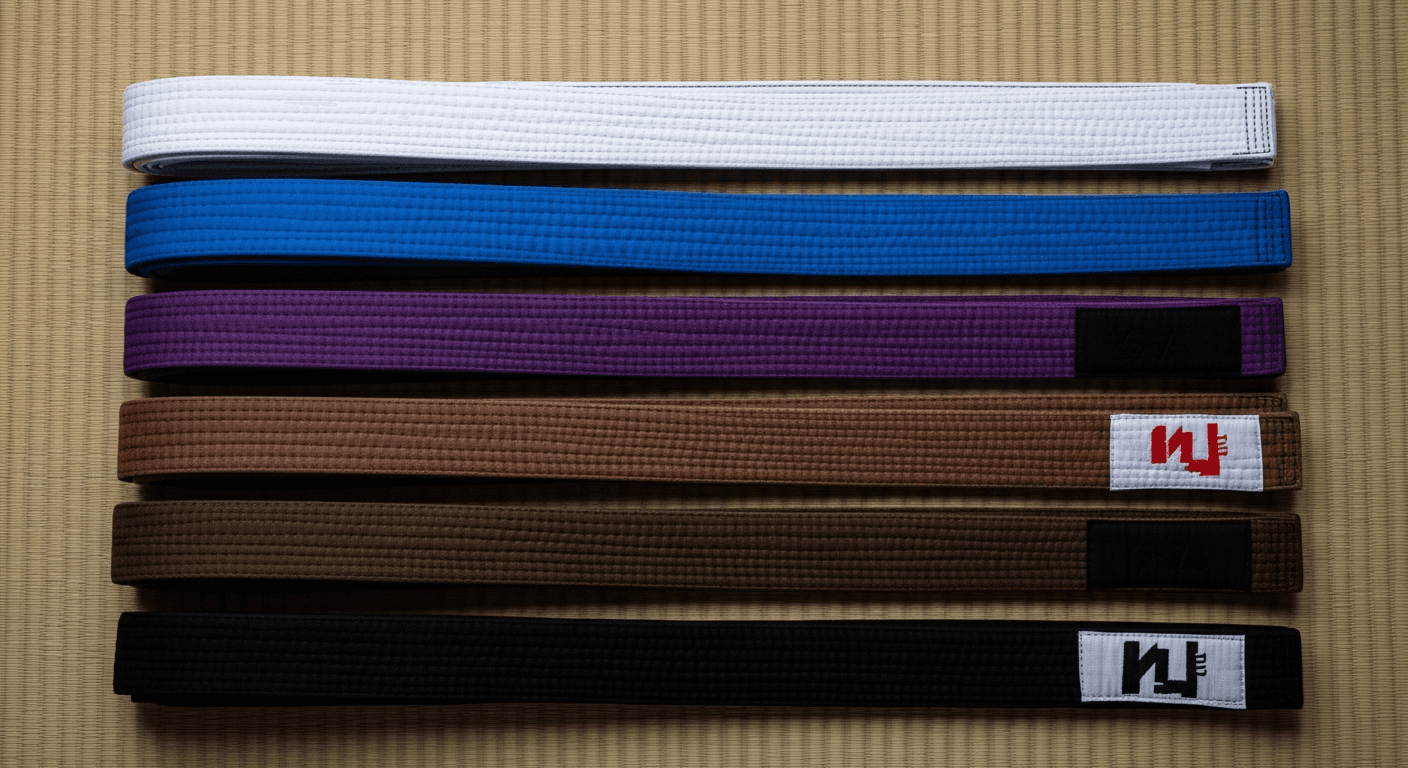
The BJJ Belt System Explained
There's a moment in every BJJ gym that stops everyone mid-conversation. The coach calls someone to the center of the mat, asks them to close their eyes, ties a new belt around their waist, and the room erupts. Teammates clap, slap the newly promoted student on the back, and someone usually gets thrown for a gauntlet line. Belt promotions are one of BJJ's most powerful rituals.
But the belt system in BJJ is often misunderstood — especially by people coming from other martial arts where belts are awarded on faster timelines. In karate or taekwondo, you might earn a black belt in three to four years. In BJJ, that journey typically takes eight to fifteen years. Each belt represents a genuine transformation in understanding, not just accumulated hours.
The Five Adult Belt Ranks
White Belt
Every journey starts here. The white belt is about survival — learning to move on the ground, understanding basic positions, and developing the instinct to protect yourself before attacking. Most white belts focus on escaping bad positions, basic submissions from closed guard, and fundamental sweeps.
What coaches look for: Consistent attendance, willingness to tap, and the ability to move from position to position without freezing. Your techniques don't need to be polished. They need to exist.
Typical duration: 1 to 2 years. Some academies award faster, some slower. There's no universal standard, but promotion at this level is about demonstrating that you understand the vocabulary of BJJ.
Blue Belt
The blue belt is where most drop-outs happen — and where the real learning begins. You know enough to be dangerous but not enough to be effective against higher belts. Blue belts start developing a personal game, identifying positions and submissions they naturally gravitate toward.
What coaches look for: Technical competence in basic positions. Can you maintain guard? Can you escape mount and side control reliably? Are you starting to link techniques together — a sweep into a pass into a submission attempt? Blue belts should also demonstrate controlled sparring, not just wild athleticism.
Typical duration: 2 to 3 years at blue belt, though some students spend longer if they train irregularly.
Purple Belt
Purple belt is the inflection point. You're no longer a beginner, and your understanding deepens beyond individual techniques into systems and concepts. Purple belts start teaching lower belts effectively, which solidifies their own understanding.
What coaches look for: A coherent game with clear strengths. Can you handle yourself against blue belts confidently and present challenges to brown belts? Purple belts should understand multiple paths from every major position and troubleshoot problems during rolling without relying on athleticism.
Typical duration: 2 to 3 years. Many practitioners describe purple belt as the most fun rank because you know enough to play creatively.
Brown Belt
Brown belt is the refinement stage. The big technical leaps are behind you; now you're polishing details, closing gaps in your game, and developing the teaching ability that a black belt needs. Brown belts are often the most dangerous sparring partners because their technique is sharp and efficient.
What coaches look for: Consistency. A brown belt handles every situation with composure. They don't panic in bad positions. Their transitions are smooth. They understand timing at an intuitive level — when to move, when to wait, when to attack.
Typical duration: 1 to 2 years, though it varies. The jump from brown to black is as much about maturity on and off the mats as it is about technique.
Black Belt
The black belt is not a destination — it's the real beginning. Black belts are expected to teach, lead, and continue refining their art for the rest of their training career. Within the black belt rank, there are degrees (up to 10th degree), with coral belts (7th and 8th degree) and red belt (9th and 10th degree) recognizing decades of contribution to BJJ.
What it takes: A genuine black belt has weathered years of plateaus, injuries, self-doubt, and evolution. They can explain any technique clearly, adapt their game to any partner, and demonstrate the values of the art both on and off the mats.
Stripes: Measuring Progress Between Belts
Most gyms use a stripe system — four small pieces of athletic tape on the belt — to mark progress between belt levels. Stripes don't have an official standard; some gyms give them based on mat time, others on demonstrated improvement, and some based on competition results.
Not every gym uses stripes. Some coaches prefer to promote directly to the next belt without intermediate markers. Neither approach is wrong — it depends on the instructor's philosophy and the academy's culture.
How Promotions Actually Work
There's no universal grading standard in BJJ. Unlike judo, which has formal promotion criteria set by the International Judo Federation, BJJ promotions are largely at the coach's discretion. This creates variation:
Some gyms require formal testing with demonstrated techniques, self-defense scenarios, and live sparring evaluations.
Others promote based on observed progress during regular training — no formal test, just the coach's judgment.
Competition results can accelerate promotions in some academies, though winning a tournament alone doesn't guarantee a new belt.
A few organizations have developed structured curricula (such as Gracie University's online system), but these remain controversial in the broader BJJ community.
The most common approach: your coach watches you train over months and years, identifies consistent improvement, and decides when you're ready. It's subjective, and it's meant to be. BJJ is too complex for a checklist.
The Problem with Belt Chasing
I've seen students fixate on their next belt to the point where it ruins their training. They compare themselves to teammates, get frustrated when someone who started later gets promoted first, and treat every roll like a promotion audition.
Here's what I tell them: the belt doesn't change your game. You don't suddenly become better the day you receive a new color around your waist. The belt catches up to your skill — it doesn't create it.
Focus on the process. The belt is a side effect.
Some of the best BJJ practitioners I know trained for years without caring about promotions. They fell in love with the problem-solving, the physical chess match, and the community. When the belt came, it was almost an afterthought.
Belt Rank and the BJJ Passport
When you travel and train at different gyms, your belt communicates your experience level instantly. Walking into a new academy with a purple belt tells the room you've put in years of work. It sets expectations for your rolling intensity and technique level.
If you're a traveling grappler, tracking your training sessions across gyms helps you build a comprehensive record of your development — regardless of where you trained.
Kids' Belt System
Children (under 16) have a separate belt system with additional ranks between white and blue: grey, yellow, orange, and green belts, each with their own stripes. This provides more frequent milestones for younger students, keeping motivation high during the long developmental years.
The Emotional Journey of Belt Progression
Nobody tells you about the emotional rollercoaster of belt progression. At white belt, every class brings visible improvement — you go from knowing nothing to knowing something, and the progress feels rapid. By blue belt, improvements become subtler. You're refining details, not learning entirely new movements. This shift catches many students off guard.
Purple belt brings a different challenge: expectation. People assume a purple belt should handle every lower belt easily. When a strong blue belt catches you, it stings. Brown belt is the lonely rank — you're close enough to black belt to feel the pressure but far enough to question whether you'll ever get there.
Understanding these emotional stages helps you navigate them. Every belt has its own psychological landscape, and knowing that the feelings you're experiencing are universal — not unique to you — makes them easier to manage.
Connecting with grapplers at similar stages can help enormously. Attend open mat sessions and talk to practitioners from other gyms about their belt journey — you'll find the struggles are remarkably consistent across academies.
What If You Disagree with Your Promotion?
It happens. Some students feel they were promoted too early (imposter syndrome) or too late (frustration). If you feel promoted too early, remember: your coach sees things in your game that you don't. Train into the belt. If you feel overlooked, have a respectful conversation with your coach about what they want to see from you. Most instructors appreciate direct communication.
Explore gyms in your area and their promotion philosophies through our academy search tool.
Belt Rank in Different Contexts
Your belt rank may carry different weight depending on context. In competition, belt divisions create fair matchups — but the skill range within a single belt can be enormous. A fresh blue belt and a blue belt with three years of experience are worlds apart, yet they compete in the same division. This is why sandbagging — deliberately staying at a lower belt to win tournaments — is considered unethical in the BJJ community.
When visiting other gyms, your belt rank serves as an introduction. It tells the room roughly what to expect from you. But experienced grapplers know that belt rank is an approximation, not a precise measurement. A purple belt from a competition-focused academy might roll very differently from a purple belt at a self-defense-oriented school. Both are legitimate — they simply emphasize different aspects of the art.
In professional contexts — teaching, opening a gym, or representing the art — belt rank carries significant weight. Most BJJ organizations require a minimum of brown or black belt to certify as an instructor. This ensures that people teaching the art have enough experience to do so safely and effectively. The years invested in reaching those ranks aren't just about skill — they're about developing the judgment and teaching ability that comes with long-term practice.
Understanding how belt rank functions in these different contexts helps you maintain a healthy relationship with your own progression. Your belt tells part of your story, but your training consistency, your attitude on the mats, and your contribution to your gym's culture tell the rest.
Frequently Asked Questions
Can you skip belts in BJJ?
It's extremely rare. Some exceptional cases exist — high-level judo or wrestling backgrounds might lead to faster promotion — but skipping entire belts almost never happens. The journey through each rank builds essential attributes that can't be shortcut.
Why do BJJ promotions take so much longer than other martial arts?
BJJ promotions are tied to demonstrated ability in live sparring, not just choreographed forms or theoretical knowledge. You have to prove your skills against resisting opponents, which requires years of mat time to develop consistently.
Is a BJJ blue belt equivalent to a black belt in other arts?
Comparisons across martial arts are unreliable because the standards differ fundamentally. However, a BJJ blue belt has typically trained 2 to 3 years with significant live sparring experience, which does represent a substantial skill level relative to most martial arts' intermediate ranks.

Marcus Delgado
black Belt
Black belt with 18 years on the mats. Head instructor and lifelong student of the gentle art.
Related Posts

Covering Your First BJJ Class Without Overteaching
Cover an adult BJJ class with a plan agreed by the head coach. Keep the lesson focused, supervise partners, and leave clear handover notes afterward.

What to Do After a BJJ Seminar: A One-Week Follow-Up
Turn a BJJ seminar into a useful week of practice. Organize your notes, mark missing details, choose one task, and follow the host's recording rules.

Better BJJ Rounds When Your Partner Is a Different Size
A weight gap changes a BJJ round. Use clear starting positions, agreed tasks, and controlled resets so training partners of different sizes get useful work.
Comments (0)
Loading comments...