
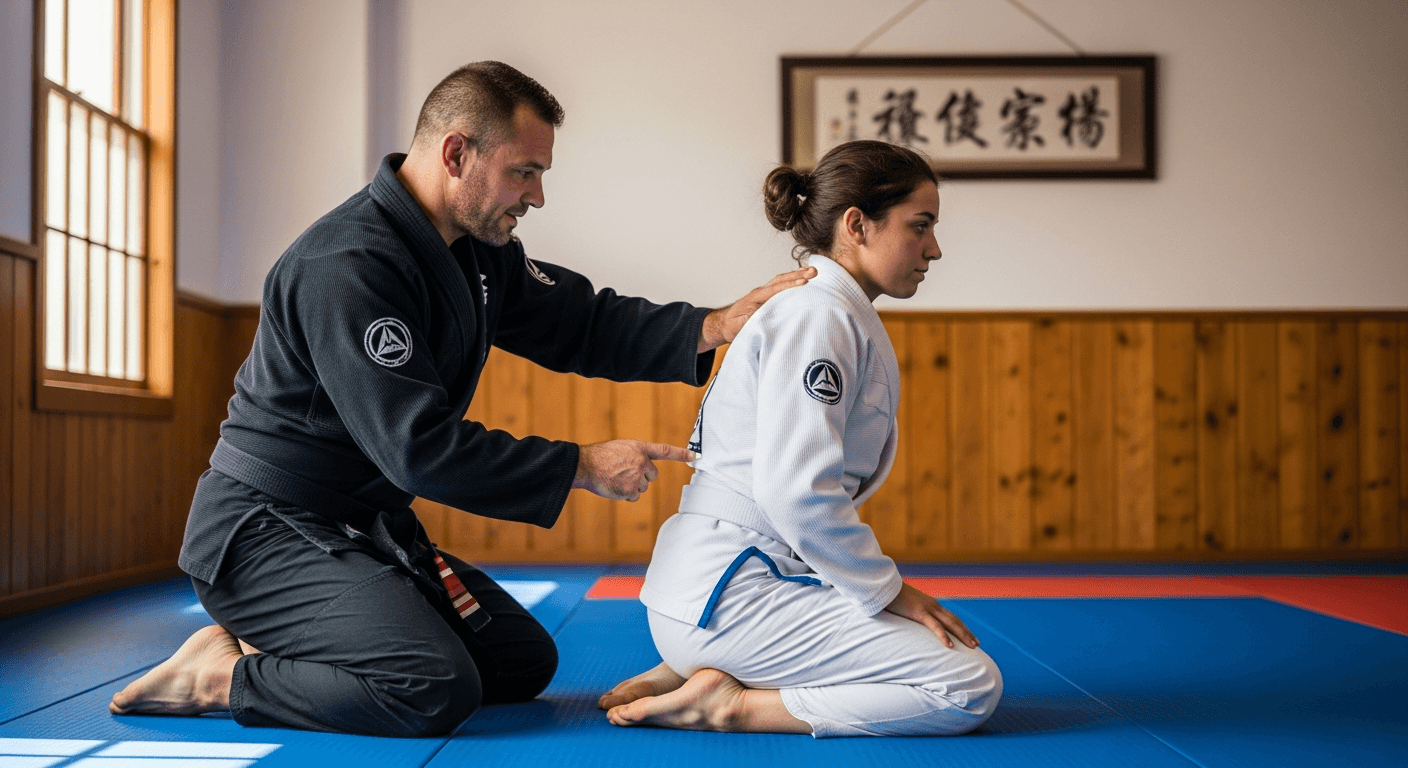
15 Common Beginner Mistakes in BJJ (And How to Fix Them)
I've coached hundreds of white belts through their first year on the mats. They all make the same mistakes. Not because they're not talented — because these errors are wired into how untrained bodies react to grappling for the first time.
The good news: every single mistake on this list is fixable. Most of them disappear with awareness and focused practice. The problem is that nobody tells beginners what they're doing wrong in a clear, actionable way. This is that list.
1. Using Strength Instead of Technique
The most universal beginner error. You muscle through positions, grip with white knuckles, and use your arms when your hips should be doing the work. This burns your gas tank in two minutes and teaches you nothing about leverage.
Fix: After every roll, ask yourself: where did I use strength to compensate for not knowing the right movement? That's where your technique gaps are. Focus your drilling on those moments.
2. Holding Your Breath
New students hold their breath during scrambles, under pressure, and during submissions. It's a panic response, and it accelerates exhaustion.
Fix: Consciously breathe out during exertion — when you bridge, shrimp, or push. Exhaling forces you to relax and keeps your muscles oxygenated. It sounds simple because it is.
3. Neglecting Defense
Beginners want to submit people. They watch highlight reels of flying armbars and think offense is the game. In reality, the first year of BJJ is about defense and survival.
Fix: Dedicate at least half of your training focus to escapes and defense. If you can survive a round with a higher belt without getting submitted, that's a win — and a sign your defense is developing.
4. Lying Flat on Your Back
When you're on bottom, your instinct is to lie flat and push your opponent away with straight arms. This is the weakest position in grappling.
Fix: Stay on your side. Keep your hips angled. Use frames — forearms and shins between you and your opponent — to manage distance. Flat on your back means you've given up your ability to move.
5. Not Moving Your Hips
Hips are the engine of BJJ. Every escape, every sweep, and most submissions start with hip movement. Beginners keep their hips glued to the mat and wonder why nothing works.
Fix: Shrimp drills aren't just warm-ups — they're the most important movement in BJJ. Practice them deliberately. In sparring, whenever you feel stuck, shrimp first and assess second.
6. Going for Submissions Too Early
You see the armbar. You reach for it. But you haven't controlled the position, and your opponent escapes and lands in a better position than they started. This happens dozens of times per class for new students.
Fix: Position before submission. Secure the position — mount, side control, back control — before hunting for the finish. Rushed attacks create openings for your opponent.
7. Ignoring Grips
Grips control distance, posture, and movement. Beginners either don't grip at all or grip the wrong thing — a fistful of gi material that does nothing strategic.
Fix: Learn the fundamental grips for each position: collar and sleeve in closed guard, crossface and underhook in side control, seatbelt from the back. Every grip should serve a purpose.
8. Crossing Ankles in Back Control
When you take someone's back, crossing your ankles exposes you to a heel lock. It's one of the first submissions beginners learn to counter.
Fix: Keep your hooks in but don't cross your feet. Instead, hook one foot on the hip and the other on the inner thigh. Body triangle is the advanced alternative once you're comfortable.
9. Standing Straight Up in Someone's Guard
When you're in your opponent's closed guard, standing fully upright without breaking their guard first is an invitation to be swept or submitted.
Fix: Break the guard first — use a knee-through or a standing break — then work your pass. Posture management in closed guard is a skill that takes months to develop. Be patient with it.
10. Not Asking Questions
Some beginners are too intimidated to ask the coach or upper belts questions. They leave class confused about a detail and don't address it until the same technique comes up weeks later.
Fix: Ask. Every coach I know would rather you ask a "dumb" question during drilling than silently practice the technique wrong for three months. Upper belts are usually happy to explain details between rounds.
11. Comparing Yourself to Others
The white belt who started three months after you just got their first stripe. The blue belt your age seems to be learning faster. Comparison is natural, but it kills motivation.
Fix: Your only competition is who you were last month. Track your own progress — can you escape positions you couldn't before? Can you hold guard against people who used to pass you easily? That's the metric that matters.
12. Training Through Injuries
Tapping late, rolling too hard, and ignoring pain signals are how minor tweaks become chronic problems. The most common beginner injuries — tweaked elbows, sore ribs, jammed fingers — are almost all preventable.
Fix: Tap early. If something hurts, stop. Take a few days off rather than training through pain and turning a two-day recovery into a two-month layoff. Your body is your training tool — protect it.
13. Wearing Improper Gear
Long fingernails, a gi that hasn't been washed, jewelry on the mats, or shoes on the training area — these are all hazards and hygiene violations.
Fix: Trim nails before every class. Wash your gi after every session. Remove all jewelry. Wear flip-flops to the edge of the mat and take them off before stepping on. These aren't preferences — they're requirements.
14. Rolling Too Hard With Everyone
Some beginners interpret every sparring round as a fight. They go 100% with smaller partners, newer students, and even the 60-year-old hobbyist who just wants a technical roll.
Fix: Match your partner's energy. If they're flowing, flow. If they escalate, it's okay to match — but initiating maximum intensity every round makes you the person nobody wants to train with.
15. Quitting After Three Months
The hardest part of BJJ isn't any technique — it's showing up consistently during the first six months when everything feels impossible and your progress seems invisible.
Fix: Commit to a minimum of six months before deciding whether BJJ is for you. The first three months are survival. Real progress starts around month four or five, when positions start making sense and you stop feeling completely lost during rolls.
The Mindset Shift That Changes Everything
Every mistake on this list stems from the same root cause: treating BJJ like something you should already know instead of something you're learning. The shift from performance mindset to learning mindset changes everything.
In performance mindset, getting tapped feels like failure. Getting swept means you're weak. Every roll is a test you can pass or fail. In learning mindset, getting tapped means you discovered a gap in your defense. Getting swept means you found a position where your balance breaks down. Every roll is data.
The best way to cultivate a learning mindset is to ask yourself one question after every roll: what did I learn? Not "did I win?" Not "did I look good?" Just: what did I learn? If you can answer that question honestly after every session, you'll progress faster than almost anyone on the mats, regardless of your athletic ability.
Students who make this mental shift stop making most of these fifteen mistakes within months. Not because they've drilled every correction, but because they've stopped viewing mistakes as threats and started viewing them as information. That single perspective change is worth more than any technique your coach will teach you this year.
Another critical piece is setting realistic expectations for your timeline. BJJ is a lifelong practice, not a twelve-week program. The people who quit after three months typically expected visible transformation in that window. The people who stay for decades understood from the beginning that they were signing up for something measured in years, not weeks.
If you're navigating these early struggles, finding the right gym with a supportive community makes all the difference. A welcoming mat culture and patient training partners turn these growing pains into growth.
Track your development and see how far you've come by logging your sessions in your BJJ training passport. Looking back at early entries is one of the most motivating things a new grappler can do.
Visit open mats near you to practice in a low-pressure environment where everyone understands what it's like to be a beginner — because everyone was one.
The Power of Drilling
Many of these mistakes persist because beginners avoid drilling. Rolling is exciting — it feels like real BJJ. Drilling feels tedious. But drilling is where corrections actually stick. Your body doesn't learn new movement patterns during the chaos of live sparring. It learns them during focused, repetitive drilling where you can think about each detail.
Your Mistake Timeline
Here's a rough timeline of when most students naturally correct these mistakes. Knowing this helps you calibrate your expectations and recognize that your timeline is probably normal:
Months one through three: You'll stop using pure strength, learn to breathe, and start moving your hips. These corrections happen almost automatically through regular mat time. Your body learns that strength without technique is exhausting, and your breathing adapts to the rhythm of rolling.
Months four through six: You'll develop basic defensive awareness, stop lying flat, and start paying attention to grips. This is the period where BJJ begins to feel less chaotic and more like a system you can learn. Positions that seemed identical now feel distinct, and you start recognizing patterns.
Months seven through twelve: You'll begin studying positions systematically, manage training intensity better, and develop the mental toughness to train through plateaus. By this point, you've survived the highest-attrition phase. You're no longer a raw beginner — you're a developing grappler with a growing understanding of what you need to work on.
For more on finding the best open mat sessions to accelerate your learning, visit our open mat listings.
Frequently Asked Questions
How long until I stop making these mistakes?
Most of these errors fade significantly within your first year of consistent training. Some — like relying on strength or neglecting hip movement — resurface even at higher belt levels during fatigue or stress. Awareness is the first step; consistent drilling is the cure.
What's the most important mistake to fix first?
Breathing. It affects everything else on this list. When you hold your breath, you tense up, burn energy, and lose the ability to think clearly. Breathing correctly makes every other fix easier to implement.
Should I drill or roll more as a beginner?
Both are essential, but drilling should take priority in your first six months. Live rolling teaches you timing and reactions, but drilling builds the muscle memory that makes your techniques available during those rolls. Aim for at least as much drilling time as rolling time.

Marcus Delgado
black Belt
Black belt with 18 years on the mats. Head instructor and lifelong student of the gentle art.
Related Posts
Covering Your First BJJ Class Without Overteaching
Cover an adult BJJ class with a plan agreed by the head coach. Keep the lesson focused, supervise partners, and leave clear handover notes afterward.

What to Do After a BJJ Seminar: A One-Week Follow-Up
Turn a BJJ seminar into a useful week of practice. Organize your notes, mark missing details, choose one task, and follow the host's recording rules.
Better BJJ Rounds When Your Partner Is a Different Size
A weight gap changes a BJJ round. Use clear starting positions, agreed tasks, and controlled resets so training partners of different sizes get useful work.
Comments (0)
Loading comments...