
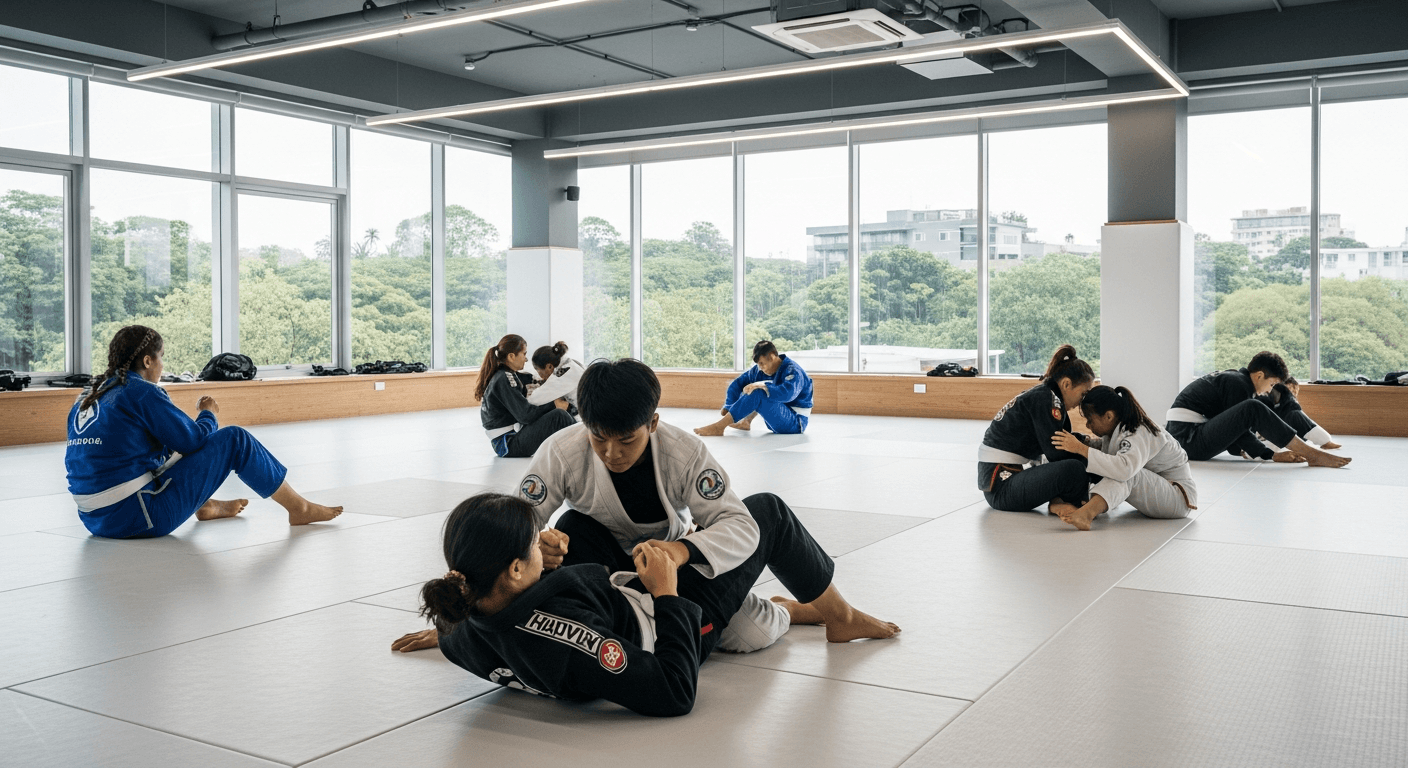
Where BJJ Is Going — The 2026 State of the Sport
If you started BJJ in 2015 and walked back onto the mats today, you'd recognize the sport — but a lot would have moved. Some of the shifts are obvious (leg locks), some are subtle (rule sets), and some are still playing out. Here's what's actually different, and what's coming.
The leg-lock revolution is over
The biggest technical shift of the last decade is over — and BJJ won.
Ten years ago, leg locks were rare, frowned upon at most schools, and banned outright at lower belts in most rule sets. The Danaher Death Squad (DDS) and their offshoots changed the math. Heel hooks, knee bars, the modern saddle/honeyhole position — all became standard parts of the no-gi game.
By 2026, leg locks are integrated into almost every serious no-gi curriculum. Most gi gyms still treat them conservatively (the IBJJF gi ruleset bans them below brown belt). But anyone training no-gi today is learning leg locks from white belt.
What this means for a new practitioner: if you're starting now, plan to learn leg defense early. The "wait until purple belt" advice from 2015 has aged out. You will encounter leg attacks in your first year of no-gi training. Better to have basic defense than to be shocked the first time someone goes for an outside ashi.
The submission-only rule set is winning
For most of BJJ's history, the dominant competition format was IBJJF points: advantages, sweeps, passes, mounts all scoring, with submission as a tiebreaker. That format is still around — and still the gold standard for gi.
But in no-gi, submission-only formats have largely taken over the prestige tier. ADCC, EBI, Who's Number One, FloGrappling Submission Series — the marquee events that draw the biggest audiences are all submission-focused with overtime rules that minimize positional stalling.
The practical effect: top-level no-gi practitioners now train very differently than they did in 2015. Positional stall games (deep half, 50/50 sit, etc.) that scored well in points are less valued. Active hunting, leg-lock entries, and submission chains have moved center stage.
A new practitioner today is being trained for a sport whose top-end format is submission-only. That filters down into gym culture even at lower belts.
The instructional-video economy
Before 2015, you learned BJJ from your coach and maybe a few books. After 2015, BJJ instructional video exploded — DVDs at first, then streaming, then the BJJ Fanatics ecosystem, then practitioner-specific platforms (Submeta, Origin Instructionals, etc.).
In 2026, every serious competitor has an instructional. Many have multiple. A single high-quality instructional from a current world champion costs $50–$150 and runs 8–15 hours.
This has produced two effects:
Faster technique diffusion. A new leg-lock entry developed at a top gym in New Jersey will be in instructional video and on YouTube within months. Practitioners in small-town gyms can study cutting-edge technique that, twenty years ago, was effectively secret.
Information overload. The downside of an unlimited library: most practitioners under-study and over-collect. Owning 30 instructionals you've watched once is normal and unproductive.
The right relationship with instructional video, especially as a beginner: ignore it until you have foundations. Read more in how to build your BJJ game.
Gym culture is professionalizing
Twenty years ago, the typical BJJ gym was a back-of-an-MMA-gym mat space with a single instructor, a chalk schedule on the wall, and a hand-cash payment system.
In 2026, most established BJJ gyms operate like real businesses:
Online booking and account systems (gym management software like GymDesk, Member Solutions, etc.)
Tiered memberships (kids/adults/family)
Online communication with members through dedicated apps
Professional photography, social media, and marketing
Sometimes a partnership with a strength-and-conditioning facility next door
This is mostly good — it means more reliable operations, better-maintained facilities, clearer communication. The downside is that the smallest, scrappiest backyard gyms (where a lot of high-level practitioners trained in the 90s and 2000s) are rarer than they used to be.
The current market is also seeing a small renaissance of "garage gyms" — invitation-only training rooms run by black belts who don't want to manage a business. These exist but aren't easy to find by browsing — they're word-of-mouth.
Women's BJJ has grown — but still has a long way to go
In 2015, most BJJ gyms had 5–10% women members and 0 dedicated women's programs. In 2026:
Most established gyms run at least one women's BJJ class a week
The IBJJF female competitor count has roughly tripled
Women's adult-blue-belt-and-up enrollment has more than doubled
Still, the sport remains male-dominated. The "find a gym near you with a women's program" search returns mixed results depending on city — major metros (LA, NYC, Miami, San Diego, Austin) have dozens of options; smaller cities still have a handful at best.
For new women practitioners: gyms with women coaches or visibly active women members are easier rooms to start in. If a gym's website doesn't show a single female competitor or instructor, that's data.
What's coming next
A few honest predictions for the next 5 years:
More cross-training between BJJ and other grappling. Wrestling crossover (especially from college wrestlers) is already big. Expect more sambo, more judo crossover at lower belts, more grappling generalists.
More online community infrastructure. Right now BJJ is fragmented across Instagram, Reddit, YouTube, individual gym apps. There's room for better tools — competition tracking, training-partner finders, gym hopping logistics. (Disclosure: we're trying to build some of this.)
A small contraction in the number of gyms. Post-pandemic, many gyms expanded. A few are over-built. Expect some consolidation, especially in markets with too many small schools.
Continued globalization of competition. The biggest events will be more international, more streamed, more accessible to fans. The economic gap between competitor and audience will continue to shrink as ADCC-format events scale.
More no-gi-specific schools. 10th Planet was the first major no-gi-only franchise. Expect more single-discipline brands as the sport segments.
What to do about all this as a practitioner
Honestly: not much. The fundamentals haven't moved. The thing that makes you good at BJJ is showing up consistently, training hard but smart, listening to your body, and being a good partner to the people you roll with.
The shifts above are interesting context. They're not a training plan. A blue belt in 2026 needs the same things a blue belt in 2006 needed: more reps, more open mats, a few good training partners, a coach who pays attention.
The sport will keep evolving. The best response is to stay in it long enough to see the next decade of changes from inside.
If you're new and reading this, the practical next move is finding the right gym. Start with the how to choose your first BJJ gym guide, then browse gyms by city. The next decade of BJJ will be shaped by the people who started training this year.

Jason Park
purple Belt
Purple belt traveler who has trained at over 60 gyms across 12 countries. Always chasing the next open mat.
Related Posts
Being a BJJ Parent on the Sideline Without Taking Over
Help your child at a BJJ tournament without adding competing instructions. Agree on parent and coach roles, respect tapping, and handle the practical work.
A family BJJ calendar should count who covers the evening
The class time leaves out travel, supervision and somebody else's plans. Build the family training week around the whole commitment.

Before you post your child's jiu-jitsu tournament photos
Before sharing your child's BJJ tournament photos, ask about their preferences, other children in frame, and the event's policy. Keep difficult moments private.
Comments (0)
Loading comments...