
BJJ belt sizing: measure the belt you actually want
Quick answer: Choose a BJJ belt by comparing its actual length with a belt that fits you over your gi. Check the manufacturer's chart for the exact model rather than assuming your gi size determines your belt size. Try the new belt before washing or personalizing it, and check the relevant uniform rules if you compete.
A belt can fit inside the delivery envelope and still fail at its only practical job. One arrives with tails that barely escape the knot. Another reaches so far down your legs that tying it feels like arranging a sash for a village ceremony.
Neither problem needs a complicated sizing formula. A tape measure, the gi you will wear, and a few minutes comparing the product details usually provide more useful information than the letter and number on the label. Begin with something you can measure rather than a guess about what size people like you normally buy.
Measure a belt that already works
Lay the belt flat and measure from one end to the other without stretching it. Include the entire belt, including the rank bar and both tips. Write down the measurement and the units. A note saying that your old belt is an A2 is less useful than the actual length you are trying to replace.
Then put on your gi and tie that belt as you normally would. Look at the finished tails and decide whether you want the replacement to be the same length, a little longer, or a little shorter. The flat measurement only becomes useful when you connect it to the way the belt fits on you.
If the existing belt has become too short, do not copy its dimensions simply because it was once correct. Measure it as a reference and explain the problem to the retailer. You are trying to improve the fit you have now.
For a first belt, ask the academy whether you can check the length of a suitable loan belt. That gives you a starting point without buying several sizes and hoping one looks familiar when it arrives.
Read the chart for the exact product
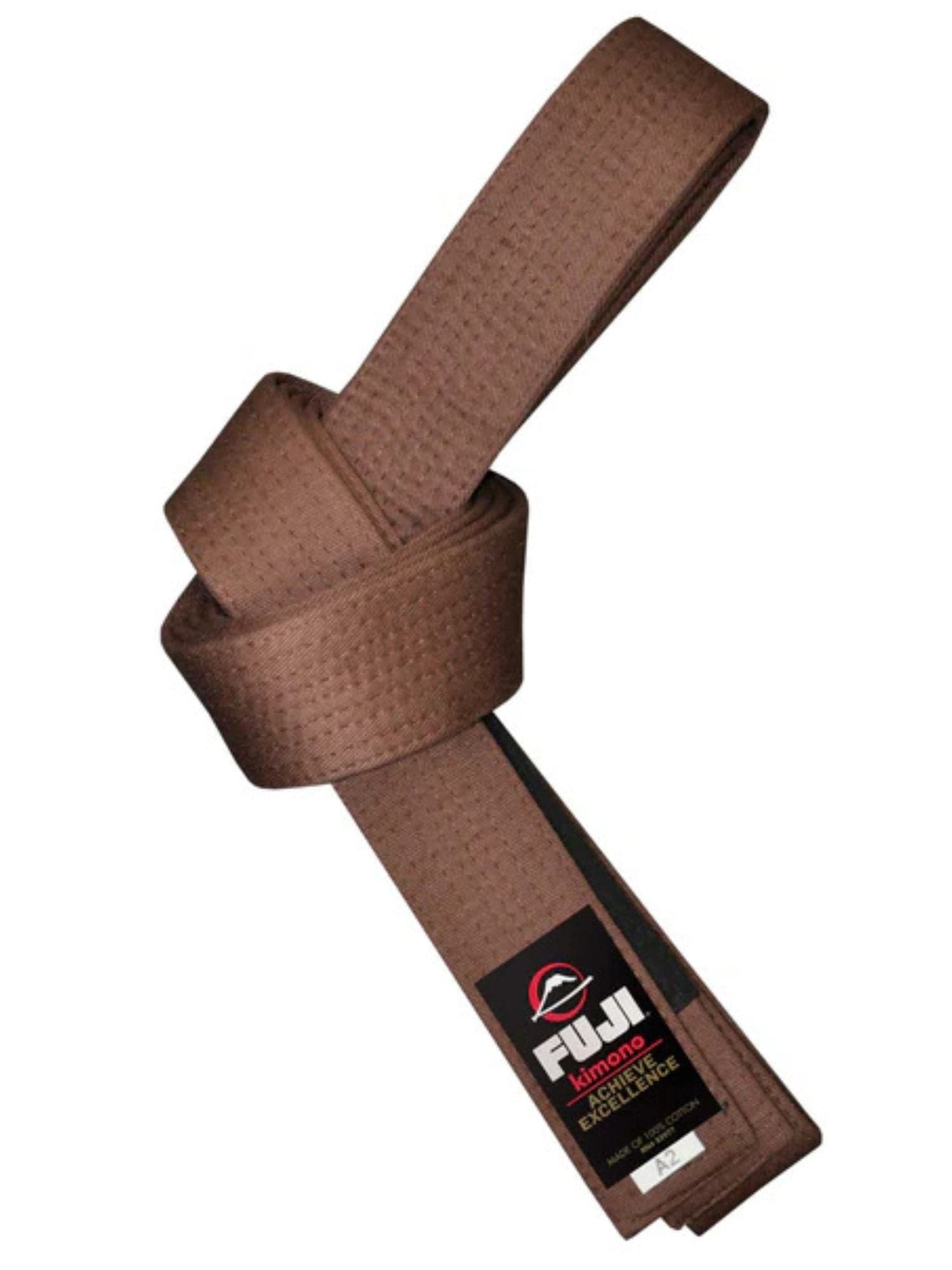
A manufacturer's chart should connect the size label with a length. On the FUJI adult belt listing, for example, A2 is listed at 110 inches and A3 at 117 inches. Those figures are examples from that product's chart, not a universal conversion for every belt carrying the same label.
Compare the measurement you took with the chart for the model you are actually ordering. Check whether the retailer is displaying an adult belt chart, a children's chart, or a gi chart. They can appear on the same website, and a helpful-looking size button is not proof that you are reading the right one.
If two measurements use different units, convert them before comparing. Avoid estimating from the apparent size of the numbers. Keep the original measurement in your order notes so you can explain the decision if you need an exchange.
When the listing supplies only height and weight recommendations, ask for the belt's finished length. Body measurements can narrow the search, but they do not tell you how much material a particular knot and gi combination will use.
Try it over the gi you intend to wear
Your belt has to go around clothing, not around the number printed on your trousers. Put on the gi jacket, arrange it properly, and tie the belt over it. Testing against a T-shirt may make the result look more generous than it will be in class.
Use your normal knot consistently during the comparison. If you change both the belt and the tying method at once, it becomes harder to tell which change produced the difference. Ask the instructor to check the knot if you are unsure how the belt should sit.
Look at both tails after tying. Uneven ends may come from where you started the wrap rather than from the overall length. Untie it and try again before deciding that one side of the belt has somehow been manufactured incorrectly.
Move around gently while wearing the gi. Sit down and stand up. The belt should let you close the jacket and train without requiring you to make it uncomfortably tight to create acceptable-looking tails. If the fit is clearly wrong, put the belt aside while you arrange the exchange.
Keep competition requirements separate from preference
For IBJJF competition, the published belt requirements specify a belt four to five centimeters wide, wrapped twice around the waist and secured with a double knot. Each tied end should hang twenty to thirty centimeters. Check the complete current requirements for rank color and the belt tip before an event.
Those measurements give you a concrete check after tying. They do not tell you which retail size to order because the result also depends on your body, jacket, and knot. A compliant length on one athlete can produce a different result on another.
Other organizers may publish different requirements or use different inspection procedures. Read the rules for your actual tournament. A product's competition-approved description is not a promise that every size of it will fit every athlete correctly.
If you already have a competition date, leave time to exchange a poor fit. Trying the belt for the first time in the venue changing room converts a small shopping problem into a problem with a deadline. The referee is not responsible for the retailer's sizing advice.
Compare thickness and stiffness without inventing a ranking
Length is the first check, but the way a belt ties matters too. A very firm belt and a more flexible one can feel different in your hands even when their flat measurements match. Product photographs cannot fully answer that question.
Look for a clear description of construction and ask the retailer if the listing leaves something important out. If a teammate owns the same model, you can ask to handle it or watch how it ties. Treat their preference as a useful observation rather than a verdict that should apply to everyone.
Avoid buying on the assumption that the thickest option must be the most serious. You need a belt you can tie securely and comfortably. Extra material is not a substitute for a correct fit, and an impressive product description will not help you retie it between rounds.
If you are replacing a familiar belt, decide whether you actually want a different feel. Changing brands, length, and construction simultaneously makes it difficult to know why the new one seems wrong. Keep the successful parts of your current choice unless you have a reason to change them.
Delay embroidery until the fit is settled
Personalization can turn an easy exchange into a much less straightforward conversation. Before ordering a name or academy logo, confirm the length and ask what the seller allows if the finished belt does not fit. Do not assume the return conditions for an ordinary item also cover customized work.
Use a short order check:
Confirm the correct rank and any academy requirements.
Match the product's stated length to your measured reference.
Check the return conditions before washing, wearing, or altering it.
Add personalization only when you are satisfied with the size.
For a gift, ask for the recipient's current belt measurement or choose a returnable option. Their gi size is a clue, not a guarantee. If the belt marks a promotion, coordinate with the instructor so the gift fits the academy's plans as well as the person.
Children's belts deserve the same measured approach. Buying a very long belt to cover years of possible growth can leave a poor fit today. Discuss the appropriate size with the school rather than treating excess length as money automatically saved.
Keep the useful information for the next purchase
Once you have a belt that works, save its model, size, and measured length. Add a brief note about how it fits over your usual gi. That small record is more reliable than trying to remember whether the previous purchase was the standard version or the premium version with a similar name.
Follow the manufacturer's care directions. Do not use aggressive washing or drying as a sizing strategy for a belt that arrived too long. If the plan depends on making it shrink by a precise amount, it is a plan built around an uncertain result.
Check the fit again if your gi or body size changes substantially. The original label will remain the same while the amount of material available for the knot changes. A replacement can be a practical equipment decision without any significance beyond that.
Keep the sizing note with your other training kit information; there is no need for a spreadsheet dedicated to one belt. A photo of the label and a measurement in your phone will do. The aim is to make the next order less surprising.
Main photo: FUJI Sports; product photograph.
The takeaway
Measure a belt you can evaluate, compare that measurement with the exact product chart, and test the replacement over your gi. Check the finished knot before washing or customizing anything. This gives you several chances to catch a poor fit while the solution is still simple.
For competition, measure the tied ends against the organizer's current rules. For everyday training, prioritize a secure, comfortable fit that works with your academy's expectations. Neither task requires guessing your belt size from somebody else's shopping history.
Check your academy's requirements
Find your school through the gym directory and ask about uniform requirements before ordering a new belt.
FAQ
Should my BJJ belt size match my gi size? It may be a useful starting point, but compare the actual belt length with a suitable reference. The finished fit over your jacket matters more than matching labels.
How do I measure a BJJ belt? Lay it flat, avoid stretching it, and measure its full length from tip to tip. Record the units and compare with the chart for the exact product.
Can I shrink a belt that is too long? Arrange an exchange where possible instead of relying on a precise amount of shrinkage. Follow the manufacturer's care instructions once you have a suitable size.
How long should the ends be for IBJJF competition? Its published requirement is twenty to thirty centimeters at each end after the prescribed double knot. Check the full current uniform rules before competing.

Owen Bellamy
Owen Bellamy writes for the person training twice a week around a job. Nothing he suggests requires quitting the job.
Related Posts

Mikey Musumeci gives up the belt to make room for MMA
Musumeci is vacating his UFC BJJ title to focus on MMA training. What he is leaving, what continues, and why the transition matters.
IBJJF membership: finish the paperwork before the deadline
IBJJF membership and tournament entry are separate steps. Plan documents, professor approval, renewals, and junior accounts before registration closes.
Choosing a BJJ seminar worth your time and travel
Choose a BJJ seminar by the subject, teaching format, access, and total cost. Know what to ask the host before buying a ticket.
Comments (0)
Loading comments...