
Becoming a BJJ referee starts before the first mat assignment
Quick answer: A rules course and permission to referee are separate steps. IBJJF describes a training and assessment pathway, including supervised event work, and its help page contains wording that needs direct clarification. Ask the federation which current route applies before treating a certificate as an officiating appointment.
A certificate can fit in an email attachment. The responsibility of stopping a live match does not. That gap deserves attention before anybody decides that knowing the points means being ready to stand between two competitors.
The IBJJF help desk gives a useful starting point for a prospective referee, including a training program and supervised experience. It also contains a course-description inconsistency. I think an honest explanation should show the unresolved part instead of quietly choosing the sentence that makes the process sound easiest.
A course gives you a starting point
The IBJJF rules help page describes taking a rules seminar or webinar, meeting a stated assessment threshold, and then requesting entry to the Referee Training Program. Those are stages in a process, rather than one interchangeable qualification.
Before enrolling, identify what you want the course to do. Learning the competition rules is useful for athletes and coaches too. Seeking the federation’s officiating pathway is a more specific aim. The same course advertisement may be read by people pursuing different outcomes.
Ask the provider what the actual enrollment includes. Is there a test? How is completion recorded? Does the course lead to a further application, or does it simply supply rules education? A clear answer can prevent you from paying for an experience that has value but does not serve your chosen purpose.
There is no need to dismiss a learning certificate because it does not appoint a referee. The mistake goes in the other direction, when a learner describes the certificate as authority the organizer has not granted. Keep the course name and its stated outcome together whenever you discuss it.
Ask about the wording that does not line up
The help page’s referee section refers to seminars or webinars as an initial route. A later course-comparison section says the in-person seminar allows an internship request while the webinar does not. Those statements leave a prospective applicant with a real question.
The sensible next step is direct clarification through the federation’s official support. Describe the course you are considering and ask which current officiating pathway it supports. Do not choose whichever paragraph sounds more convenient and spend money on that interpretation.
Save the reply. If the process changes later, you will have a dated answer attached to a particular course and application. That is more useful than repeating a broad claim that online courses count or that online courses never count.
This small inconsistency illustrates something larger about rules work. Careful reading includes noticing when two statements cannot safely be combined. A referee must eventually act decisively, but decisiveness does not require pretending every preparatory question is already settled. The habit worth practicing is identifying the exact uncertainty and finding the person authorized to resolve it.
Supervised work is a different kind of learning
IBJJF’s described pathway includes supervised event work, beginning with uniform inspection and some matches assisted by an experienced referee, followed by a minimum number of internships. Verify the current requirements directly rather than treating this summary as an acceptance letter.
A written test and a live assignment ask different questions. A test can present a complete description of an action. A mat presents movement, a changing angle, noise, and limited time to recognize what matters. Understanding the written condition remains necessary; applying it is another skill to develop.
For a learner, the useful response is to ask what feedback is available. Who observes the assignment? Which errors should be discussed afterward? How do you record an unresolved interpretation without disrupting the next match? These are practical training questions, not evidence that you are unfit to start learning.
Uniform inspection also deserves respect. It is tempting to treat the position away from the center of the mat as an administrative prelude. It has its own rules and consequences for real competitors. Learning to apply a requirement clearly and explain the next step is part of the event’s sporting work.
Study observable conditions rather than move names
A useful reading session starts with an action and the conditions the rule requires. A familiar technique name can be too broad. It may describe several configurations, only some of which satisfy the scoring or legality provision under discussion.
Use the federation’s books-and-videos reference as the official starting point. If you keep personal notes, attach each one to the relevant provision. A sentence such as a sweep scores two points is an incomplete learning note if it leaves out the starting position and conditions you are trying to recognize.
One practice exercise is to separate three columns in your notes, without publishing them as a universal scoring chart. Record what the footage clearly shows, the applicable rule question, and the detail you still need. An obscured grip belongs in the last category until another angle or an authorized explanation resolves it.
The referee-signals article can help a spectator connect a gesture to the match. For a trainee, recognizing a signal is only the beginning. The harder work is knowing when the conditions justify making it and how the event expects the decision to be communicated.
Your event role is an assignment
Knowing the rulebook does not authorize a spectator to become an unofficial second referee. A tournament assigns roles, and the people within those roles need space to do the work.
If you want event experience, ask what approved positions are available and what training each requires. A table assignment, uniform inspection, and refereeing a match are different responsibilities. Describing them accurately is useful for the organizer and fair to the other people who trained for their tasks.
Before accepting work, clarify the practical terms:
The role, reporting time, and person supervising it.
The training or approvals required for that assignment.
The process for breaks and replacing a staff member.
The route for raising an uncertainty during the event.
A person can be willing to help and still need those answers. Volunteering enthusiasm does not establish competence in every position. Equally, a limited first assignment can provide useful exposure without being presented as a grand career milestone. Do the assigned job carefully and ask what learning can follow it.
Keep a review without collecting an argument
Every close call can attract a confident explanation from somebody outside the match. A developing referee needs feedback that can be connected to the rules and the actual sequence, rather than simply to the volume of the complaint.
Ask the supervisor how to preserve questions for review. Where recording is allowed, the relevant sequence and its context may help. The event’s review process still controls what happens to an official result. A training discussion afterward is not the same process as a competitor’s challenge during the tournament.
For your own notes, name the issue narrowly. Perhaps the action was visible but the timing was uncertain. Perhaps the timing was clear and the category-specific restriction was misread. Those are different learning problems, and they call for different follow-up.
Leave personality judgments out of the record. An opponent or coach may be upset without their reaction supplying the correct interpretation. A calm review can acknowledge the effect of a decision while still testing the evidence. That is a more serious form of accountability than promising never to make a mistake again, a promise no course certificate can support.
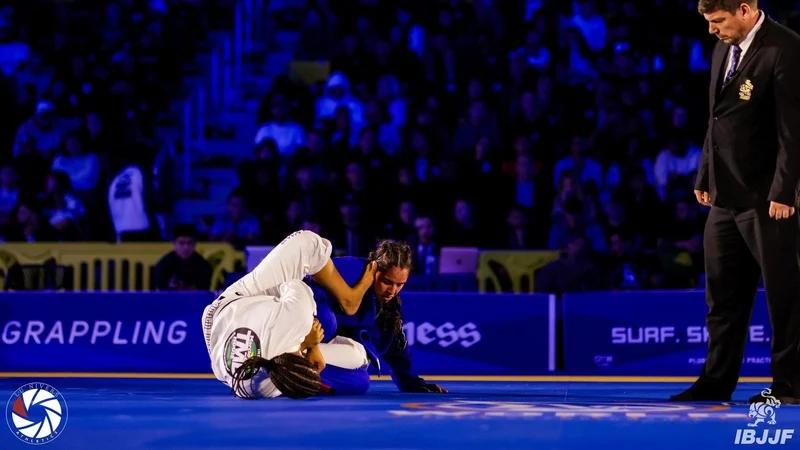
Main photo: ibjjf.com (source publisher; photographer not identified). A referee oversees a gi match in IBJJF’s official 2024 Worlds recap.
The takeaway
Becoming an IBJJF referee is a process to confirm, apply for, and learn through. Start with the current official requirements, ask about the seminar-versus-webinar inconsistency, and distinguish education from an approved event assignment.
Then treat supervised work as learning with consequences. Exact rules, clear communication, and specific feedback matter more than announcing certainty. A responsible first step is a question addressed to the federation before the first course or travel booking becomes a commitment.
Understand the event from the other side
Read the Let’s Roll tournament guide to connect officials’ responsibilities with the competition day athletes experience.
FAQ
Does passing a rules course make me an IBJJF referee? A course is part of a wider process described by the federation. Confirm the current application, training, assessment, and supervised-event requirements directly before describing yourself as approved to officiate.
Can a webinar lead to the referee pathway? The help page contains differing wording between its referee section and course-comparison section. Ask IBJJF which current course route applies to your situation and save the dated answer before enrolling for that purpose.
Is a black-belt rules certificate the same as referee approval? Do not combine those outcomes. Ask which certificate the course provides and what further steps are required for the specific role you want. A similar document name does not make the responsibilities identical.
How should a trainee handle a disputed call? Follow the supervisor’s and organizer’s procedures during the event. Preserve a specific question for approved review, separating what was visible from what needs clarification. A learning discussion does not independently change an official match result.

Kit Langford
Kit Langford covers the louder parts of jiu-jitsu — the marketing claims, the arguments, the gear that promises more than gear can deliver. The jokes are expected to survive a fact-check.
Related Posts

ADCC Trials qualification starts with the right region
ADCC Trials, Opens, and Worlds are different entries. Read regional eligibility and the actual qualifying event before planning a title route.

AGF rules: the bracket and the scoring both need a read
American Grappling Federation uses its own formats and scoring details. Read the regular and Challenger options before bringing an IBJJF game plan.

FUJI BJJ rules: read the event before packing the gi
FUJI BJJ has its own division, weigh-in, and technique rules. Build an entry plan from the actual event rather than another organizer’s checklist.
Comments (0)
Loading comments...