
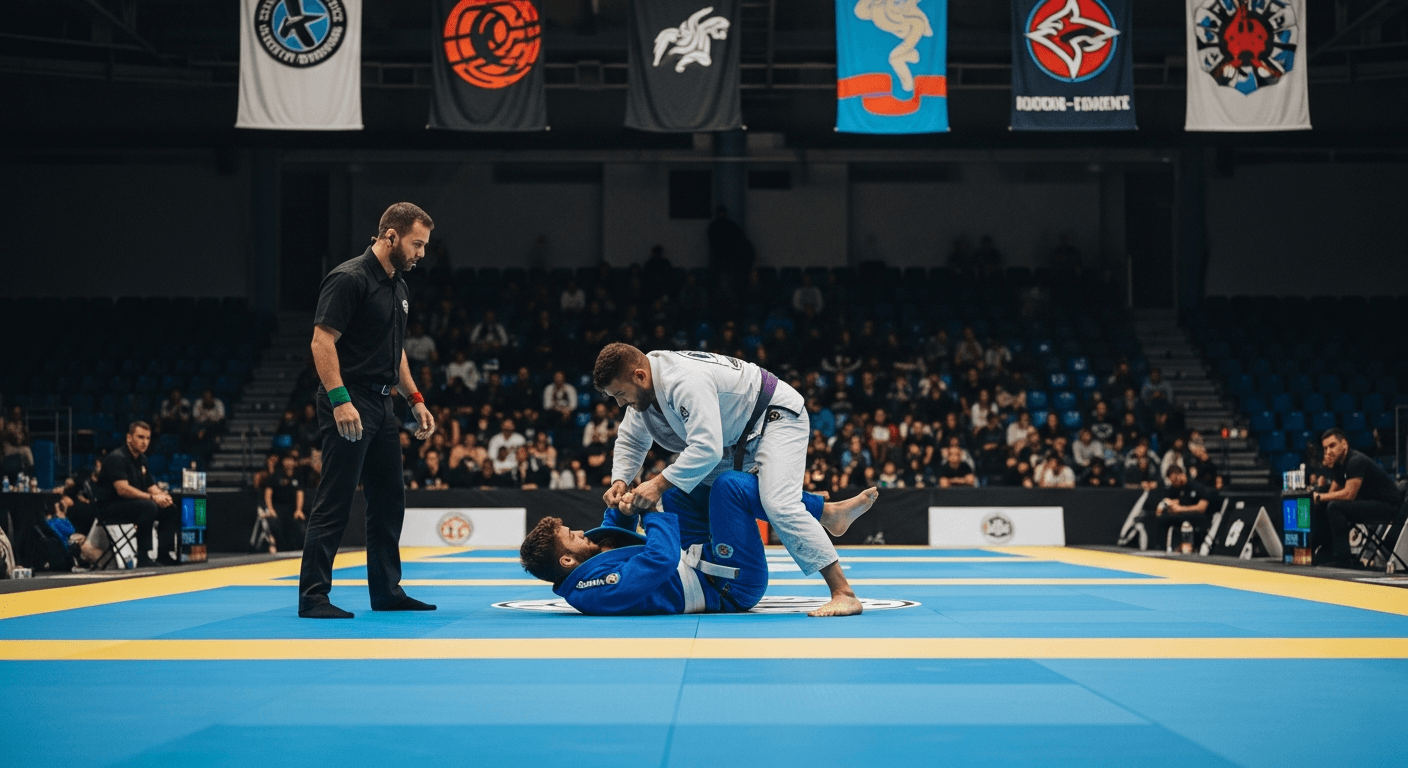
A Complete Guide to BJJ Tournaments and Competitions
Your first tournament will feel nothing like training. The warmup area is loud. Your gi is soaked before your first match. Time moves differently — the five-minute round either stretches into an eternity or collapses into a blur. You'll make mistakes you never make in the gym. You'll freeze at moments when you usually flow.
And none of that matters. Competing strips BJJ down to its rawest form and shows you exactly where your game stands. No friendly restart, no coach pausing the action, no second chance at a scramble. What you know, you know. What you don't becomes immediately obvious.
I've coached competitors at every level from local NAGA events to IBJJF Worlds. Whether you're considering your first tournament or preparing for your tenth, this guide covers what you need to know.
Major Tournament Organizations
IBJJF (International Brazilian Jiu-Jitsu Federation)
The largest and most prestigious BJJ competition organization. IBJJF hosts the World Championships (Mundials), Pan-American Championships, European Open, and numerous regional opens. IBJJF requires annual membership and follows a strict gi and no-gi rule set.
ADCC (Abu Dhabi Combat Club)
The premier no-gi submission grappling event. ADCC's rule set heavily rewards submission attempts and penalizes passivity. The biennial ADCC World Championship is considered the most prestigious no-gi tournament in the world.
NAGA (North American Grappling Association)
The most beginner-friendly major organization. NAGA events are widely available, relatively inexpensive, and offer both gi and no-gi divisions. The experience level divisions make NAGA an excellent first tournament.
Other Organizations
Grappling Industries, Good Fight, AGF (American Grappling Federation), and local state-level organizations all run regular events. Smaller tournaments are often the best starting point — shorter waits, smaller brackets, and a less intense atmosphere.
Understanding Weight Classes and Divisions
Tournaments divide competitors by belt rank, age, and weight. Weight classes vary by organization, but IBJJF's adult male divisions provide a standard reference:
Rooster: up to 127.5 lbs / 57.5 kg
Light Feather: up to 141.5 lbs / 64 kg
Feather: up to 154.5 lbs / 70 kg
Light: up to 167.5 lbs / 76 kg
Middle: up to 181 lbs / 82.3 kg
Medium Heavy: up to 194.5 lbs / 88.3 kg
Heavy: up to 207.5 lbs / 94.3 kg
Super Heavy: up to 221.5 lbs / 100.5 kg
Ultra Heavy: over 221.5 lbs / 100.5 kg
For your first tournament, compete at your natural weight. Don't cut weight. The stress of a first competition is enough without adding dehydration and caloric restriction.
Scoring System
Points in BJJ competition reward positional advancement:
Takedown: 2 points
Sweep: 2 points
Knee on belly: 2 points
Guard pass: 3 points
Mount: 4 points
Back control (with hooks): 4 points
Advantages are awarded for near-successful techniques and are used as tiebreakers. Penalties are given for stalling, illegal techniques, or unsportsmanlike conduct.
Submissions win the match regardless of score. This is the most important rule: if you catch a submission, nothing else matters.
Preparing for Your First Tournament
4–6 Weeks Before
Register early — popular weight classes fill up
Confirm your weight class and start monitoring your weight
Identify two or three high-percentage techniques from each major position
Begin increasing sparring rounds with competition-intensity partners
2–3 Weeks Before
Drill your A-game relentlessly — your takedown-to-pass-to-submission chain
Practice starting from standing (many gym rolls start from knees, but tournaments start standing)
Simulate match conditions: five-minute rounds with a referee scoring mentally
Fine-tune your warm-up routine
Competition Week
Reduce training intensity to avoid injury
Confirm your weight — weigh in on your own scale wearing your gi
Pack your bag: gi, belt, rash guard, shorts, water, snacks, athletic tape, flip-flops
Review the tournament rules one more time
Get sleep. Nothing else you do this week matters more.
Competition Day: What to Expect
Arrive at least 90 minutes before your division starts. Check in, get your bracket information, and find your warm-up area. The venue will be chaotic — multiple mats running simultaneously, crowds, loudspeaker announcements that are barely audible.
Warm up progressively: light movement, drilling your takedown entries, a few positional reps with a training partner if you brought one. Don't exhaust yourself before your first match.
Between matches, stay warm. Walk, stretch lightly, and stay hydrated. Don't eat heavy food. Don't watch YouTube highlights. Stay focused on your gameplan.
Common First-Tournament Mistakes
Over-warming up. You don't need 45 minutes of intense sparring before your first match. A 10-minute progressive warm-up is sufficient.
Abandoning your game plan. Under pressure, people revert to random movements. Stick to the techniques you drilled. Even if they fail, structured failure is better than chaos.
Ignoring takedowns. Many gym practitioners pull guard in competition because they never practice standing. If you can score a takedown, you start the match with a 2-point lead and a psychological advantage.
Not managing the clock. If you're ahead on points with a minute left, play conservative. Protect your lead. If you're behind, escalate your attacks. Clock management is a skill.
Your Corner Team
Having a coach or training partner in your corner makes a significant difference. A good corner person keeps track of the score, manages the clock for you, and provides clear, concise tactical instructions — not a stream of consciousness play-by-play.
Before the tournament, discuss hand signals or key phrases with your corner. Keep it simple: one phrase for "you're ahead, slow down," another for "you need points, attack now," and one for "they're about to pass, hip escape." In the heat of competition, complex instructions are useless. Simple, clear directives save matches.
If you don't have a coach who can corner you, bring a training partner who understands your game. Their primary job is clock management and score awareness — two things that are nearly impossible to track yourself while grappling.
After the Tournament
Win or lose, review your matches. If they were filmed, watch them critically. Where did you feel confident? Where did you freeze? What technique gaps showed up under pressure?
Use this analysis to direct your training for the next several weeks. Competition footage is the most honest assessment of your game you'll ever get.
Talk to your coach about what you observed. They'll see things in the footage that you missed. A good coach can turn a five-minute match review into a six-week training plan that addresses the specific weaknesses the tournament revealed.
Don't rush back into another tournament immediately. Give yourself two to four weeks of focused training on the gaps your competition exposed. Then register for the next one. Consistent tournament participation — two to four per year for most hobbyists — creates a cycle of testing and improvement that dramatically accelerates your development.
Weight Management for Competition
Weight cutting is a reality of BJJ competition that needs honest discussion. Most beginners should compete at their natural weight — cutting weight adds stress to an already stressful experience. As you gain competition experience, you might consider strategic weight management, but it should never involve dangerous dehydration or crash dieting.
The healthiest approach is to compete consistently at a weight class where you can perform at your best without significant cutting. A five-pound water cut the morning of weigh-ins is manageable for most adults. Anything beyond that requires careful planning, ideally supervised by someone with experience. Competing dehydrated or nutritionally depleted defeats the purpose — you'll weigh in lighter but perform worse, which negates any size advantage the weight cut was supposed to provide.
Tournament Day Logistics
The logistics of tournament day catch many first-timers off guard. Weigh-ins may happen the morning of or the day before, depending on the organization. Brackets are often posted last-minute and subject to change. Your division might compete at the scheduled time, or it might be delayed by hours. Bring snacks, water, entertainment, and patience.
Arrive early — at least an hour before your scheduled division. This gives you time to locate your mat, find the warm-up area, use the bathroom, and settle your nerves. Rushing through a crowded venue trying to find your bracket five minutes before your match is the worst possible way to start your competition day.
Bring everything you might need: extra gi, tape, mouthguard, flip-flops for walking between mats, a change of clothes, towel, and more food than you think you'll eat. Tournaments are full-day events, even if your matches take twenty minutes total. Treat it like an expedition, not a quick outing. Some experienced competitors create a tournament bag that stays packed and ready to go — knowing you have everything prepared reduces pre-competition stress and lets you focus on what actually matters: your performance on the mats.
The Emotional Side of Competition
Nobody talks enough about the emotional experience of competing. The adrenaline dump before your first match can make your legs feel like concrete and your brain feel like static. This is normal — even elite competitors experience pre-match anxiety. The difference is that experienced competitors have learned to perform despite it, not without it.
Post-match emotions are equally intense. Winning feels euphoric — you did it, your training worked, the hours on the mat justified themselves. Losing feels devastating, especially when you made a mistake you've drilled against a thousand times. Both emotional states are temporary. What persists is the learning.
If you lose your first tournament, you're in excellent company. Most of the greatest competitors in BJJ history lost their first several tournaments. The difference between practitioners who quit after a loss and those who go on to excel is simply the willingness to sign up again. Competition is a skill that improves with repetition. Your first tournament is a baseline, not a verdict.
Share your competition experience with your gym community — the wins and the losses. Vulnerability about your tournament performance strengthens the bonds within your training group and helps newer students understand that competition anxiety is universal, not a personal weakness.
Find upcoming competitions near you through our gym directory — many listed academies post their tournament schedules. Track your competition experiences alongside your regular training in your BJJ passport, and connect with other competitors by visiting open mat sessions at competition-focused gyms.
Frequently Asked Questions
What belt level should I be before competing?
You can compete as a white belt with as little as three to four months of training. Many organizations have beginner divisions specifically designed for this. Competing early accelerates your learning and removes the mystique of tournament environments.
Should I compete in gi or no-gi first?
Compete in whichever format you train more often. If you're comfortable in both, gi can be more strategic for beginners because the slower pace allows more thinking time. No-gi matches tend to be faster and more scramble-heavy.
How do I deal with pre-competition anxiety?
Anxiety is universal — every competitor experiences it. Structured warm-ups, breathing techniques, and a clear game plan reduce anxiety's impact. With experience, the anxiety doesn't disappear, but you learn to perform through it.

Marcus Delgado
black Belt
Black belt with 18 years on the mats. Head instructor and lifelong student of the gentle art.
Related Posts
Demian Maia made the route to the back worth watching
Demian Maia won ADCC gold and challenged for two UFC titles. Revisit his routes to the back, major submissions, and the fights that tested his grappling.
ADCC 2026 results: the stories that survived the predictions
ADCC 2026 results from Krakow: Jaworski, Maciel, Crevar, Pena, the women's champions, and the superfight outcome, with official podiums and match context.
Xande Ribeiro: from absolute titles to the masters mat
Explore Xande Ribeiro's absolute Worlds victories, two ADCC titles, Six Blades, and the distinction between his 2022 Worlds farewell and later masters gold.
Comments (0)
Loading comments...