
Andre Galvao: six ADCC titles, two very different jobs
Quick answer: Andre Galvao won his six ADCC titles through two different formats: weight-class and absolute gold in 2011, followed by four superfight victories from 2013 to 2019. His career also includes five IBJJF world titles and a long role leading Atos. Read those records separately and a more interesting athlete appears than the title count alone suggests.
In the official results from Nottingham, Andre Galvao's name appears at the top of two tables. One is the under-88-kilogram division. The other is the absolute. Above the name, the page says gold; below it, somebody else has to settle for silver.
That was 2011. Over the next four editions of ADCC, Galvao would keep winning, but his name would occupy a different part of the results sheet. The tournament champion became the man waiting in the main superfight. The six titles fit neatly on a biography. The work behind them does not fit in one category.
Nottingham gives the number its meaning
ADCC's official 2011 results place Galvao first at under 88 kilograms, ahead of Rousimar Palhares, and first in the absolute, ahead of Pablo Popovitch. The event took place at Nottingham's Capital FM Arena. On the same card, Braulio Estima won the main superfight.
Those are three separate entries. Keeping them separate matters. Galvao had won two divisions; he had not won that edition's main superfight. A reader working backward from the familiar six-time-champion description can otherwise flatten different achievements into a single uninterrupted tournament run.
A bracket gives an athlete a sequence of problems. Advance and another opponent remains. Winning once does not finish the assignment. The absolute adds another draw beyond the weight-class contest. That structure is part of what a tournament gold means, even when a short biography leaves only the medal and year.
The results page cannot tell us what Galvao was thinking between matches. It gives us something less dramatic and more dependable: where he finished. Begin there. The achievement is large enough without supplying a locker-room speech nobody recorded.
Four editions on the other side of the draw
ADCC's historical statistics list Galvao as main-superfight winner in 2013, 2015, 2017 and 2019. These are four victories across four editions. They are not four additional weight-class championships.
A tournament asks an athlete to keep advancing. A scheduled superfight concentrates the assignment into one opponent and one match. Calling either format easy would miss the point. They expose a competitor to different demands, and a useful account of a career should say which test was passed.
The opponent list supplies the rest of the scale. ADCC Latin America's Hall of Fame account names Braulio Estima, Roberto Abreu, Claudio Calasans and Felipe Pena as the men Galvao defeated in those four superfights, respectively. The years keep moving; the names change; Galvao remains on the winning side.
For a viewer, that is a better starting point than a greatest-ever argument. Pick one of those matches and watch it as a particular contest. Notice the opponent, the score and the time available. A reputation enters the match with an athlete. It does not tell you why a particular exchange succeeded.
Before the champion, there were teachers
Galvao's development did not begin with an academy bearing the authority of his own name. BJJ Heroes' biography identifies Luis Dagmar as his black-belt instructor and Fernando Terere as another major teacher. It describes Dagmar encouraging him to seek a stronger competitive environment. Galvao received his black belt in 2005.
That detail about leaving for harder training deserves space. An ambitious student needs instruction, but also people who can expose the limits of what he already does well. In this account, the original teacher helped make that move possible. The later champion's progress involved somebody recognizing that the next useful room might be somewhere else.
It also complicates the solitary-athlete version of sporting history. A match has one winner. A development story can have several teachers, partners and institutions without taking anything away from that winner. Naming them is a matter of getting the history right.
Lineage is useful here as a map of relationships. It becomes less useful when it is treated as a complete explanation of a person's game. Learning from a great competitor does not make a student a copy. To understand Galvao's own decisions, return to his matches rather than asking the family tree to perform the analysis.
The gi belongs in the picture
In its May 2023 introduction to a Galvao podcast episode, the IBJJF identifies him as a five-time world champion and a member of its Hall of Fame. That record belongs alongside the ADCC results, with its own label.
It is easy to let the most familiar rivalry determine which part of an athlete survives in conversation. Start with an ADCC superfight and the gi can become a brief credential near the bottom of the page. Start with the federation's introduction and the balance changes. There is an entire competition career outside the no-gi headline.
The distinction matters when watching old footage, too. Cloth grips alter what is available to both athletes. A sequence built around a sleeve cannot simply be copied into a match where there is no sleeve. Our guide to gi and no-gi BJJ explains that practical difference without turning the two formats into rival belief systems.
For a useful viewing exercise, choose one gi match and one no-gi match. Write down what the athletes can hold, where the position changes and how the next attack becomes possible. Compare the tasks in front of them. Medal totals establish achievement; footage gives you something you can actually examine.
Atos made the story bigger than one competitor
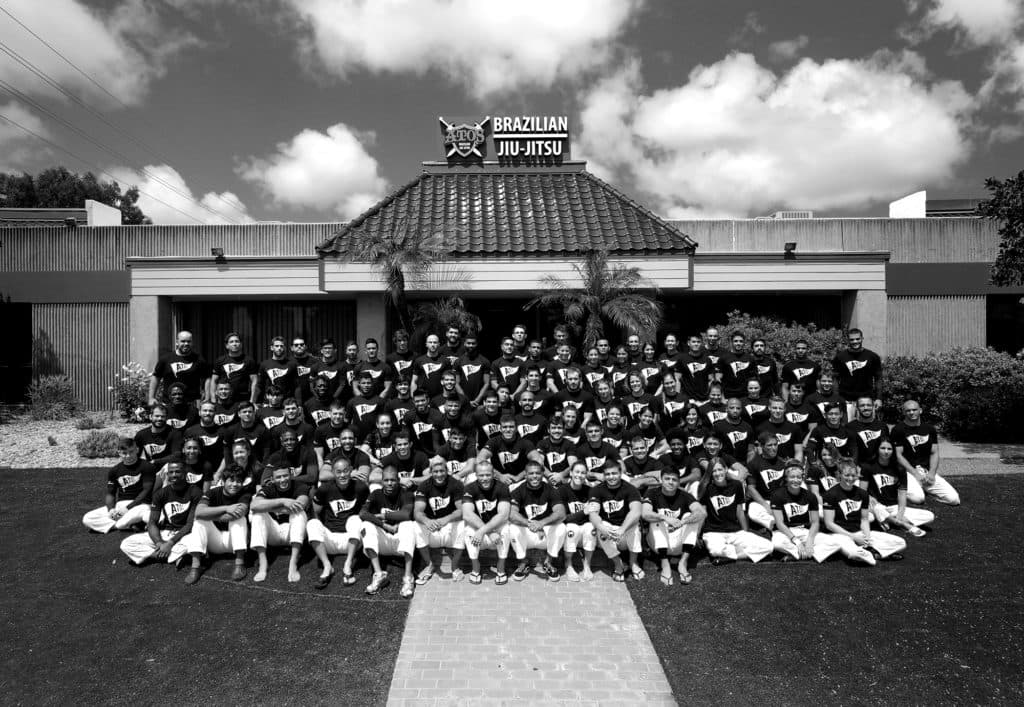
Atos's own history dates the team's founding to 2008 and names an early group including Rafael and Guilherme Mendes, Claudio Calasans and Gilbert Burns. It identifies Galvao as the team's leader. This is the academy's account of itself, so its claims of superiority deserve the same scrutiny as anybody else's promotional language.
The names alone make one point clear: Atos's history contains multiple athletes. Reducing that history to a single champion would make everybody else an accessory. Reducing Galvao to his own medals would leave out the institution with which his name became associated.
A team result and an individual result answer different questions. The first asks what a group produced under a shared name. The second tells you what happened when one athlete competed. Both can matter, but crediting every teammate's achievement to a famous coach makes the account less accurate, not more admiring.
For readers choosing a place to train, the distinction has a practical consequence. A champion's name may bring an academy to your attention. Your class still has a particular instructor, schedule and group of partners. Check those details. A competition biography is a good reason to be interested; it cannot answer every question about an ordinary Tuesday evening.
Coaching was already part of the competition years
A small item on the academy's website gives the chronology some texture. In a March 2017 Atos post, a photograph is captioned as Galvao helping students during a class at the San Diego headquarters. The date places the teaching account within his run of ADCC superfight victories.
That is more useful than a tidy career outline in which the athlete competes, finishes competing and only then becomes a coach. The public record shows overlap. The classroom work was already there while the competition record was still accumulating.
The photograph does not reveal the lesson plan or tell us how every student experienced the class. Nor does a promotional academy post establish that a champion must be an exceptional teacher. It documents the narrower point: at this stage of his career, Galvao was being presented in both roles.
Keeping that overlap in view changes the profile. The athlete preparing to solve his own competitive problem was also associated with helping other people solve theirs. Those responsibilities can coexist for years. A story organized only around medals will keep missing one of them.
A loss belongs in the same record
Galvao lost the 2022 ADCC superfight to Gordon Ryan. BJJ Heroes' report from that event records Ryan winning both his weight division and the superfight. For the other side of that career story, see our Gordon Ryan profile.
The result should appear plainly. Writing around it would turn a profile into an endorsement. Asking it to invalidate every earlier result would be equally careless. A loss changes the record by adding a loss. It does not change who won in another year.
When returning to Galvao's career, keep three viewing questions nearby:
Which event and format produced the result being discussed?
What does the available footage show, rather than what does a reputation suggest?
Is the claim about Galvao's performance, his teaching or the achievements of an entire team?
Those questions make room for admiration without demanding that the reader surrender judgment. They also leave room for the opponent. A meaningful account of a champion has to explain who could challenge him, and acknowledge the person who eventually won.
The takeaway
Galvao's career becomes more substantial when its parts stay visible: tournament competition, the long superfight run, gi titles and teaching that overlapped with his own competitive years. None needs to borrow the achievement of another to count.
Return to the results sheet from Nottingham. His name is at the top of two tables. Years later it will appear elsewhere on the page, carrying a different assignment. Following that change tells us more than repeating the number six.
Main photo: Andre Galvao official website; archive photograph.
Find your next training room
A famous competition team can start your search. Use Let's Roll's gym directory to find options, then confirm the class, instructor and visitor arrangements with the academy before going.
FAQ
How many ADCC titles did Andre Galvao win? Six: the under-88-kilogram and absolute divisions in 2011, plus main-superfight wins in 2013, 2015, 2017 and 2019. The format distinction explains the total.
Who gave Andre Galvao his black belt? BJJ Heroes identifies Luis Dagmar as his black-belt instructor. Fernando Terere was also a significant teacher in his development; those relationships should not be collapsed into one name.
Was Galvao also successful in the gi? Yes. The IBJJF described him as a five-time world champion and Hall of Fame member in its May 2023 podcast introduction. That is a separate record from his ADCC titles.
Did Galvao beat Gordon Ryan at ADCC 2022? No. Ryan won that superfight. The result belongs in Galvao's career account alongside the earlier victories, without pretending one match can stand in for all the others.

Miles Serrano
Miles Serrano writes about competitors and the decisions that shaped their careers. He is more interested in the adjustment someone made in the third minute than in the medal count afterward.
Related Posts

Training with women in BJJ: listen before you roll
Be a better BJJ training partner with women: agree on intensity, provide honest resistance, ask before coaching or filming, and respect a declined round.
Bia Mesquita: the grappling record behind the MMA newcomer
Follow Bia Mesquita's path from 2014 Worlds double gold and a 2017 ADCC title to her 2025–2026 UFC results, with dated sources and match context.
Ffion Davies: winning across gi and no-gi
Explore Ffion Davies's 2022–2023 championship results, from gi Worlds and ADCC gold to a World No-Gi double, with context for the matches behind the medals.
Comments (0)
Loading comments...