
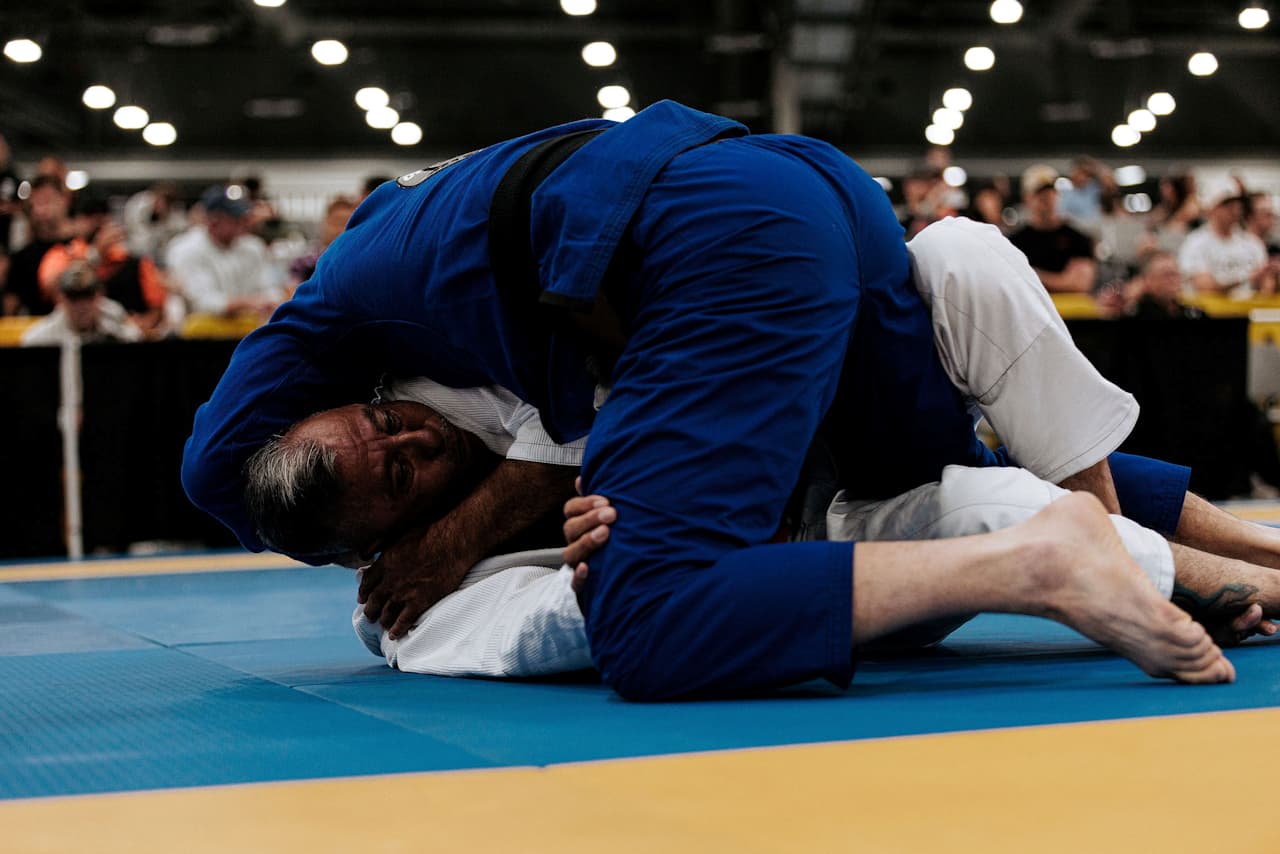
World Master 2026: the people around the podium
Quick answer: World Master 2026 is worth reading through the accounts of the competitors and academies who went, as well as the championship results. Scott Roffers' match report and EDJ's team recap describe different pieces of the same weekend. Together, they offer a useful picture of competition as something a whole training room helps make possible.
Scott Roffers came back from Las Vegas with silver and bronze. In his account of the tournament, the medals share space with a late passing attempt, the details of his matches, and thanks to the people who helped him get there.
That is a good place to begin a World Master story. The official results establish who placed. The reports written afterward can explain which parts of the weekend stayed with people. Neither needs to replace the other, and neither requires every athlete to have arrived with a famous name.
A competitor's account leaves the unfinished work visible
In his 2026 World Master report, Roffers describes taking silver at black belt Master 7 heavyweight and bronze in the open class. He writes about submission wins, a close final, and an open-class semifinal in which a late passing sequence came too late to earn the score he needed.
The official result can hold all of that in two lines. His account does something else: it leaves the unresolved moments in view. He remembers the work involved in trying to pass, not merely the placing that followed it. He also thanks his partner, Jodi Mallas, for her time at tournaments supporting his competing and coaching.
There is no need to improve that account with invented backstage dialogue or a claim about how he felt while waiting to compete. The detail he chose to publish already makes the result more specific. A reader can appreciate the medals and still understand why a particular exchange remained worth describing afterward.
That is one reason to read competitors' own reports. The writer of a results roundup has to decide what fits. The person who competed may choose an entirely different center for the story.
The official table still matters
The IBJJF's final standings confirm Roffers' heavyweight silver for Brasa CTA. They also put Alliance first in both the master male and master female academy categories, with Gracie Barra second in each.
Those team results deserve to be recorded accurately. They are the accumulated outcome of many divisions, not an invitation to turn an entire weekend into a contest between gym reputations. The same results page contains a much wider range of academies than the top few rows.
Try reading a division where you do not recognize anyone. Keep the age group, belt, and weight category attached to each placing. The names become easier to follow once they have that context, and the event becomes less dependent on your existing knowledge of professional competitors.
There is also a useful limit to the table. It cannot tell you how someone arranged time away, who gave them rounds in preparation, or whether this was the event they had been considering for years. Unless a participant has shared those details, they remain unknown. Respecting that gap makes the stories that are documented more valuable.
EDJ's recap includes the people who did not enter
EDJ School of Jiu-Jitsu's September 14 team report lists double bronze for Kimberly Bowser, bronze for Larry Casias, and bronze for Jorge Arispe at World Master. It separately records Aaliyah Caceres' silver at Jiu-Jitsu Con. Keeping those event labels distinct avoids giving someone a result in the wrong tournament.
The academy's account also describes traveling, watching, and spending time together. Some people competed; others came to support. It credits people who helped with warmups, recorded matches, and contributed training rounds before the trip.
That is a team report with room for more than the team sheet. It recognizes specific kinds of participation without pretending that carrying a camera and entering a bracket are identical experiences.
For another academy planning a trip, that distinction is useful. Ask who wants to compete and who would enjoy coming along. Give supporters a clear invitation instead of assuming everyone understands that they are welcome. A person may be interested in the atmosphere and still have no wish to be weighed, called, or coached into a match of their own.
Master is a category, not a personality
The word master does not tell you whether a competitor is a longtime black belt, a newer student, a full-time instructor, or someone fitting classes around another occupation. Those details belong to individuals. An age category does not supply them automatically.
The IBJJF's registration guidance defines age divisions by birth year rather than the exact birthday. Competitors need to consult the event's belt-and-age table and their actual eligibility. That administrative definition is more useful than a loose assumption that everyone in master competition occupies the same stage of training.
Coverage can be generous without becoming patronizing. A difficult match deserves attention for the decisions inside it. A medal does not need to be described as surprising merely because its owner competed in a higher age group.
The same applies back at the academy. Ask someone about their match before deciding what their story represents. They may want to talk about the opponent's guard, a grip they could not establish, or the problem they intend to work on next week. Let that answer shape the conversation instead of delivering a speech about what their age means to you.
Support works better when the job is clear
For a future team trip, support can be organized in small, practical ways. None requires a person to become an unpaid event manager for everyone else.
A useful starting conversation covers a few jobs:
Ask which athlete wants their matches recorded and where the files should go.
Decide who is available to help with warmups, subject to venue access rules.
Choose a meeting point that does not depend on finding a face in a crowded hall.
Agree who will check the organizer's current schedule and pass on changes.
Then leave room for people to say no. Someone who traveled to watch may want to spend an hour following another division. A teammate who just competed may need some time before taking on a task. Clear expectations make it easier to offer help without turning a friendly trip into an obligation nobody remembers accepting.
The most useful question is often very ordinary: what do you need before your next match? It gives the athlete a chance to ask for something concrete. It also saves a supporter from guessing that encouragement must always be loud, public, or delivered at length.
The first conversation back should not be an interrogation
A returning competitor does not owe the changing room an immediate technical debrief. Give them an opening and let them choose how much of the trip they want to revisit.
Some may have a video ready. Others may be more interested in a person they met or a match they watched. Someone who lost early may already know exactly which mistake you are about to identify. Asking whether they want to review the footage is a better start than pressing play and explaining the result to them.
For coaches, a short scheduled review can keep the useful material from being buried beneath a crowded evening class. Pick one sequence to examine, agree on a practice task, and return to it later. That is a proposed way to use a competition, not a claim that every academy needs the same review process.
For teammates, there is value in offering the next round. A competitor returns to the room where the ordinary work happens. A thoughtful training partner can help make that return easy without requiring a medal, a dramatic lesson, or a declaration about entering again.
A large event can lead to a smaller next step
Watching World Master does not create a requirement to book Las Vegas. Someone curious about competing may prefer a local event first. Someone interested in the community may simply want to attend a tournament with their gym and watch.
The tournament directory can help locate options, but the organizer's own page should settle eligibility, dates, and entry requirements. Talk with your instructor about which event fits your experience and preparation. A familiar venue or a shorter trip may be a more useful first experiment than the largest possible stage.
It is also reasonable to come away interested in training more consistently without entering anything. The stories around a championship can make a regular class look different: the partner across from you may be preparing for something you have not heard about yet.
Ask about it when there is room for a conversation. Then take their answer seriously. A modest local goal is allowed to matter just as much to the person pursuing it as a major championship matters to someone else. There is no requirement to enlarge the ambition before offering a good round.
Main photo: Katy Petty Photography, via Scott Roffers; World Master 2026.
The takeaway
World Master 2026 produced champions and team titles. It also produced accounts like Roffers' detailed match report and EDJ's record of a shared trip. Those pieces do different work: one stays close to a competitor's exchanges, while the other widens the frame to the people around the team.
Read both alongside the results. There is enough documented material to appreciate the event without inventing a life story for every name or turning every medal into the same lesson.
Find a room to train in
Explore jiu-jitsu gyms near you and ask about their classes, training community, and competition options.
FAQ
Is this a complete World Master 2026 results report? No. This is a community-focused article built around published competitor and academy accounts. The official IBJJF results page supplies the full division and academy standings.
Who won the master academy categories? Alliance finished first in both master male and master female. Gracie Barra finished second in both categories, according to the final standings.
Do master age categories use your exact birthday? IBJJF guidance uses birth year. Consult the specific event's belt-and-age table rather than calculating eligibility from your birthday alone.
Can someone support a competition team without entering? Yes, if the gym and event arrangements allow it. Ask the team what help would be useful and check the organizer's spectator and access rules before traveling.

Rafael Moura
Rafael Moura profiles competitors as people with lives outside the bracket. Some of those stories are comebacks. Most are not, and he does not force them.
Related Posts
Mikey Musumeci gives up the belt to make room for MMA
Musumeci is vacating his UFC BJJ title to focus on MMA training. What he is leaving, what continues, and why the transition matters.
IBJJF membership: finish the paperwork before the deadline
IBJJF membership and tournament entry are separate steps. Plan documents, professor approval, renewals, and junior accounts before registration closes.
Choosing a BJJ seminar worth your time and travel
Choose a BJJ seminar by the subject, teaching format, access, and total cost. Know what to ask the host before buying a ticket.
Comments (0)
Loading comments...