
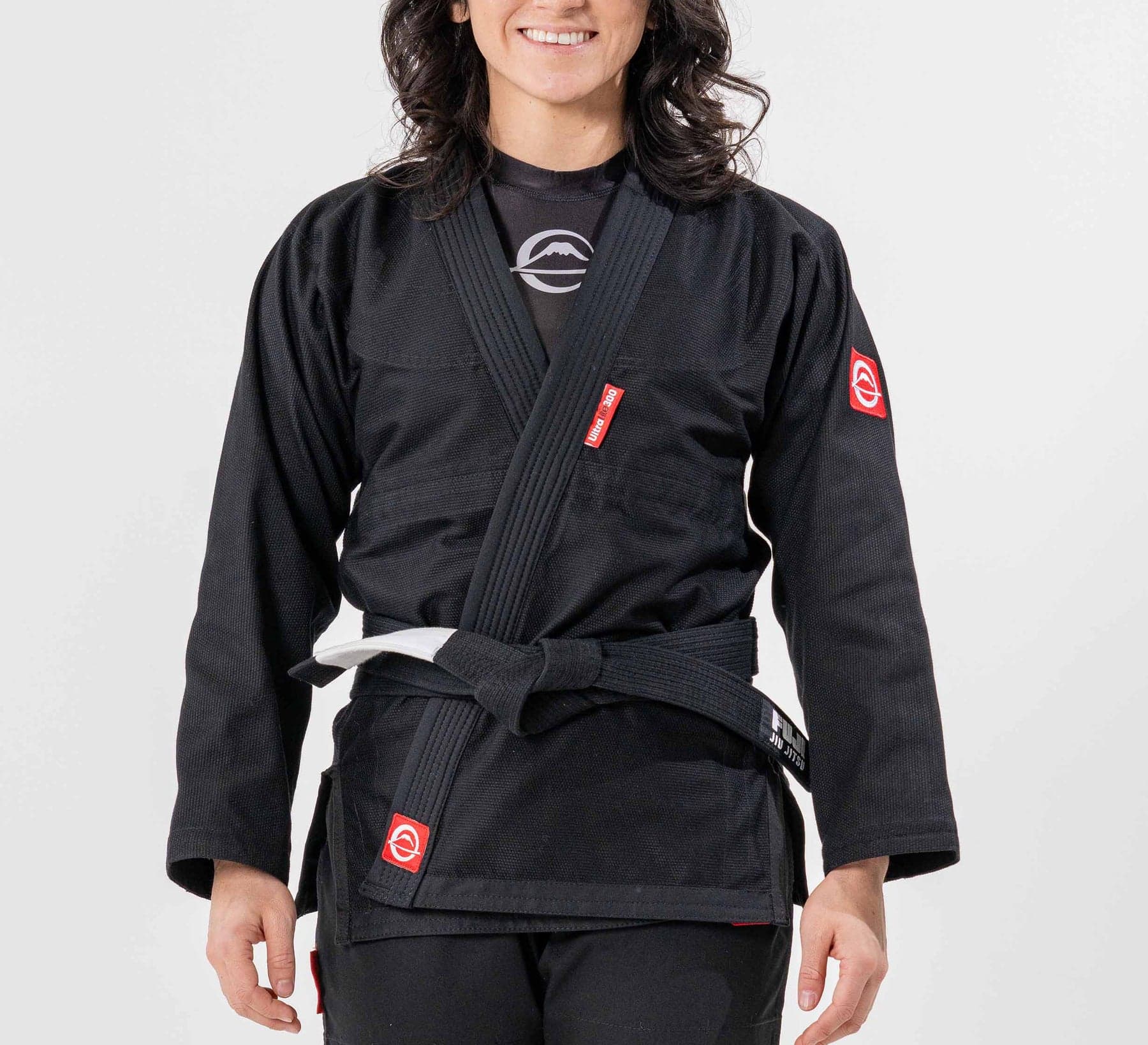
Women’s BJJ gis: finding the fit beyond the size label
Quick answer: A women’s BJJ gi should give you usable room through the shoulders, seat, and thighs without leaving the sleeves or trousers excessively long. Start with the exact model’s chart, then check jacket and trousers separately. Keep the first fitting clean and unwashed until you know whether you need an exchange.
A gi can fit your height and still argue with every other part of you. The trousers pull when you sit. The jacket closes only if you stand perfectly still. Somehow, despite both problems, the cuffs are on the floor.
That is a clothing problem. You do not need to change your body to make a manufacturer’s rectangle more convincing. Shopping gets easier once you stop treating the number on the label as the answer and start treating it as the first question.
The women’s label narrows the search, not the possibilities
A women’s cut gives you another set of proportions to try. It does not establish one correct shape for all women, and an adult or unisex model may suit you better. What matters is the relationship between the jacket, the trousers, and your body during training.
Compare products without assuming that identical letters mean identical dimensions. FUJI’s women’s chart uses W sizes and includes height and weight ranges. Its W1, for example, lists 5 feet 2 inches to 5 feet 5 inches and 120–140 pounds. That is a manufacturer’s starting range, not a promise about every person inside it.
You might fall inside that range and still need a different cut because of your shoulders or leg length. Equally, a model outside the women’s section might solve the problem neatly. There is no prize for finding your size in the approved aisle. Buy the garment that lets you train.
Separate the jacket problem from the trouser problem
Try the two pieces independently before judging the set. A jacket that fits well cannot compensate for trousers that restrict a squat. Trousers that stay put cannot rescue sleeves that disappear up your forearms when you reach.
For the jacket, pay attention to shoulder movement, room across the upper back, and whether the front closes comfortably over your usual training layer. Tie the belt as you would in class. A jacket held closed with your hands can conceal a problem that becomes obvious once those hands have another job.
For the trousers, check the rise and room through the seat and thighs as well as length. Tightening a drawstring fixes some waistband looseness; it does not add fabric somewhere else. If the waist needs extreme gathering to keep the trousers up, consider whether a different cut would be less distracting.
Ask the seller whether separate sizes or replacement trousers are available. Do not assume a whole new set is the only option, but do not assume a brand offers split sizing either. A brief answer before purchase can save a lengthy exchange afterward.
Give the fitting a small job to do
Standing in front of a mirror tells you what the gi looks like while you stand in front of a mirror. Training asks rather more. Within the seller’s try-on conditions, use a clean, dry space to check a few ordinary movements without turning the fitting into practice.
Reach both arms forward and notice whether the shoulders pull sharply.
Sit and bend your knees, checking the seat and front of the trousers.
Raise one knee slowly and notice any restriction through the thigh.
Tie and retie the trousers using the actual drawstring, not a temporary knot.
These checks are practical shopping suggestions, not a competition inspection. You are looking for obvious conflicts before committing to the garment. If a movement feels restricted, stop and identify where the fabric is pulling rather than forcing your way through it.
Wear the underlayer you expect to use in class, provided it is clean and compatible with the return conditions. Trying on a jacket over a thick sweatshirt tells you surprisingly little about how it will feel over a rash guard.
Measure something you already trust
A borrowed or older gi that fits reasonably well is a useful reference. Ask permission before measuring someone else’s, and write down the brand, model, and whether it has been washed. An unknown gi with an unreadable label is less useful than it first appears.
Lay the garment flat without stretching it. Record the dimensions the seller actually requests, using its diagram rather than inventing your own measurement points. Across the shoulders, sleeve tip to sleeve tip, and shoulder seam to cuff are different measurements. Sending one when the retailer expects another can produce a very confident wrong answer.
Then describe the fit you want to change. “These trousers fit through the hips but are too long” is more useful than “What size am I?” It gives customer service a comparison and a specific problem.
Tatami’s size guide explicitly describes its charts as approximate and directs unanswered sizing questions to its support team. That is a sensible cue to ask about the exact product. A chart should shorten the conversation, not prevent it.
Do not ask the dryer to become a tailor
Buying too large because you plan to shrink one troublesome area is a gamble. You want shorter trousers; the jacket may also change. You want less room at the waist; length may be the part you notice first. A laundry machine does not receive a sketch of your preferred alterations.
Follow the care instructions attached to the specific gi. FUJI’s linked women’s chart recommends cold washing and hanging to dry, and warns that preshrunk does not mean shrink-proof. It also says returns require items to remain unwashed and unworn for practice. Check the current seller’s terms before treating any first wash as an experiment.
If you are between sizes, send the seller your measurements and ask how that particular model behaves under its recommended care. Keep the response with your order information. Advice for a different weave or an older version may not answer your question.
Once you keep the gi, note your normal wash routine. A future replacement is easier to choose if you know what the current garment became after ordinary care, rather than remembering only how it looked on delivery day.
Training fit and competition fit are separate checks
A comfortable class gi still needs to meet the rules of an event you enter. Before buying a competition uniform, open that organizer’s current requirements and check the exact model, color, measurements, and permitted alterations. A teammate’s successful inspection last season is useful context, but it is not your inspection.
Ask your coach to look at the garment after you have washed it according to its instructions. Bring up any planned patch placement or tailoring before paying for it. The cheap adjustment becomes less cheap if it makes the uniform unsuitable for its intended use.
For everyday classes, ask the academy about its uniform policy as well. You can use the gym directory to identify the school, then confirm the details directly. This is particularly useful before buying your first gi or visiting a new academy.
Avoid letting competition requirements turn a simple shopping trip into an attempt to predict every event you might enter. Start with the classes you actually attend and the competition you have actually chosen. Broader plans can wait until you have a garment that fits.
Spend on the problem you have
A premium price does not answer a fit question. Neither does a color you really like, although it is perfectly reasonable to enjoy the color. Decide which practical failure you are trying to avoid before comparing the extras.
If your current trousers pull through the thighs, prioritize a cut and measurements that address that. If the gi never dries before your next class, consider whether a second suitable set would help more than one expensive replacement. Think through your washing arrangements rather than making a blanket assumption about fabric weight.
Check the total cost of an exchange, including shipping, before ordering several speculative sizes. Local stock or an academy sample can be useful when the online chart leaves you between options. Ask whether the sample is the same model and generation as the one being sold.
After a few classes, keep a short note on anything you constantly adjust. A waistband you forget about is doing its job. A jacket you pull into place between every drill deserves attention when it is time to buy again. That small record is more reliable than trying to remember six months later why you disliked the blue one.
Main photo: FUJI Sports.
The takeaway
The best women’s gi for you is the one that works through ordinary training movements, survives its intended care routine, and meets the requirements of your academy or event. Its label can guide the search without settling it.
Check the jacket and trousers separately, use consistent measurements, and keep your exchange options open until the fitting is resolved. A few specific questions before checkout are preferable to spending every warm-up negotiating with your waistband.
Put the fit to work
Find a suitable session through Let’s Roll open mats, and confirm the host’s uniform and visitor requirements before attending.
FAQ
Do women have to wear a women’s BJJ gi? The label alone does not determine fit. Compare women’s, adult, or unisex cuts as needed, while following your academy’s and competition organizer’s uniform requirements.
Should I size up if my height and weight point to different sizes? Ask the manufacturer about the exact model and explain which measurements fall between sizes. A generic answer cannot account for different jacket and trouser proportions.
Can I shrink an oversized gi into the right fit? Do not rely on washing to correct a specific fit problem. Follow the care label, ask about expected changes, and resolve obvious sizing issues while an exchange is still possible.
What if the jacket fits but the trousers do not? Ask whether the seller offers separate pieces or mixed sizes. If it does not, compare another cut rather than accepting restricted movement simply because half the set fits well.

Owen Bellamy
Owen Bellamy writes for the person training twice a week around a job. Nothing he suggests requires quitting the job.
Related Posts

Mikey Musumeci gives up the belt to make room for MMA
Musumeci is vacating his UFC BJJ title to focus on MMA training. What he is leaving, what continues, and why the transition matters.
IBJJF membership: finish the paperwork before the deadline
IBJJF membership and tournament entry are separate steps. Plan documents, professor approval, renewals, and junior accounts before registration closes.
Choosing a BJJ seminar worth your time and travel
Choose a BJJ seminar by the subject, teaching format, access, and total cost. Know what to ask the host before buying a ticket.
Comments (0)
Loading comments...