
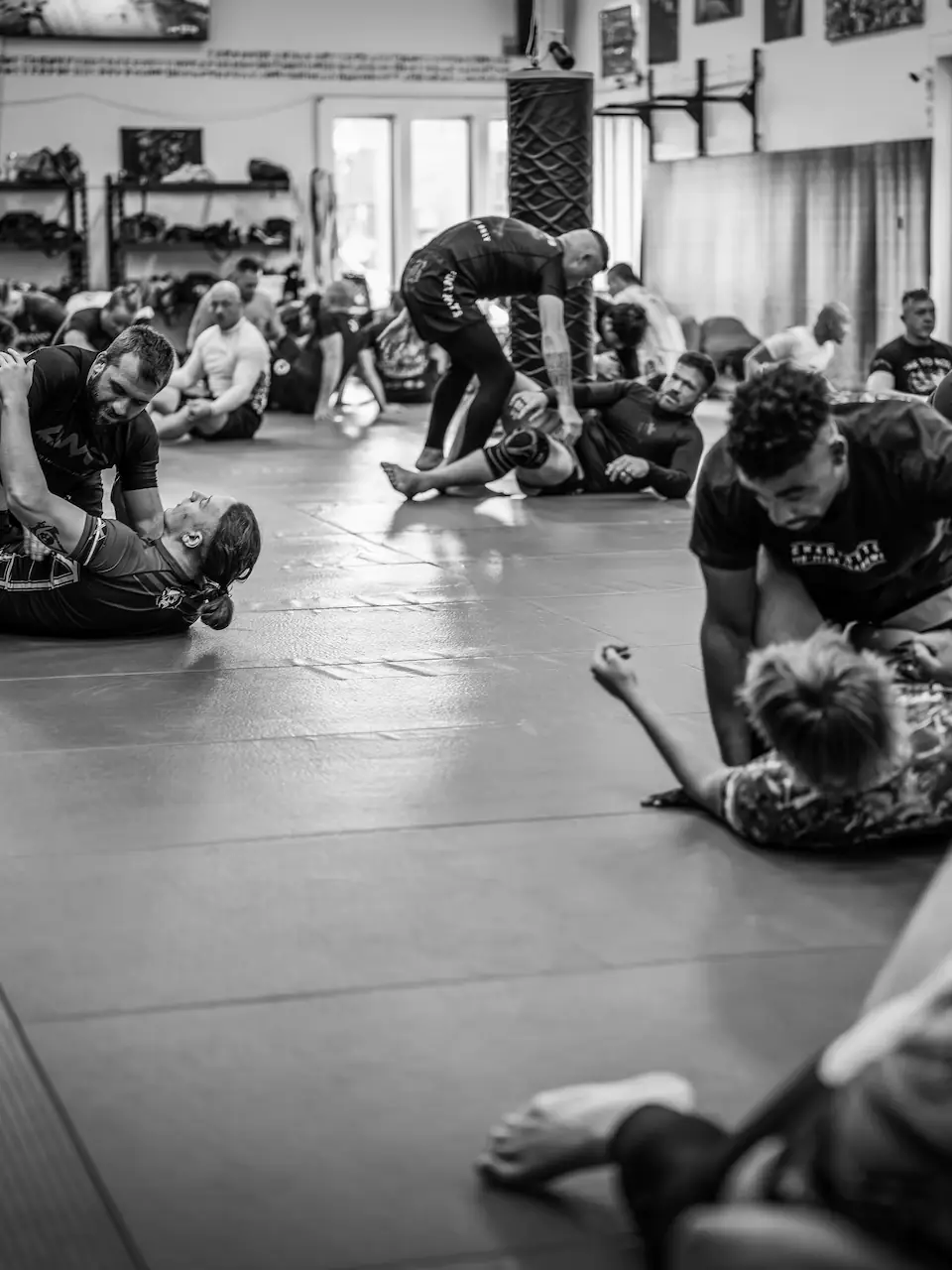
What Is 'Rolling' in BJJ? A Beginner's Guide to Sparring
Quick answer: "Rolling" is the BJJ term for live sparring — practicing techniques against a fully resisting partner. You start from kneeling or standing, try to control, sweep, and submit each other, and tap to concede when caught. Rolling is where BJJ becomes real, and beginners should focus on staying calm, breathing, and surviving rather than winning.
Walk into any BJJ gym and you'll hear people talk about "rolling." It's one of the first bits of jargon every beginner encounters, and it's the heart of what makes jiu-jitsu work. Here's exactly what it means and how to do it without panicking.
Rolling = live sparring
In BJJ, rolling is free sparring: two people grappling at real, resisting intensity, trying to control and submit each other. Unlike drilling — where a cooperative partner lets you practice a move — rolling is alive and unscripted. Your partner is actually trying to stop you and beat you, within the safety rules of the sport.
This is the secret sauce of BJJ. Because you pressure-test everything against full resistance, thousands of times, you quickly learn what actually works versus what only looks good on a compliant partner.
How a roll works
A typical roll runs a set time — often 5 or 6 minutes. You usually start from the knees (or standing at more advanced gyms), then:
Fight for grips and position.
Try to pass guard, sweep, take a dominant position, or set up a submission.
Tap when caught in a submission you can't escape — a clear double-tap on your partner or the mat, or saying "tap."
Reset and continue, or start a new round with a new partner when the timer sounds.
The tap is the safety system that lets rolling be intense but safe. Tapping isn't losing — it's how you train hard for years without injury.
How hard should you go?
This is the most important etiquette in rolling: match your partner and communicate. Before a roll, it's normal to ask "flow or hard?" Flow rolling is light and movement-focused; hard rolling is competitive. As a beginner you should mostly roll at a controlled, moderate pace — going 100% as a spazzy white belt is how people get hurt and how you gas out in 90 seconds. For more on surviving early rolls, see our white belt survival guide.
Rolling etiquette
A few unwritten rules keep rolling safe and fun:
Slap and bump (or fist bump) before you start — it's the sport's handshake.
Tap early and respect the tap. Release a submission the instant your partner taps; never crank.
Control your intensity with smaller, newer, or older partners.
Communicate injuries — tell partners about a bad shoulder or knee so they roll accordingly.
No ego. Getting tapped is information, not humiliation. Everyone taps.
Surviving your first rolls
Your first rolls will feel chaotic and exhausting — that's universal. The goal isn't to win; it's to:
Breathe and stay calm. Panic burns energy fast.
Survive and defend rather than chase submissions.
Protect your neck and limbs, and tap without hesitation.
Have fun and learn. You're not supposed to be good yet.
Many gyms let true beginners watch or sit out rolling for their first session or two — that's completely fine.
The takeaway
Rolling is live, resisting sparring — the part of BJJ where technique becomes real skill. Start moderate, breathe, focus on survival over winning, tap early, and treat every roll as practice rather than a fight to win. Get comfortable rolling and you've unlocked the most addictive part of jiu-jitsu.
Flow rolling vs hard rolling
Not every roll should be a war. "Flow rolling" is light, continuous movement where both partners let things happen to explore positions and transitions — it builds smoothness and is gentle on the body. "Hard rolling" is competitive, full-resistance sparring closer to a match. Beginners benefit enormously from flow rolling, because it lets you practice technique without the panic and gas-out of going 100%. A healthy training week mixes both: mostly controlled, technical rolls, with the occasional hard round to test yourself. Knowing the difference — and choosing on purpose — is a mark of a smart grappler.
Find a gym and start rolling
Find a BJJ gym near you on Let's Roll → — look for one with a beginner-friendly culture and controlled rolling.
FAQ
What does "rolling" mean in BJJ? Rolling is live sparring — grappling against a fully resisting partner to control, sweep, and submit each other, with tapping as the safety mechanism.
How hard should beginners roll? At a controlled, moderate pace. Ask "flow or hard?" first, and avoid going 100%, which leads to injuries and exhaustion. Survival and calm matter more than winning.
Do you have to roll your first class? Not necessarily — many gyms let beginners watch or sit out live rolling for the first session or two, then ease in.
Is getting tapped a lot normal for beginners? Completely normal. Everyone, including future black belts, got tapped constantly at first. Tapping is how you learn safely.
Related Posts

Mikey Musumeci gives up the belt to make room for MMA
Musumeci is vacating his UFC BJJ title to focus on MMA training. What he is leaving, what continues, and why the transition matters.
IBJJF membership: finish the paperwork before the deadline
IBJJF membership and tournament entry are separate steps. Plan documents, professor approval, renewals, and junior accounts before registration closes.
Choosing a BJJ seminar worth your time and travel
Choose a BJJ seminar by the subject, teaching format, access, and total cost. Know what to ask the host before buying a ticket.
Comments (0)
Loading comments...