
The Arena San Diego: training BJJ inside a real fight gym
Quick answer: The Arena is a 27,000-square-foot combat sports gym at 3350 Sports Arena Blvd in San Diego's Midway District, at the base of the Point Loma peninsula. It traces directly back to a judo school opened in 1949 by Marine Corps veteran Al Holtmann and calls itself the oldest continuously operating martial arts school in North America. It runs boxing, Muay Thai, kickboxing, wrestling, judo, MMA, Filipino martial arts and jiu-jitsu under one membership, with over 30 weekly adult BJJ classes as a Six Blades affiliate under Xande Ribeiro.
Most jiu-jitsu academies start with a black belt and a lease. The Arena started with a Marine sergeant major who learned jujutsu in Hawaii before Pearl Harbor.
That's not a marketing line. Aloysius C. Holtmann enlisted in the USMC in 1937, trained in Hawaii between 1938 and 1940 under Seishiro "Henry" Okazaki, the founder of Danzan-Ryu Jujutsu, and received his black belt and teaching certificate in May 1940. He then fought through Guam and Okinawa, retired in 1946, finished a degree at San Diego State, and in 1949 opened the Southern California School of Judo and Ju Jitsu on 30th Street.
The gym has been open ever since. Different name, different address, same continuous line.
Seventy-seven years without closing
Holtmann taught for seven decades and by the gym's own count put more than 100,000 students through his classes. He appeared in the first issue of Black Belt Magazine in 1961 and in its pages repeatedly over the following thirty years. He died in December 2001 at 85, and the Kodokan in Tokyo posthumously awarded him a sixth-degree black belt the following year.
Sensei Gene Mauro, a retired Air Force veteran, San Diego police officer and former national heavyweight judo champion, ran the school until his own death in August 2005.
In 2006, after 57 years on 30th Street, the school moved into a much larger facility on Sports Arena Boulevard and changed its name to The Arena, adding boxing, kickboxing, Muay Thai, MMA, wrestling and Filipino martial arts to the judo and jiu-jitsu that were already there. That's the year the modern gym begins.
The judo program still runs. In a building full of cages and heavy bags, that continuity is the most interesting thing about the place.
What 27,000 square feet holds
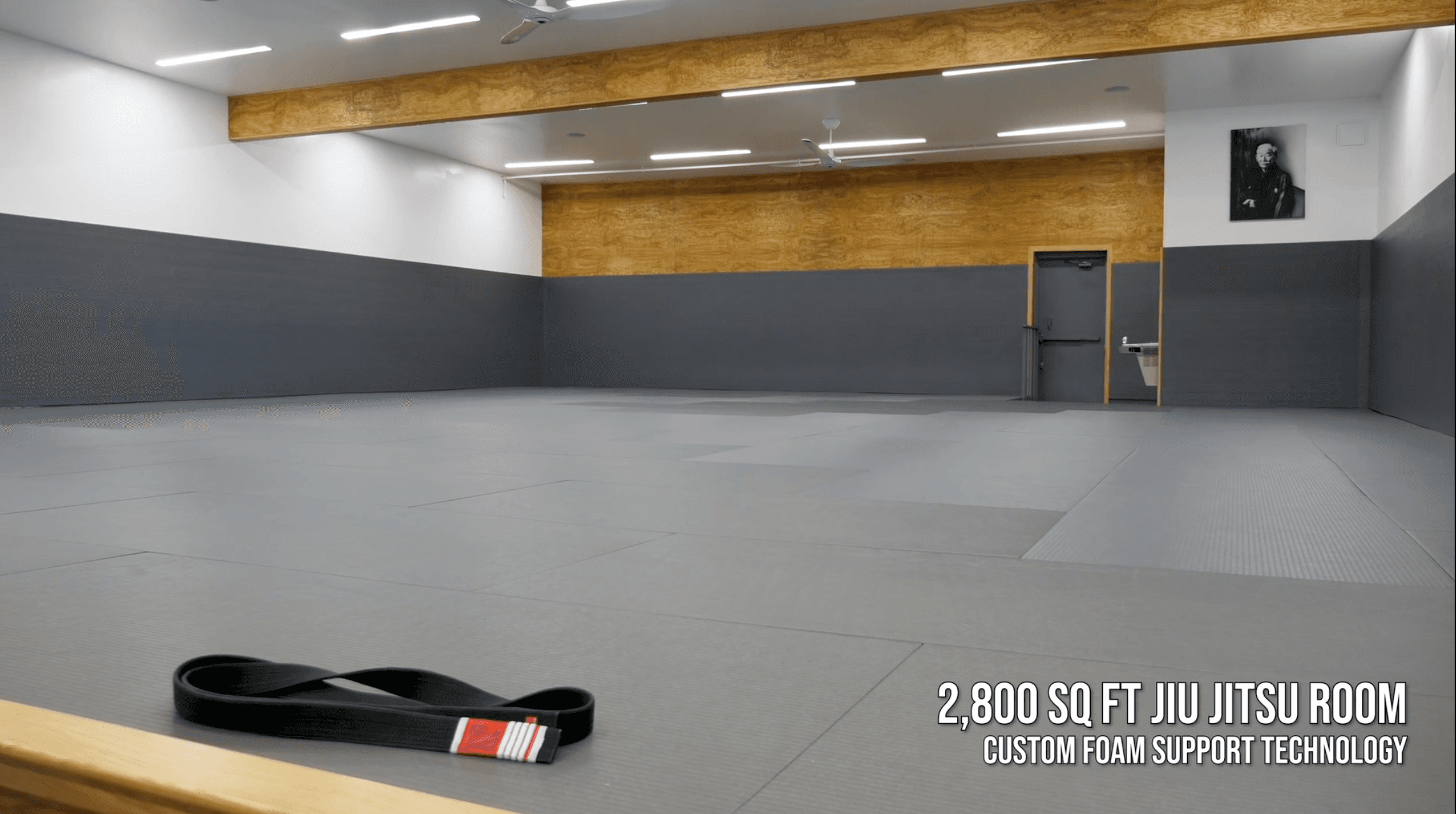
The numbers, per the gym: 27,000 square feet across three separate training buildings, about 8,000 square feet of mat, roughly 35 striking bags, two competition rings, and cleaning twice a day. Coverage from 2022 put membership around 1,200.
Three buildings matters more than the square footage. It means a Muay Thai class and a jiu-jitsu class can run at the same time without either one hearing the other's timer, which anyone who has tried to teach guard retention next to a bag class will appreciate.
Parking is Midway District parking, which is to say you'll circle. Victory MMA is a few minutes up the road on Midway Drive, so this small pocket of San Diego contains two of the larger fight gyms in the country within about a mile of each other. That's a strange and very San Diego fact.
The fight team, and how to read claims about it
The Arena's identity is built on producing fighters. The gym started its modern chapter in 2006 partly as a training base for professionals before opening more broadly, and its own blog has run results posts for its amateur and pro team going back well over a decade.
Names get thrown around when people talk about who has trained here, and this is where I'd be careful. Older gym posts and local coverage have listed fighters like Rani Yahya, Cris Cyborg and Roger Huerta as having trained or camped at The Arena, but a lot of that material is ten or more years old, and fight-gym rosters churn constantly. Pros float between camps for a single fight and then leave. Treat any "so-and-so trains there" claim, at any gym, as a statement about a moment rather than about today.
What you can verify is the current coaching page, and it's a serious one across every discipline. That's the more useful signal anyway. You will not be training with the pro team as a new member; you'll be training with the coaches, and those are the names to check.
The jiu-jitsu program
The BJJ side runs over 30 adult classes a week, gi and no-gi, roughly six a day, all included in the single membership that covers every other program in the building. There's no kids jiu-jitsu program; the school says so plainly on its own site, which is unusual and worth knowing if you were hoping to train while your child does.
The gym is a Six Blades affiliate under Xande Ribeiro, who is listed as jiu-jitsu program director. Xande's credentials are not in dispute anywhere: multiple-time IBJJF world champion at black belt, a two-time ADCC champion who won the under-99kg division in 2007 and 2009, and the record holder for most ADCC matches and wins. He was named to the first ADCC Hall of Fame class in 2024. He moved to San Diego in 2007 and has been part of the county's jiu-jitsu ecosystem ever since.
Adam Bradley is the head jiu-jitsu instructor. Before his black belt he was ranked the number one brown belt in the world by FloGrappling and was one of sixteen competitors on FloGrappling's "Who's Next" series. He teaches escapes as a specialty, which is the correct thing for a head instructor at a gym full of beginners to specialize in.
For a stretch of the gym's history the program was headed by Baret Yoshida, who joined in 2014. Yoshida is a genuine grappling legend, a black belt under the Inoue brothers, a multiple-time no-gi world champion and the only person to have competed at ADCC ten times. He is not listed on the gym's current coaching page, so treat his involvement as history rather than this week's schedule.
Where a fight gym falls short for a gi competitor
This part gets glossed over in gym write-ups, so let's be direct.
At a dedicated BJJ academy, especially a competition academy, the whole institution is organized around one thing. The head instructor knows your game. The Tuesday advanced class builds on the Thursday one. The gi program has depth because there's nothing else competing for mat time or attention.
At a fight gym, jiu-jitsu is one of eight or nine programs. The instruction can be excellent, and at The Arena it clearly is, but the culture is broader and shallower by design. If your ambition is IBJJF Worlds in the gi, you will probably want a room where everyone else is chasing the same medal and the guy next to you isn't cutting weight for a fight in six weeks.
There's also the intensity question. A room full of amateur and pro fighters trains hard. That's the appeal for a lot of people and the reason others quietly move to a smaller academy after six months. Neither reaction is wrong. Go for a week and find out which one you have.
One more thing worth knowing: at a gym this size, no one manages your development unless you ask. Introduce yourself, tell someone what you're trying to fix, and the coaching is there. Sit in the back and you can go a long time without anyone learning your name.
What you get at a multi-discipline fight gym
The real question isn't whether The Arena is good. It's whether a fight gym is the right kind of gym for you, and that's a genuine trade-off in both directions.
What you gain:
Bodies. More classes and more members means you always have partners, at your size, at your level, at 6am and at 8pm. Small academies can't promise that.
Wrestling that isn't an afterthought. A dedicated wrestling program next door to your BJJ classes is worth more to your jiu-jitsu than most people admit. If you've been losing every scramble and every guard-pull negotiation, that's the fix, and it's included. We get into why in our breakdown of BJJ versus wrestling versus judo.
Judo, still, after 77 years. Throws taught by people who compete in judo, in a building where the throws came first.
Striking on the same membership. If you've ever wanted to know what your guard is worth against someone allowed to punch, that answer is available here without a second gym fee.
The takeaway
The Arena is two things at once and both are unusual. It's the oldest continuously operating martial arts school on the continent, running unbroken from a 1949 judo class taught by a Pacific War veteran, through his students, into a building on Sports Arena Boulevard that now houses nine disciplines. And it's a working fight gym, where the jiu-jitsu program is one of the largest adult schedules in the city and sits under an ADCC Hall of Famer.
If you want to train jiu-jitsu and nothing else, forever, in a room organized entirely around that, San Diego has fifty academies that fit better. If you want to grapple four days a week, hit pads on the fifth, learn to shoot a double leg from someone who wrestled, and do it all on one membership in one building, this is close to the best version of that in the country.
Try both kinds of gym before you commit. Most people don't, and then spend two years wondering why their training feels slightly off.
Compare it against the rest of the county
The Arena is listed with its programs and location on Let's Roll: The Arena in San Diego. Line it up against a dedicated BJJ academy near you in the gym directory, then go take a free class at each.
FAQ
How old is The Arena in San Diego? The school traces back to 1949, when Marine Corps veteran Al Holtmann opened the Southern California School of Judo and Ju Jitsu on 30th Street. It has operated continuously ever since, moving to 3350 Sports Arena Blvd in 2006 and taking the name The Arena. The gym describes itself as the oldest continuously operating martial arts school in North America.
Does The Arena teach Brazilian jiu-jitsu? Yes, with over 30 adult classes a week in gi and no-gi, around six a day, included in the standard membership. The program is a Six Blades affiliate under Xande Ribeiro as program director, with Adam Bradley as head instructor. There is no kids jiu-jitsu program.
Is a fight gym a good place to learn BJJ as a beginner? It can be, and the trade-offs are real. You get more class times, more training partners and free access to wrestling and striking, which will improve your grappling. You get less gi-specific depth and less individual attention than at a small academy where the head instructor knows every student's game. Beginners who ask for help do fine; beginners who hide in the back tend to stall.
What else does The Arena offer besides jiu-jitsu? Boxing, kickboxing, Muay Thai, MMA, judo, wrestling, submission grappling, Filipino martial arts, strength and conditioning, personal training and fight camps, all under one membership across roughly 27,000 square feet and three separate training buildings.
Related Posts
Mikey Musumeci gives up the belt to make room for MMA
Musumeci is vacating his UFC BJJ title to focus on MMA training. What he is leaving, what continues, and why the transition matters.
IBJJF membership: finish the paperwork before the deadline
IBJJF membership and tournament entry are separate steps. Plan documents, professor approval, renewals, and junior accounts before registration closes.
Choosing a BJJ seminar worth your time and travel
Choose a BJJ seminar by the subject, teaching format, access, and total cost. Know what to ask the host before buying a ticket.
Comments (0)
Loading comments...