
A technical stand-up starts before you lift your hips
Quick answer: A technical stand-up needs a usable post, room for the moving leg, and enough separation to complete the change of level. Learn the movement with a coach, then practice recognizing when those conditions exist against a partner. A clean solo repetition does not mean every seated position is an invitation to stand.
Getting upright is only part of the job. A stand-up that ends with you stumbling into your partner has met the most literal definition of standing and missed the purpose of the exercise.
The technical stand-up is often easy to recognize in a demonstration: one hand on the mat, the opposite foot planted, and the other leg moving underneath. During a round, however, the difficult moment may arrive before any of that. You have to decide whether there is room to use it.
Treat those as separate problems. First learn the movement. Then learn to identify the position in which you can actually perform it. Mixing both problems immediately makes it harder to tell why a repetition failed.
Identify the space you actually have
Distance changes the available movement. In their discussion of guard range, Stephan Kesting and Rory Van Vliet distinguish an unattached, seated position from the much closer relationship of deep half guard. Getting to the feet from the former is a different task from doing so while underneath someone's hips.
For practice, make the starting relationship explicit. Is the partner standing away from you? Holding a leg? Kneeling close enough to connect their weight? Those are different starting positions, even though you may be seated in all three.
A useful first exercise is simply to name the condition before moving. Say whether the leg is free or caught, and whether the partner is connected or separated. Have the coach correct that assessment before asking for speed.
This gives you something more precise to investigate than a general complaint that the technique does not work. A failed attempt from the wrong starting relationship may say very little about your ability to perform the movement itself.
Learn one version clearly before collecting variations
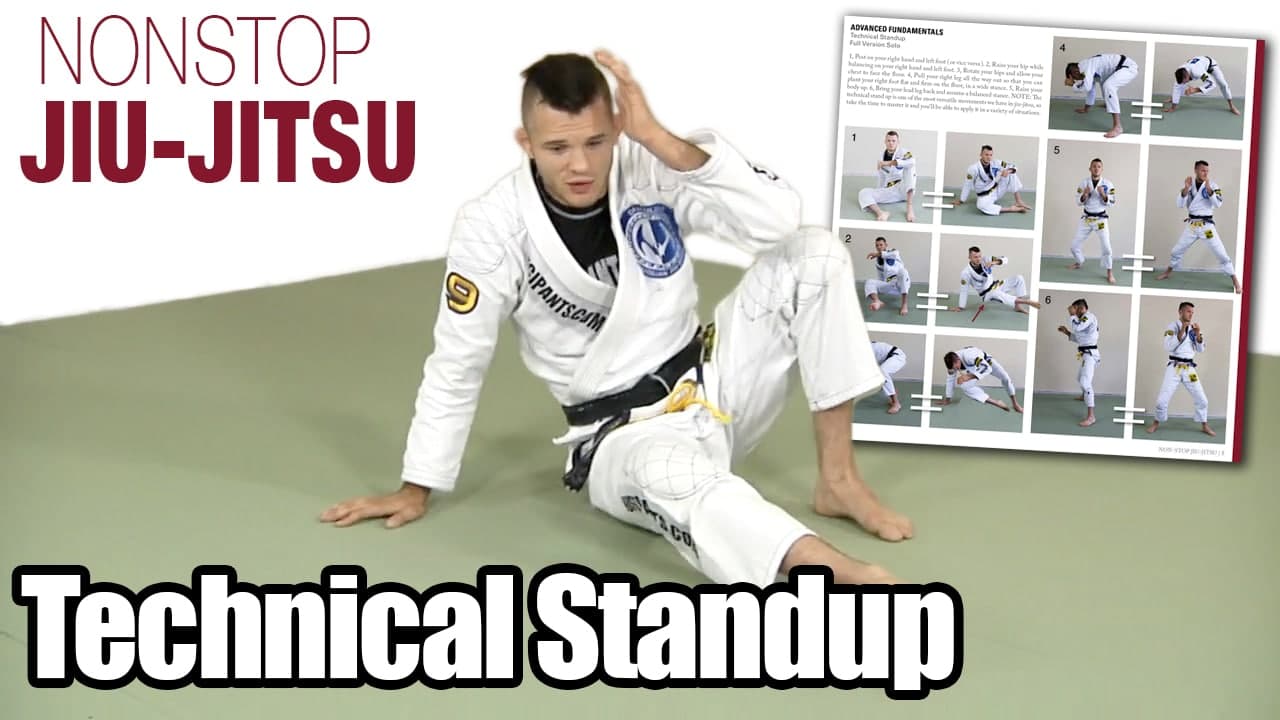
In Brandon Mullins and Stephan Kesting's technical stand-up lesson, the full version uses opposite-side supports: for example, the right hand and left foot. The hips lift, the free leg withdraws, and the feet finish separated rather than crowded together. Their lesson also presents knee-supported and elbow-supported variations, plus the reverse movement back down.
Use the version your coach is teaching as the immediate reference. Ask them to identify the start and finish, then perform a slow repetition on each side. Keep the demonstration available if a left-right instruction becomes confusing. Watching the same version twice is more useful than blending fragments of several explanations.
Do not race through the side that feels unfamiliar merely to return to the comfortable one. That is the repetition worth asking someone to observe. Describe what happens rather than diagnosing it yourself: the moving foot catches, the hand changes position, or the finish feels crowded.
If the movement is painful, stop and seek appropriate guidance. Increasing the repetition count is not a solution to pain.
Make the end position part of the repetition
Decide with your coach what counts as finished. For a basic practice round, that might mean you are upright, facing the partner, and able to hold the assigned stance without an extra recovery step. The exact target should match the lesson rather than a picture you remember from somewhere else.
Then pause there. A brief pause makes the result visible to both people. If you immediately wander back to the start, an unstable finish can disappear into the reset and become difficult to discuss.
Try describing the outcome in observable terms. You needed another step. You turned away. You reached for the partner to balance. Each description points to a moment someone can inspect. Calling the whole repetition bad gives them less to work with.
Do the same with successful attempts. Notice which conditions were present instead of treating success as a pleasant accident. A coach can help you decide which details matter and which are incidental. The aim is a repeatable movement under an understood set of conditions, not a pose held long enough for approval.
Give the partner a limited job
A partner can make the exercise more realistic without making it a contest immediately. Start by telling them exactly what you need them to do. Standing at a fixed distance is one job. Gradually approaching along an agreed line is another. Grabbing anything available and trying to win is a third, much larger assignment.
Choose a narrow task with your coach. For example, the standing partner might approach slowly while the seated player decides whether to begin the movement or remain in the assigned guard. The partner should not add surprise attacks to an exercise that was agreed as a recognition drill.
Useful agreements include:
The starting distance and whether either person begins with a grip.
The actions the partner may use during this particular drill.
The moment that ends a repetition and triggers a reset.
A clear stop signal if either person loses balance or needs to pause.
Keep the area clear of other pairs. This exercise changes level and uses space behind the seated player; choose a place where that movement will not cross someone else's round. At an open mat, confirm that the host has room for the kind of practice you are proposing.
Include the decision to stay down
An exercise that rewards standing every time can teach an unhelpful habit: beginning the movement because it is the day's assignment, regardless of what the partner has done. Leave room for a correct decision that does not end upright.
Here is a practice format to discuss with your coach. The partner alternates between the agreed open starting position and a closer position the coach has identified as unsuitable for that stand-up. The seated player first names the difference, then either moves or keeps the assigned guard. Resistance remains low while the decision is being learned.
The purpose is to make the condition matter. You are not trying to invent a universal rule for every possible grip or distance. You are learning to distinguish two examples clearly enough that the technique has a reason to begin.
Afterward, ask what changed your decision. If the answer is simply that it felt different, return to the positions and identify the visible difference together. Feeling is useful information; connecting it to something specific makes it easier to practice again.
Add resistance one variable at a time
Once the movement and the starting conditions are understood, the next task is to test them against a partner who can interfere within agreed limits. Keep those limits small enough that you can still explain what happened.
Kesting's guide to targeted positional sparring describes several ways to organize repetitions, including resetting after an escape or exchanging roles. The useful principle here is a defined starting problem with a recognizable stopping point. It gives each person repeated exposure to the same task.
For your stand-up practice, ask the coach to add one obstacle before adding several. Keep notes on that obstacle rather than collecting a general win-loss record. If the new grip stops every attempt, work on understanding the grip's effect before increasing the partner's speed too.
A controlled drill is allowed to be repetitive. Its value comes from the question being stable enough to investigate. Save broader sparring for the stage when both people know the exercise and can keep it controlled. Adding unpredictability should have a purpose beyond making the round harder to survive.
Review the moment before the attempt
When an attempt fails, the obvious place to look is the point where you fall back down. That may be the final consequence rather than the useful explanation. If both people consent to filming and the gym permits it, review a short clip beginning before the hips leave the mat.
Look for the first difference between the planned repetition and the one that happened. Perhaps the partner started closer than agreed. Perhaps the grip had changed. Perhaps you began moving before checking the available space. Ask the coach which difference matters before prescribing your own fix.
One correction is enough for the next set. Trying to remember six adjustments can turn an ordinary movement into a verbal checklist you cannot complete at training speed. Establish whether the first change helps, then decide what still needs attention.
A useful note after practice might record the starting position, the obstacle you tested, and the correction you will revisit. Avoid a vague promise to get better at stand-ups. Write something that will let you and the next partner recreate the same problem without a long explanation.
Main photo: Grapplearts / Brandon Mullins and Stephan Kesting — Nonstop Jiu-Jitsu lesson artwork.
The takeaway
Separate the movement from the decision to use it. Learn a clear version, define its finish, and practice recognizing the starting conditions before asking a partner to interfere. A stand-up becomes easier to evaluate when everyone knows what the repetition is meant to demonstrate.
The next time an attempt stalls, begin your review before the hips rise. Check what space and connections were present. That is often a more useful coaching conversation than simply asking how to stand faster.
Find a place to practice with feedback
Use the gym directory to look for instruction near you, then ask the coach where technical stand-ups fit into their beginner classes.
FAQ
Is a technical stand-up only a warm-up movement? No. The movement has grappling applications, but a solo warm-up does not supply the timing or decisions required against a partner. Ask your coach to connect the version you practice to a specific training position.
Should I always stand when I am in seated guard? No. The partner's position, grips, and the task you are practicing matter. Learn to recognize a suitable starting situation rather than treating being seated as an automatic instruction to get up.
What if one side feels much less coordinated? Slow that side down and ask someone qualified to watch a repetition. Describe the specific difficulty. Do not force through pain or assume that more speed will resolve a movement you have not yet understood.
How should I practice this at open mat? Agree on the starting position, permitted resistance, and reset with your partner. Keep enough space around the pair and follow the host's rules. If you are unsure of the mechanics, get instruction before turning it into live resistance.

Nina Okada
Nina Okada explains positions the way a good training partner does: one problem at a time, with the limits of the explanation said out loud. She is careful about the difference between what footage shows and what it only suggests.
Related Posts

Mikey Musumeci gives up the belt to make room for MMA
Musumeci is vacating his UFC BJJ title to focus on MMA training. What he is leaving, what continues, and why the transition matters.
IBJJF membership: finish the paperwork before the deadline
IBJJF membership and tournament entry are separate steps. Plan documents, professor approval, renewals, and junior accounts before registration closes.
Choosing a BJJ seminar worth your time and travel
Choose a BJJ seminar by the subject, teaching format, access, and total cost. Know what to ask the host before buying a ticket.
Comments (0)
Loading comments...