
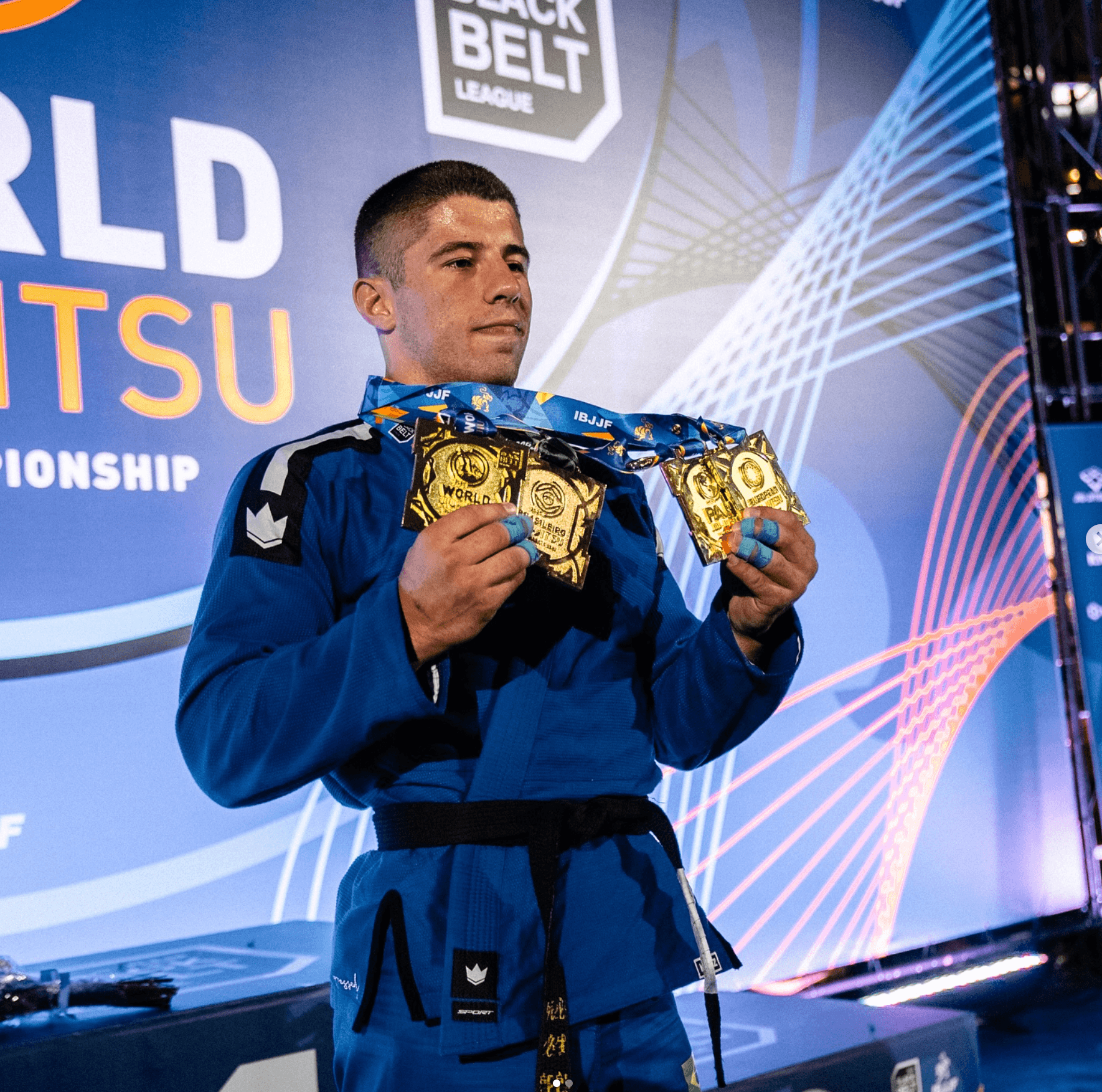
Tainan Dalpra: six minutes of mat time and a fourth world title
Quick answer: Tainan Dalpra is a Brazilian black belt out of Art of Jiu-Jitsu in Costa Mesa, California, and the most feared gi competitor of his generation at middleweight. At the 2026 IBJJF World Championship in Long Beach he won his fourth world title, submitting all four opponents in roughly six minutes of total mat time. He also became, per the IBJJF, the first man to complete the Grand Slam — European, Pan, Brazilian Nationals and Worlds in a single calendar year — twice.
Six minutes. That is how long Dalpra spent on the mat to win the 2026 middleweight world title, according to the IBJJF's own recap of the event. Four matches at the Pyramid in Long Beach. Four submissions. And all four were the same submission: a choke from the back.
In most sports that would read as promotional copy. Here it reads as a scouting report, because everyone in the division already knew what was coming and it happened anyway. Oilson Alvim in the round of 16, Pedro Leonardo in the quarters, Matheus Luna in the semis, Natan Chueng in the final. Back, back, back, back.
What follows is a look at how a 25-year-old from Florianópolis got here, what his jiu-jitsu is built to do, where the "undefeated" talk holds up and where it doesn't, and why comparing him to Gordon Ryan or Marcus Buchecha misses the thing that makes him strange.
The 2026 run, in detail
The 2026 Worlds was the 30th edition of the event, and BJJ Heroes counted 335 adult black belt matches across the weekend with a 34% submission rate. Dalpra's personal rate that weekend was 100%.
The IBJJF's write-up called the run "one of the most dominant Worlds performances of all-time" and singled out his passing pressure, not his guard, as the thing that decided the division. Reports out of Long Beach had the final finish arriving inside the first minute against Chueng, who had just beaten Tommy Langaker and taken a split decision over Jose Steve to get there. It was not a soft bracket.
That performance closed a season in which he had already won the European Championship, the Pan, and the Brazilian Nationals.
What a Grand Slam is, and why two of them is new
The IBJJF Grand Slam means winning all four majors in the same calendar year: Europeans in January, Pans in March, Brasileiros in the spring, Worlds at the start of June. It is a scheduling problem as much as a competitive one. You have to be healthy in January, still healthy in June, and willing to fly to Europe, California, São Paulo and back while everyone in your bracket gets one clean shot at you.
Dalpra did it in 2025 and again in 2026. The IBJJF's recap describes him as the first male athlete to win two Grand Slams. FloGrappling reported that the 2025 version came while he was dealing with a hand injury for much of the season, which, if accurate, makes the second one more impressive rather than less.
He and Gabi Pessanha were the only two grapplers to sweep all four majors in 2026.
The undefeated thing, and the three losses
You will hear that Dalpra has never lost at black belt. That is not true, and the real version is more interesting.
BJJ Heroes' database credits him with 115 wins and three losses. None of the three came by submission. Here they are:
A referee decision against Mica Galvão at a 2021 event outside the IBJJF circuit, at 77kg.
The 2023 Worlds final against Jansen Gomes, 0-0 on points, decided by a single advantage. Jits Magazine reported it as the first loss of his IBJJF black belt career, roughly two and a half years after his promotion.
A disqualification in the quarterfinals of the 2024 Worlds against Francisco Lo, for what officials judged a dangerous knee position out of a De La Riva entry. FloGrappling covered it as one of the tournament's flashpoints and a lot of decorated black belts publicly disagreed with the call.
So: one loss on points in six years, one loss to a rule interpretation, and one loss at a non-IBJJF show early in his black belt career. No one has submitted him. That is a more useful sentence than "undefeated," and it has the advantage of being true.
Costa Mesa, 2015
Dalpra was born on November 6, 2000, in Florianópolis, in Santa Catarina. His father, Deivid Soares, started taking him to the gym at five, mostly to sit and wait while the adults trained. He eventually got on the mat.
At 13, competing at the IBJJF Pan Kids as an orange belt, he met Rafael and Guilherme Mendes. In 2015 he moved to Costa Mesa, California, and became one of the first athletes in the Mendes brothers' Believe and Achieve scholarship program, which housed and trained young talent that had ability but no money. The same program produced Mateus Rodrigues, Jessa Khan and Johnatha Alves.
Guilherme Mendes promoted him to black belt in October 2020, on the podium at the Pan. He won the Worlds thirteen months later.
The AOJ detail people miss is how narrow the pipeline is. AOJ does not run a global affiliate network the way Alliance or Gracie Barra do. It is one academy in Orange County that keeps producing world champions, and in 2026 alone its athletes won the men's light-featherweight, featherweight and middleweight titles plus two women's divisions.
Passing into the back, over and over
Of Dalpra's 85 career submission wins, 36 are chokes from the back. Add 19 armbars and you have roughly two-thirds of his finishing record in two positions.
That sounds like a back-attack specialist, which is only half right. The back is where he finishes. The passing is where he wins. His pattern is to establish an outside passing threat, force the opponent to defend a wide angle, then close distance and collapse into a tight pass that exposes the far shoulder. Once the near hip turns, he is not passing to side control so much as passing straight into a back take. Most people who defend his pass end up giving up their back to do it.
Two things make that work in the gi specifically. First, the grips: lapel and sleeve control means he can hold a broken position for as long as he wants while the opponent's escape window closes. Second, he almost never trades. He does not enter leg entanglements, does not play the inverted scramble game, and does not give up top position to chase a submission. His record has zero submission losses in part because he spends very little time in positions where a submission loss is available.
Why he is not Gordon Ryan, and not Buchecha either
The comparison to Gordon Ryan is the one that gets made most often, and it does not survive contact with the details. Ryan built his case in no-gi, in submission-only and ADCC formats, against opponents who had to engage him. Dalpra's case is built inside a points ruleset, in a gi, in a single weight class, where his opponents are allowed to stall and often try to.
Winning by submission in that environment is harder, not easier. There is no overtime pushing anyone into a scramble. A silver medal in the 2023 final came down to one advantage.
The Buchecha comparison fails differently. Buchecha's 13 world titles include six absolute golds, which is the traditional route to the "greatest gi competitor" argument: beat everyone at your weight, then beat people 40 pounds heavier on the same day. Dalpra has not made that run at black belt. His case is depth in one division rather than reach across all of them.
Whether that matters is a genuine argument. Some people think absolute gold is the only real test of a gi player. Others think the modern middleweight bracket is deeper than any absolute division has ever been. I lean toward the second, but I do not think it's settled, and anyone telling you it is settled is selling something.
Four titles against Buchecha's thirteen
The count: Marcus Buchecha at 13 world titles, Roger Gracie at 10, Dalpra at four, with a 2027 season ahead of him. He is not in the conversation yet on volume. He is in it on manner.
The number that matters over the next few years is not his title count but the shape of his season. A third straight Grand Slam and the arithmetic starts working in his favor fast. A blown knee, or the sport's money continuing to pull talent toward no-gi superfights, and the ceiling drops.
If you want to see how his results ripple out to his team's standing, AOJ's position on the team power rankings tells that story better than any highlight reel.
The takeaway
Tainan Dalpra is not undefeated and he has not won an absolute world title. What he has is a four-year stretch where the best middleweights in the world knew exactly what he was going to do and could not stop it, capped by a weekend where he won the sport's biggest tournament using about as much mat time as one competitive match.
The gi is a slower, grabbier, more conservative ruleset than no-gi, and the standard complaint about it is that elite matches turn into ten minutes of grip fighting and one advantage. Dalpra is the counterargument. He goes and gets people. That is why the middleweight bracket at every major reads like a list of very good black belts hoping to land on the other side of the draw.
Four titles is not a legacy yet. The way he wins already is.
Watch a division like this and you want to train
Elite gi jiu-jitsu is the most technical version of this sport, and the only way it makes sense is from the inside. Find a BJJ gym near you and go do a week of gi classes.
FAQ
How many world titles does Tainan Dalpra have? Four IBJJF gi world titles at middleweight, won in 2021, 2022, 2025 and 2026. He also took silver in 2023, losing the final to Jansen Gomes by a single advantage, and was disqualified in the quarterfinals in 2024.
Is Tainan Dalpra undefeated at black belt? No, though the reputation is close to earned. BJJ Heroes lists three losses against 115 wins, none by submission: a referee decision to Mica Galvão in 2021, the 2023 Worlds final on advantages, and a disqualification at the 2024 Worlds. He has never been submitted as a black belt.
Who is Tainan Dalpra's coach? Guilherme Mendes, who promoted him to black belt on the Pan podium in October 2020. Dalpra represents Art of Jiu-Jitsu in Costa Mesa, California, which he joined in 2015 through the Mendes brothers' Believe and Achieve scholarship program after meeting them at the Pan Kids at 13.
What is the IBJJF Grand Slam? Winning the European Championship, the Pan, the Brazilian Nationals and the World Championship in the same calendar year. Dalpra completed it in 2025 and 2026; the IBJJF described him as the first male athlete to do it twice, and he and Gabi Pessanha were the only two grapplers to sweep all four majors in 2026.
Related Posts
Mikey Musumeci gives up the belt to make room for MMA
Musumeci is vacating his UFC BJJ title to focus on MMA training. What he is leaving, what continues, and why the transition matters.
IBJJF membership: finish the paperwork before the deadline
IBJJF membership and tournament entry are separate steps. Plan documents, professor approval, renewals, and junior accounts before registration closes.
Choosing a BJJ seminar worth your time and travel
Choose a BJJ seminar by the subject, teaching format, access, and total cost. Know what to ask the host before buying a ticket.
Comments (0)
Loading comments...