
Robert Drysdale: a champion asking where the story began
Quick answer: Robert Drysdale won the 2005 IBJJF black-belt heavyweight world title and the 2007 ADCC absolute. He later wrote about jiu-jitsu's history in books including Opening Closed Guard and The Rise and Evolution of Brazilian Jiu-Jitsu. The combination makes him interesting as both a participant in the sport and someone investigating its development.
Robert Drysdale's name appears above Marcelo Garcia's in the final standings of the 2007 ADCC absolute. That is a substantial place to begin a profile, and an easy place to stop one.
His writing offers another route. A competitor whose own results belong in the archive became interested in the archive itself: the people, accounts, and decisions behind the version of jiu-jitsu students encounter on the mat. The useful tension is that sporting achievement and historical authority are different things. A championship establishes that someone won; a historical argument still has to show its evidence.
The gi title belongs to a specific division
The IBJJF's 2005 results list Drysdale, representing Brasa, first in the adult black-belt men's heavyweight division. Fernando Marques is second, with Lucio Rodrigues and Fabio Leopoldo in the bronze positions. This was a weight-division title, not the open-class championship.
That distinction is worth preserving because world champion can become a loose label once a career is compressed into a sentence. The division and year make the result available for comparison. They also prevent a later achievement from being folded into an earlier one by accident.
For a student encountering Drysdale through a book or a coaching appearance, the result provides context. He was not approaching the subject solely as an outside observer. He had competed successfully within one of the institutions whose history a reader might want to understand.
The result should still be allowed to do its own job. It establishes a sporting achievement. It does not decide whether every interpretation he later offers about the sport's past is correct.
The 2007 absolute widened the sporting record
The official ADCC absolute bracket places Drysdale first, Garcia second, and Andre Galvao third. Drysdale's final opponent is the name most readily attached to the result, but the title is the product of a tournament rather than an isolated meeting.
ADCC's contemporary event report recorded Drysdale submitting Garcia in the final with a reverse head-and-arm choke. The same report recorded his quarterfinal against David Avellan as a 2–0 win. That detail is a useful guard against retellings that turn the whole run into an uninterrupted list of submissions.
The contrast with 2005 is clear without making either title larger than it was. One result came in a gi weight division; the other came in ADCC's open-weight competition. Together they give the sporting biography two distinct reference points.
A good profile can retain those differences and still move on. There is more to investigate than which of the two medals deserves the larger photograph.
A book grew around a film project
The published description of Opening Closed Guard explains its connection to the documentary project Closed-Guard: The Origins of Jiu-Jitsu in Brazil. The book combines an account of the production process with interviews, research material, and the author's interpretations. That description establishes the project's form; it is not a substitute for reviewing the complete text.
The title can mislead a reader expecting a technical manual. The subject here is the history of the art in Brazil, not a sequence for breaking somebody's closed guard. Its questions concern origins and development, including the relationship between received stories and the evidence behind them.
That is a different kind of work from an instructional video. A technique demonstration can be tested against a partner under defined conditions. A claim about an event decades ago requires records, testimony, and care about what each source can establish.
Readers interested in the project should approach it with that distinction intact. The promise is an investigation into the sport's story, not a new finishing sequence to bring to tomorrow's class.
Drysdale linked the research back to coaching
In a 2023 interview with Budovideos, Drysdale discussed The Rise and Evolution of Brazilian Jiu-Jitsu and his interest in history. He said the writing had changed how he understood the influence of culture and training methods, alongside techniques and rules. He connected that understanding to his perspective as a coach.
This is an interesting route back to the mat. A training method can feel inevitable when it is the only one a student has encountered. Historical inquiry invites a different question: how did this way of organizing practice become familiar, and what did it prioritize?
Those questions do not require an instructor to abandon a successful class format. They ask the instructor to identify its purpose. A session arranged around a competition, a self-defense scenario, or a narrow technical problem may legitimately emphasize different work.
The interview supplies Drysdale's stated connection between research and coaching. The broader practical suggestion is for readers: when a routine is presented as the only possible way, ask what goal the routine was designed to serve.
Read historical claims with the source still attached
A useful reading habit is to distinguish an event from someone's later explanation of it. A dated result can establish who won a division. An interview can establish what a participant said. A book can connect those materials into an argument, but the connection remains something to examine.
Keep a few questions beside any history of the sport:
Is this a contemporary record, a later recollection, or the author's interpretation?
Does the source support the precise claim being made?
Are competing accounts identified rather than silently discarded?
Is a conclusion about one event being extended to a much larger period?
What evidence would change the interpretation?
This is not a special burden reserved for Drysdale. It is a fair way to read anybody writing history, including an athlete you admire. Respect for a competitor and scrutiny of an argument are compatible.
The same habit improves short sports profiles. A result table, a highlight clip, and an academy biography are different sources with different purposes. Keeping them distinct prevents a promotional sentence from quietly becoming an established historical fact.
The familiar version is a starting point for better questions
A lineage chart can introduce names and teaching relationships. It cannot, on its own, explain every influence on a training culture. A championship result can identify a successful athlete. It cannot describe all the methods used by the people in the room around them.
That gap is where a reader can become more interested without becoming more hostile. Asking how an account was assembled is different from assuming somebody must be dishonest. Memories can be incomplete, categories can change, and a short explanation may leave out context simply because it is short.
Drysdale's combination of sporting record and historical writing gives readers an accessible entrance to those questions. Someone might arrive because they recognize the Garcia match and stay because they want to understand why the sport's practices developed as they did.
There is no need to turn that curiosity into a contest between academies or families. Read the claim, follow the source, and identify what remains uncertain. The result should be a more specific understanding, not a new set of slogans to repeat after class.
Keep the competitor and the author in the same frame
It would be easy to divide this career into a physical chapter and an intellectual chapter, as if the two could not inform one another. The more useful distinction is between the kinds of evidence each activity produces. A competition result and a historical argument have different tests.
Drysdale's medals make the participant's perspective relevant. His writing and interviews give readers material to examine beyond those medals. Neither needs to cancel the other, and neither makes the other automatically persuasive.
The Leo Vieira profile offers a related way to read a long career: begin with documented competition, then look at what the person helped build or teach. The later work deserves its own attention rather than serving only as an extended caption beneath a podium photograph.
For Drysdale, the distinctive later subject is the story of jiu-jitsu itself. A student can know the famous match and still have something new to investigate. That is a better reason to revisit a champion than another argument over a greatest-of-all-time list.
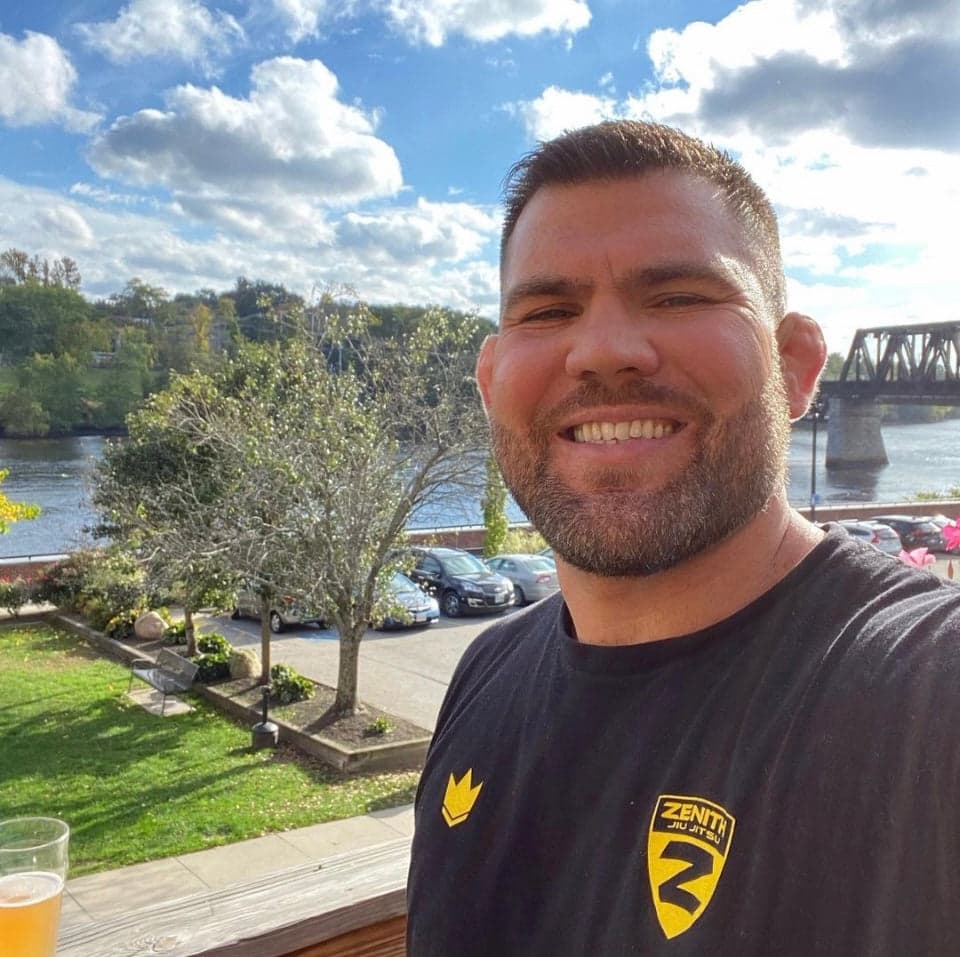
Main photo: Budovideos; photograph accompanying its Robert Drysdale interview.
The takeaway
Drysdale's record includes a 2005 IBJJF heavyweight title and the 2007 ADCC absolute. Keep the divisions, results, and sources clear; they are strong enough without embellishment.
His books and interviews add a separate reason to pay attention. They invite readers to examine how jiu-jitsu developed and how that history relates to training. Approach the writing with curiosity and source questions, giving the argument the same care that the competitive record deserves.
Take a question back to class
Explore gyms on Let’s Roll, and ask prospective instructors how they organize training for the goals you want to pursue.
FAQ
Which IBJJF world title did Robert Drysdale win? The official 2005 results list him first in the adult black-belt men's heavyweight division, representing Brasa. That should be distinguished from an open-class title.
Who did Drysdale beat in the 2007 ADCC absolute final? Marcelo Garcia. ADCC's contemporary report records a submission by reverse head-and-arm choke, and the official bracket lists Drysdale as the absolute champion.
Is Opening Closed Guard a technique book? Its published description presents a history and documentary-related project, including interviews, research, and interpretation about jiu-jitsu in Brazil. The title is not a promise of a closed-guard instructional system.
Why read a competitor's work on BJJ history? It provides a participant's perspective and a set of arguments to examine. Competition success supplies context, while the historical claims should still be assessed through their evidence and sources.

Miles Serrano
Miles Serrano writes about competitors and the decisions that shaped their careers. He is more interested in the adjustment someone made in the third minute than in the medal count afterward.
Related Posts
Mikey Musumeci gives up the belt to make room for MMA
Musumeci is vacating his UFC BJJ title to focus on MMA training. What he is leaving, what continues, and why the transition matters.
IBJJF membership: finish the paperwork before the deadline
IBJJF membership and tournament entry are separate steps. Plan documents, professor approval, renewals, and junior accounts before registration closes.
Choosing a BJJ seminar worth your time and travel
Choose a BJJ seminar by the subject, teaching format, access, and total cost. Know what to ask the host before buying a ticket.
Comments (0)
Loading comments...