
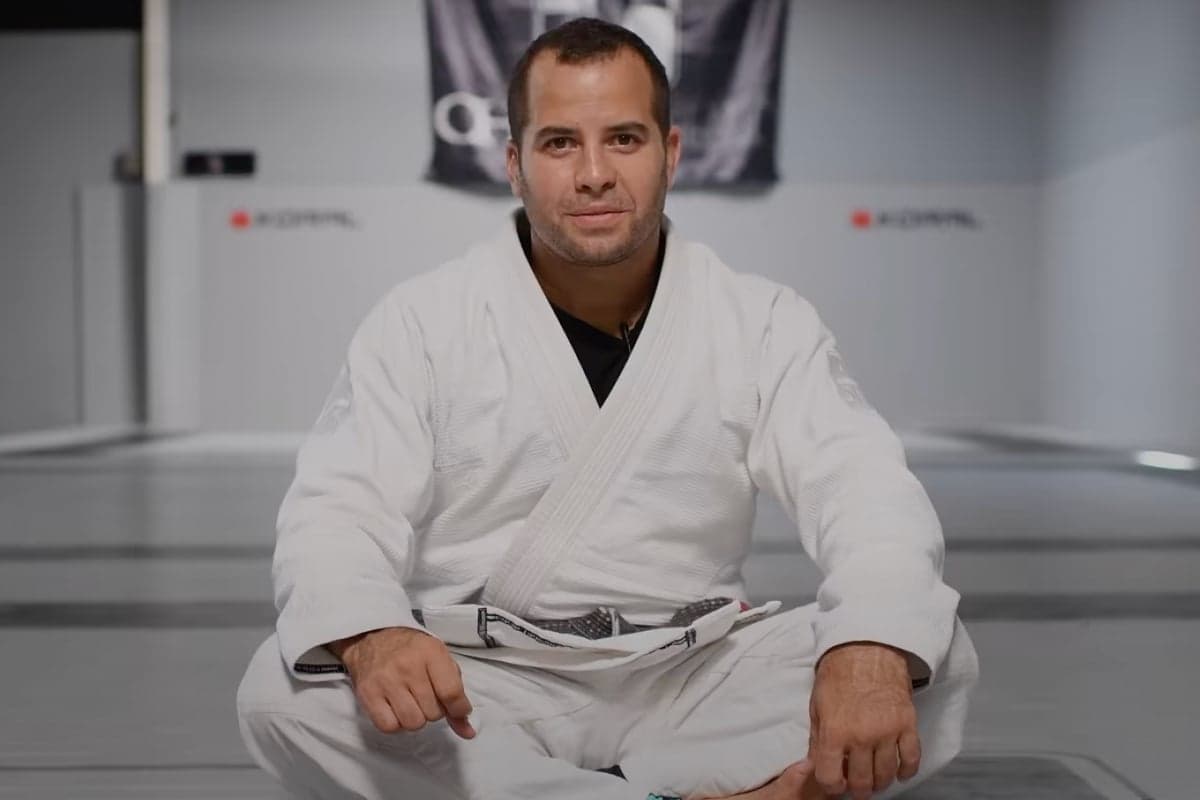
Leo Vieira: the competitor who helped build Checkmat
Quick answer: Leonardo “Leo” Vieira won the ADCC under-66kg division in 2003 and 2005, then helped establish Checkmat with his brothers. His career also extended into promotion when ONE Championship appointed him vice president of grappling in 2022. His influence is easier to understand when those jobs are considered separately, rather than squeezed into a list of medals.
The champion of a famous tournament is not always the person most remembered from it. At ADCC 2003, Eddie Bravo's win over Royler Gracie became a lasting reference point. Leo Vieira won the division.
That distinction is a useful entrance to Vieira's career. The memorable moment and the completed assignment are not always the same thing. Over the years, his assignments expanded from surviving a bracket to helping build a team and taking an organizational role in professional grappling.
Start with the name at the top of the bracket
The official ADCC 2003 results place Leonardo Vieira first at under 66kg, with Baret Yoshida second. The event took place in São Paulo. Those details establish the result without requiring a retrospective argument about which individual match mattered most.
It is worth reading an old bracket before watching the clip that made it famous. A clip gives you a dramatic exchange. A bracket tells you who kept advancing after that exchange was over. Both are useful, but they serve different purposes.
For newer fans, Vieira can arrive in the story already labeled a coach or team founder. The competition record corrects that perspective. He was not simply standing beside the athletes who made the sport interesting. He had already occupied the final line of one of its hardest tournaments.
That is the first reason to study him. Start with what he won, then investigate the choices that allowed him to win it. Reversing that order can leave a reader with a reputation and no clear understanding of the work behind it.
The defense came with another life attached
A 2005 interview by Gleidson Venga for TATAME, preserved by ADCC, gives the title defense a less polished frame. Vieira described dividing his time between training and the demands of his physiotherapy studies. He also emphasized the next opponent rather than a hypothetical later rival.
The interview does not need to be enlarged into a story about private sacrifice. Its interest is already there: a reigning champion describing limited time. The preparation was happening alongside another substantial commitment, not in a world with every other obligation removed.
That is an accessible detail for an ordinary student, although the competitive level is different. A training plan can be serious without occupying every hour. What matters is whether the available work addresses the contest in front of you.
The account also resists hindsight. Before the tournament, another gold was not an item waiting to be added to a biography. There was still a first match to win. The completed record can make a title defense look tidier than it was while someone was preparing for it.
A second gold changes the reading of the first
The 2005 ADCC results again list Vieira as the under-66kg champion, this time with Rani Yahya in second place. Two separate tournaments, two gold medals. That is a more substantial statement than a single weekend preserved in highlights.
A successful defense matters because the original result is already public. Opponents have a champion to study. The field changes, the immediate problems change, and the previous medal does not score anything in the next match.
This does not mean repeating a title is automatically harder than winning one for the first time. Such comparisons need more evidence than a slogan supplies. It means the repeat supplies a second test. Vieira's case is supported by another completed bracket, not simply by the reputation created by the first.
For a reader building a viewing list, those two editions belong together. Watch for differences as well as familiar patterns. A useful study does not begin with the assumption that the athlete solved every opponent through the same move or the same pace.
Watch the transitions before naming a style
Calling a grappler creative is easy. Explaining the usefulness of a particular decision takes more work. With Vieira, a productive viewing exercise is to pause around transitions rather than collecting only the most visually unusual moments.
Use a few questions to keep that exercise concrete:
What contact does he retain while the position changes?
When does the opponent have to turn, post, or recover balance?
Does the next action follow a visible reaction, or begin before it?
These are viewing prompts, not claims that every match contains the same answer. They let the footage supply the evidence. If you cannot identify the position clearly, slow the sequence down and ask an instructor instead of assigning an impressive label to it.
The same approach helps prevent bad imitation. An entertaining movement may depend on grips, timing, and an opponent's response that a short replay barely shows. Taking the movement home without those conditions can produce a trick that works only when a partner politely completes the missing half.
A better training experiment starts with the problem the athlete solved. Your own answer may look less spectacular and still be more useful to your current game.
Checkmat made the team part of the story
ONE's biographical account of Vieira dates Checkmat's founding to 2008 and identifies his brothers Ricardo and Leandro as fellow founders. It also names Marcus “Buchecha” Almeida and Michelle Nicolini among the team's prominent athletes. That is a different form of reach from an individual title.
A competition result belongs to one bracket. A team places an identity across many training relationships. The significance is not that a founder personally explains every success achieved by every athlete wearing the patch. That would erase other coaches, partners, and the athletes themselves.
The more interesting point is structural. Building an organization creates a place for work to continue when its founder is not competing. It allows a career to influence the conditions in which other careers develop, though the quality of any individual room still has to be assessed on its own.
If you encounter Checkmat through a local academy, the affiliation is a piece of history worth understanding. It is not a substitute for observing the class, meeting the instructor, or finding out whether that particular schedule fits your life. Team history and daily training answer different questions.
Leadership requires a different kind of result
The IBJJF's Leo Vieira Q&A explicitly frames part of its interview around the difficulties and rewards of leading Checkmat. Even that choice of subject is revealing. The conversation around him had expanded beyond how to win the next exchange.
A teacher cannot finish a student's match from the sideline. An organizer cannot personally supply every good training partnership. These roles involve making other people's work possible, then accepting that those people must perform it themselves.
That distinction is an editorial way of reading Vieira's career, not a quotation of his coaching philosophy. It prevents a familiar mistake in athlete profiles: treating a championship as automatic proof of excellence at every later job. Competing, teaching, and leading overlap, but none is simply the others performed in different clothing.
For students, this makes a celebrated instructor more interesting rather than less. Ask what is being taught and how the room learns it. The medal establishes competitive achievement. The class has to show what the instructor can communicate to someone whose body, experience, and ambitions may be very different.
The promotion job widened the frame again
On May 10, 2022, ONE Championship announced Vieira's appointment as vice president of grappling. The announcement put a former ADCC champion into a formal role concerned with the promotion's submission-grappling divisions.
That move adds another perspective to the biography. An athlete deals with the match they have entered. A promotion must also consider how matches are assembled and presented. The competitive exchange remains the center, but it sits inside decisions that viewers do not necessarily see on the mat.
The appointment itself does not prove the success of every later decision, and it would be careless to attribute an entire organization's output to one executive. What it establishes is the breadth of Vieira's involvement: his career reached beyond participating in events to helping shape a platform for them.
Taken alongside the titles and Checkmat's formation, this is the reason his name belongs in more than a nostalgia conversation. There are several careers to examine within it. The tournament calendar shows the visible end of an event; the work that gets athletes there is a much larger subject.
Main photo: ONE Championship.
The takeaway
Vieira's record offers three separate reasons to pay attention: the competitor who won consecutive ADCC editions, the co-founder whose team identity traveled beyond his own matches, and the grappling executive appointed by ONE. Each role deserves its own evidence and its own questions.
For a student, begin with the competition footage and resist rushing to a signature move. Follow how an exchange develops. For a fan, keep the whole bracket in view. The athlete who finishes first may have a larger story than the moment everybody remembers.
Put team history beside the actual class
Explore the gym directory, then judge a prospective academy through its current instruction, schedule, and training environment.
FAQ
Are Leo Vieira and Leonardo Vieira the same person? Yes. Leo Vieira and the nickname Leozinho refer to Leonardo Vieira, the ADCC champion and Checkmat co-founder discussed here.
Which ADCC titles did Leo Vieira win? The official results list him as the under-66kg champion in 2003 and 2005. Those are separate editions of the world championship.
Did Leo Vieira found Checkmat alone? ONE's biographical account identifies Ricardo and Leandro Vieira alongside Leo as founders. A team history should acknowledge that shared role rather than attribute the organization to one person alone.
When did Leo Vieira join ONE Championship's leadership? ONE announced his appointment as vice president of grappling on May 10, 2022. That announcement documents the role; it does not by itself establish responsibility for every later promotional decision.

Miles Serrano
Miles Serrano writes about competitors and the decisions that shaped their careers. He is more interested in the adjustment someone made in the third minute than in the medal count afterward.
Related Posts
Mikey Musumeci gives up the belt to make room for MMA
Musumeci is vacating his UFC BJJ title to focus on MMA training. What he is leaving, what continues, and why the transition matters.
IBJJF membership: finish the paperwork before the deadline
IBJJF membership and tournament entry are separate steps. Plan documents, professor approval, renewals, and junior accounts before registration closes.
Choosing a BJJ seminar worth your time and travel
Choose a BJJ seminar by the subject, teaching format, access, and total cost. Know what to ask the host before buying a ticket.
Comments (0)
Loading comments...