
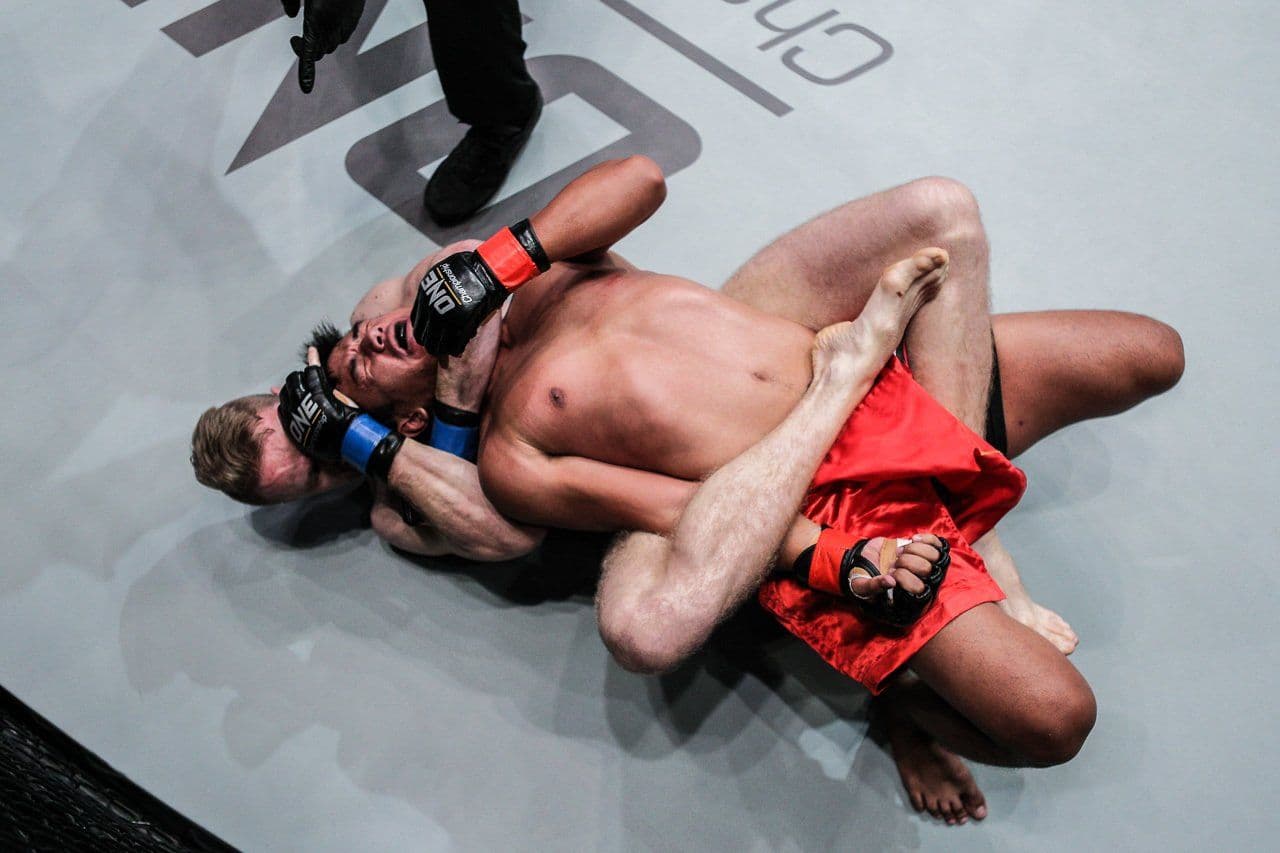
The Rear Naked Choke: Why Back Control Ends Fights
Quick answer: The rear naked choke (RNC) is a strangle applied from behind, with one arm wrapped around the neck so the elbow lines up under the chin. It's the highest-percentage submission in both grappling and MMA because it comes from back control — the one position where your opponent can't see you, grab you, or hit you. The choke is easy. Earning and keeping the back is the hard part.
If you only ever learned one submission, this would be the one. The rear naked choke has ended more MMA fights than any other submission, and it dominates grappling stats at every level. Understanding why tells you something important about how jiu-jitsu actually works.
Why this choke finishes more than anything else
Most submissions are a trade. Attack an armbar from guard and you give up position if it fails. Hunt a leg lock and your own legs are exposed on the way in.
The RNC has no trade. You attack it from behind your opponent, where they have almost nothing to offer back — no punches in MMA, no grips worth much, no view of what your hands are doing. If the choke fails, you're usually still on the back, free to try again. That asymmetry, more than any mechanical detail, is why it converts so often.
Back control comes first
The choke is genuinely simple. What's difficult is the position underneath it, and BJJ treats back control as the top of the positional food chain — above mount, above side control, above everything covered in the positional hierarchy.
Good back control has layers, and each one matters more than the choke itself:
The seatbelt is the anchor. One arm over the shoulder, one under the armpit, hands connected on the chest. With a solid seatbelt you can follow your opponent through every roll and scramble.
The hooks keep you attached. Your feet hook inside their thighs — not to squeeze, but to keep your hips glued to theirs so they can't slide down and away.
The body triangle is the upgrade. Locking your legs around their torso instead of using hooks trades mobility for crushing control. Higher belts live here.
Your chest stays welded to their back. Any daylight between you is space they'll turn into.
Beginners obsess over the choking arm. Experienced grapplers obsess over the seatbelt, because they know the choke arrives on its own once the control is real.
Blood choke vs air choke
This distinction matters for safety, so it's worth being precise.
A proper RNC is a blood choke: your forearm and bicep press on the sides of the neck, compressing the carotid arteries and reducing blood flow to the brain. It's relatively painless, works in seconds, and — when the tap is respected and the choke released immediately — is safe to train daily. Millions of these are applied in gyms every week without incident.
An air choke is what happens when the forearm ends up across the windpipe instead. It hurts, it takes far longer, and it's the mark of a sloppy angle rather than a different technique. If your training partner is coughing instead of tapping, your elbow isn't centered under their chin.
Either way, the rules are absolute: apply pressure gradually, release the instant you feel a tap, and never hold a choke on someone who's gone limp. Getting briefly choked unconscious does happen in training, and the standard response is immediate release — but the goal is that it never gets there.
Position before submission
You'll hear this phrase in your first month, and the RNC is its clearest proof. The most common way to lose the back isn't a slick escape — it's the attacker abandoning control to chase the neck.
The moment you release the seatbelt to dig for the choke, your opponent's hand-fighting gets easier and your connection gets worse. Strong back players are patient: they keep the seatbelt, trap one of the defender's arms when they can, and let the defender exhaust themselves before the choking arm ever slides in.
The hand fight is the real battle. Two of their hands defending one of your arms is a losing game for you; change the angle, trap a wrist, and it flips.
Defending it honestly
Tucking your chin is not a defense — it's a delay. It buys you seconds to do the actual work: control their choking hand with both of yours, get your shoulders to the mat on the side of their underhook arm, and clear the hooks so you can turn back into them.
And when the forearm is genuinely under your chin and the squeeze is on, tap. There's no toughing out a blood choke; there's only being awake or not. Nobody in the gym is impressed by the second option.
The takeaway
The rear naked choke finishes more fights than anything else in grappling, but the honest framing is that back control finishes them — the choke just signs the paperwork. Learn the seatbelt before the squeeze, value the position over the finish, and treat every choke you apply with the care you'd want on your own neck.
The best place to learn it is a good room
Chokes are learned from patient training partners and coaches who sweat the safety details. Both come with picking the right gym. Find a BJJ gym near you on Let's Roll →
FAQ
Why is it called a rear naked choke? The "naked" means no gi is involved — the choke uses only your arms, not cloth. It comes from the judo technique hadaka-jime, which translates to "naked strangle," and it works identically in gi and no-gi.
How fast does a rear naked choke work? A well-placed blood choke can produce unconsciousness in under ten seconds, which is exactly why you tap early. In training, taps come well before that point and pressure is applied gradually.
Is the rear naked choke dangerous to train? Trained properly — gradual pressure, immediate release on the tap — it's one of the safest submissions in BJJ, far gentler on the body than joint locks. The danger comes from ignoring taps or holding chokes too long, which good gyms treat as serious violations.
What's the best defense against the RNC? Fight the hands before the arm gets under your chin, and address the position, not just the choke — clear the hooks and turn toward your opponent. Once the forearm is fully across your neck, the correct defense is tapping.
Related Posts

Mikey Musumeci gives up the belt to make room for MMA
Musumeci is vacating his UFC BJJ title to focus on MMA training. What he is leaving, what continues, and why the transition matters.
IBJJF membership: finish the paperwork before the deadline
IBJJF membership and tournament entry are separate steps. Plan documents, professor approval, renewals, and junior accounts before registration closes.
Choosing a BJJ seminar worth your time and travel
Choose a BJJ seminar by the subject, teaching format, access, and total cost. Know what to ask the host before buying a ticket.
Comments (0)
Loading comments...