
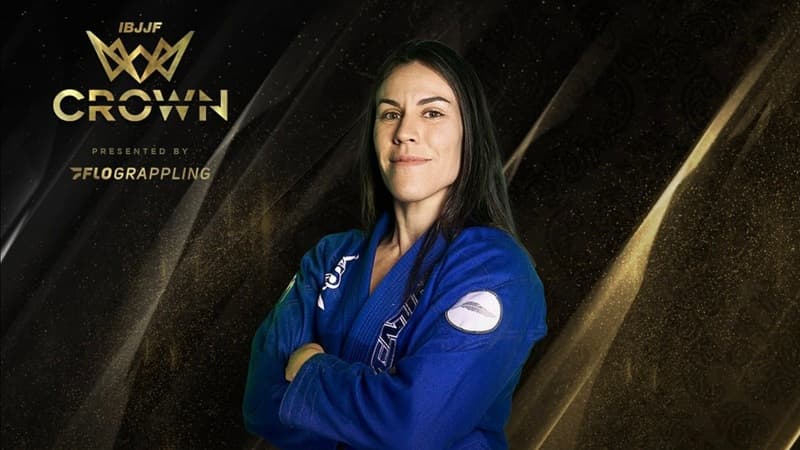
Luiza Monteiro's career doesn't fit a tidy ending
Quick answer: Luiza Monteiro won her third adult black belt world title in 2024, submitting every opponent before announcing a retirement from Grand Slam tournaments. The following year, the IBJJF recorded silver medals for her at both Pans and Worlds. Her career is better understood as a long series of competitive decisions than as a single farewell performance.
Four matches. Four submissions. At the 2024 Worlds, Luiza Monteiro gave a retirement story almost everything a sports writer could ask for: a champion, a gold medal, and an ending that appeared to arrive on her terms.
Then the results continued. That is the part worth keeping beside the photograph of the celebration. A career belongs to the person living it, and a good ending on Sunday does not sign a contract with the following season.
For anyone who knows Monteiro mainly from one highlight or a list of titles, the years around that championship offer a more interesting introduction. They contain a demanding ambition, an opponent who complicated it, a different outcome the next year, and more competition after the supposed final chapter.
Begin with the final, then look beyond it
The IBJJF's 2024 Worlds recap records Monteiro's third world title and her announcement that she was retiring from Grand Slam events. It also credits her with twelve black belt Worlds finals. The gold belonged to a much longer record of reaching the last match of the division.
That distinction matters. A title count gives the winners their due, but it can make every other season disappear. A final requires an athlete to reach it. Silver describes the result of the last match, not the absence of a competitive year.
Monteiro's record is an invitation to watch beyond the medal color. A viewer can appreciate the title without treating every earlier final as unfinished business that had value only because another gold eventually arrived. Those matches had opponents, decisions, and consequences of their own. The career becomes more interesting when all of them remain in view.
Her 2023 ambition had a specific shape
Before the 2023 Europeans, Monteiro told the IBJJF that her goal was to win all four major gi championships at lightweight: Europeans, Pans, Brazilian Nationals, and Worlds. The interview also recalled her 2019 European campaign, when she won medium-heavyweight gold and open-class silver. The new plan concerned a particular division and a complete season.
There is a useful difference between that kind of goal and a general intention to compete more. A calendar can answer it. Each event creates another result, and the goal remains visible even when the outcome changes. It doesn't depend on a spectator deciding that an athlete looked sufficiently motivated.
For an ordinary competitor, copying the volume would miss the point. A smaller version might be entering two selected events in the same division or returning to one tournament with a specific preparation change. The useful part is the precision. You can tell what you intended to do without having to manufacture a heroic explanation afterward.
One opponent helped keep the season complicated
By September 2023, the federation's Crown preview reported Monteiro's gold medals at Europeans, Pans, and Brazilian Nationals that year. It also recorded a Worlds loss to Brianna Ste-Marie, whom Monteiro had beaten roughly a month earlier at Brazilian Nationals. Two meetings produced different answers.
That is more useful than reducing a matchup to a permanent ranking of two people. A win tells you who won that match. It doesn't remove the next contest's uncertainty, and it doesn't make the other athlete's work irrelevant. Repeat opponents give a career continuity without guaranteeing that the same story will happen again.
For a viewer, this is where a pair of complete matches becomes more revealing than a compilation. Watch how each athlete tries to establish the first useful position. Notice what is contested early. Keep the result in mind, but resist reading every movement as proof that the eventual winner was always in control of the afternoon.
The four finishes deserve separate attention
The federation's submission breakdown lists a kimura, a mount choke, a triangle, and a toe hold in Monteiro's 2024 title run. The final finish came against Ste-Marie. A perfect submission rate is the headline, but the range of finishes gives a viewer several different things to study.
A submission label describes the ending of an exchange. It doesn't explain how an athlete obtained the angle or control that made the ending possible. The useful footage starts earlier, when both competitors still have choices. That is where a replay can become more than a few seconds of admiration.
Try a simple viewing exercise:
Watch the match once without stopping, so the overall contest remains clear.
On the second viewing, pause before the finishing position is established.
Identify the control that limits the defender's movement.
Rewind again if the entry still seems to have happened out of nowhere.
These are observation questions, not instructions to copy an advanced submission during the next open mat. Take the position to a coach if you want to understand how it fits your training and the rules you use.
A retirement announcement is a decision made in time
Sports coverage likes a final image because it makes the years before it easier to arrange. The last medal becomes the destination, the difficult seasons become obstacles, and the athlete's whole career appears to have been moving toward one photograph. Real calendars are less cooperative.
There is no need to guess why Monteiro later competed again. The public results establish that she did. They do not establish a private conversation, a change of heart on a particular morning, or a secret plan behind the earlier announcement. Those details would need her own account.
That leaves plenty to appreciate. A farewell performance can be significant even when it does not remain the last performance. The achievement doesn't shrink because the athlete returns. What changes is the description around it. A careful profile makes that adjustment instead of forcing later events to fit the older headline.
The next year's results belong in the same profile
Monteiro's IBJJF athlete record, listed under Luiza Costa, records second place at both the 2025 Pans and 2025 Worlds in the adult lightweight category. Those are results after the 2024 announcement. A current account that stops at retirement would leave out another season at the sharp end of the division.
It would also confuse two different claims: that a champion announced an intention to stop a particular circuit, and that she never competed there again. The first can be accurately reported without turning it into the second.
For fans, the lesson is practical rather than philosophical. Check the date on a profile before passing it along as the complete account of someone's career. Results pages are less dramatic than farewell videos, but sometimes the most interesting line is the small one that appears a year later. An updated record can change the opening paragraph without taking anything away from the original moment.
Watch a career in pairs of matches
One highlight is a good invitation. It is a poor substitute for the rest of the match, let alone the rest of a career. To get a better sense of a competitor, choose footage that creates a comparison instead of selecting only the cleanest finishes.
For Monteiro, the documented meetings with Ste-Marie provide one starting point. Another is to choose a match from the 2023 season and one from the following Worlds. You are looking for decisions under different circumstances, not trying to diagnose an entire personality from grips and posture.
Keep the notes small. Write down one entry that held your attention, one defensive response, and one sequence you couldn't explain. Bring the last question to class. A coach can help distinguish a repeatable detail from something that depends on timing or context you haven't yet learned to see.
Watching jiu-jitsu tournaments with that habit changes what holds your interest. You start noticing the work before the score or submission, and an unfamiliar athlete becomes worth following for a reason beyond their place on a podium.
Leave room for a career to keep changing
It is tempting to turn a champion's life into advice for everyone else in the gym. The temptation should have limits. A professional athlete's calendar, resources, and reasons for competing are not interchangeable with those of someone arranging training around a job or caring for a family.
What an ordinary practitioner can borrow is permission to describe the present accurately. A goal can belong to one season. A decision to compete less can be reconsidered. Returning does not require pretending that the earlier decision was insincere, and staying away does not require a public defense.
That is an interpretation of the record, not a claim about Monteiro's private reasons. Her actual decisions remain hers. The viewer's responsibility is simpler: follow the evidence, enjoy the matches, and avoid writing the last sentence before the results have stopped arriving.
Main photo: IBJJF / The Crown; 2023 promotional portrait, photographer not identified on source page.
The takeaway
Monteiro's 2024 Worlds run stands on its own: four finishes and a third title. Put it beside the surrounding seasons, though, and the profile becomes richer. Ambition, repeat opponents, and later results give the achievement a setting that a retirement headline cannot provide by itself.
Start with the matches that interest you, then look a year in either direction. The record will not always produce a neat rise, fall, and return. In this case, that untidiness is part of what makes the career worth following.
Take a better question to the mat
Find a local open mat, and ask your coach which part of a match study would be useful to explore in your regular training.
FAQ
How many adult black belt world titles did Luiza Monteiro have after 2024? The IBJJF described her 2024 lightweight victory as her third world title. Its event report also credited her with twelve black belt Worlds finals by that point.
Did Luiza Monteiro retire in 2024? She announced a retirement from Grand Slam tournaments after the 2024 Worlds. That announcement was not the end of her results on the circuit: the federation lists Pans and Worlds silver medals in 2025.
How did she win the 2024 Worlds final? The IBJJF's submission breakdown records a toe hold against Brianna Ste-Marie. It also records submissions in all four of Monteiro's matches during that title run.
Where should a new fan start watching her? Try a complete match from the 2024 Worlds, then compare it with an earlier meeting or another season. Focus on how positions develop before the finish rather than trying to copy every technique immediately.

Rafael Moura
Rafael Moura profiles competitors as people with lives outside the bracket. Some of those stories are comebacks. Most are not, and he does not force them.
Related Posts
Mikey Musumeci gives up the belt to make room for MMA
Musumeci is vacating his UFC BJJ title to focus on MMA training. What he is leaving, what continues, and why the transition matters.
IBJJF membership: finish the paperwork before the deadline
IBJJF membership and tournament entry are separate steps. Plan documents, professor approval, renewals, and junior accounts before registration closes.
Choosing a BJJ seminar worth your time and travel
Choose a BJJ seminar by the subject, teaching format, access, and total cost. Know what to ask the host before buying a ticket.
Comments (0)
Loading comments...