
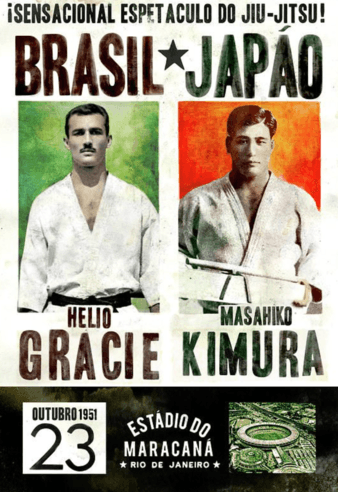
The Kimura: The Lock That Named Itself by Beating a Gracie
Quick answer: The kimura is a rotational shoulder lock secured with a figure-four grip on the wrist and forearm. It's named after judoka Masahiko Kimura, who used it to break Helio Gracie's arm in their famous 1951 match in Rio de Janeiro. It's also much more than a submission — the same grip controls posture, drives sweeps, and opens back takes, which is why modern grapplers treat it as a whole system.
Most techniques get named after what they look like. The kimura got named after a man — and a specific night in 1951 when he beat the co-founder of Brazilian jiu-jitsu in front of a stadium crowd.
It's one of the best-documented stories in grappling, and worth telling properly, because the lock's history explains a lot about how it's used today.
The night the lock got its name
In October 1951, Masahiko Kimura — regarded by many as the greatest judoka of his generation, possibly ever — faced Helio Gracie at Maracanã stadium in Rio de Janeiro, before a crowd reported in the tens of thousands.
The matchup was lopsided on paper. Kimura was younger, significantly heavier, and near the peak of an almost unbeaten judo career. The story — repeated so often it's practically canon — is that Kimura said if Helio lasted three minutes, he should consider it a victory.
Helio lasted far longer than three minutes. But in the second round, Kimura secured gyaku ude-garami — a reverse arm entanglement — and began rotating Helio's shoulder. Helio refused to submit. The arm broke, and his corner threw in the towel.
The Gracies, by every account, took the loss with respect. They named the technique after the man who used it, and "kimura" is what the grappling world has called it ever since.
It was the double wristlock first
Kimura didn't invent the lock. Catch wrestlers had used it for decades as the "double wristlock," and in judo it existed as ude-garami, an arm entanglement documented long before 1951.
That lineage still echoes. In 2000, Kazushi Sakuraba — a fighter steeped in catch wrestling — used the same lock to break Renzo Gracie's arm in Pride, another famous case of a Gracie refusing to tap to it. Different era, same mechanics, same lesson.
Whatever you call it — double wristlock, ude-garami, kimura — you're describing one idea: a figure-four grip that turns the shoulder past where it wants to go.
A control system, not just a submission
Here's what separates the modern kimura from simply knowing a shoulder lock: the grip is valuable even when the tap never comes.
The figure-four controls the whole shoulder line. Once you own someone's wrist and thread your other arm through, you can steer their upper body almost like a handle.
It converts to position. The "kimura trap" idea — popularized over the last decade or so — uses the grip to take the back, finish armbars, and hold pins, treating the submission as one exit among several.
It punishes common defenses. When someone grabs their own belt or pants to survive, the grip still lets you sweep, pass, or transition while both their arms are busy defending.
That's why coaches call it a system. A guillotine threat mostly ends when it's defended. A kimura grip keeps paying rent.
Where you'll meet it first
Without turning this into a tutorial, three places produce most kimuras. Side control and north-south, where your chest takes over the pinning work and frees both hands to hunt the figure-four. And closed guard, when your opponent makes the classic mistake of posting a hand on the mat — sitting up over that arm is many people's first-ever kimura.
The common thread: the kimura appears wherever an arm gets separated from a torso. Your job is mostly noticing. If you're still building your foundations, it sits comfortably alongside the staples in our beginner submissions guide.
The grip matters more than the crank
Beginners lose kimuras by yanking on the wrist with their arms. The finish actually lives in the body: elbow trapped tight to your chest, the right angle on the arm, rotation driven by your torso rather than your hands.
That's also what makes it safe to train. A slow, connected kimura gives your partner a long window to tap. A fast wrist-yank doesn't — which brings up the part that matters more than any technical detail.
Tap early — this one doesn't negotiate
The kimura's origin story is literally about what happens when someone refuses to tap to it. Shoulders don't give the same clean warning an elbow does; by the time it hurts sharply, you're already at the edge.
So tap early, and when you're the one attacking, apply it slowly. Nobody at your gym is Helio Gracie at the Maracanã with a family's honor on the line. It's Tuesday. Tap, reset, learn. That culture of early tapping is the only reason any of us gets to train this stuff for decades.
The takeaway
The kimura earned its name by beating a Gracie, but it earned its permanent place in grappling by being more than a submission — a grip that controls, sweeps, transitions, and occasionally finishes.
Learn the story, respect the shoulder, and treat the figure-four as a position in its own right. It'll be in your game at every belt.
Learn it with supervision
A lock with this much history deserves a coach who teaches it with control. Find a BJJ gym near you on Let's Roll →
FAQ
Why is the kimura called the kimura? It's named after Masahiko Kimura, the Japanese judoka who defeated Helio Gracie in Rio de Janeiro in 1951, breaking his arm with the lock when Helio refused to submit. The Gracies named the technique in his honor.
Is the kimura the same as the double wristlock? Mechanically, yes. Catch wrestlers called it the double wristlock and judo calls it ude-garami; "kimura" is simply the name that stuck in BJJ after the 1951 match.
Is the kimura good for beginners? Yes — it's usually among the first submissions taught, especially from closed guard and side control. Just apply it slowly in training, because shoulders give less warning than elbows.
What is the kimura trap? It's the idea of using the kimura's figure-four grip as a control position rather than only a finish — steering opponents into back takes, sweeps, and armbars while they're stuck defending the shoulder.
Related Posts

Mikey Musumeci gives up the belt to make room for MMA
Musumeci is vacating his UFC BJJ title to focus on MMA training. What he is leaving, what continues, and why the transition matters.
IBJJF membership: finish the paperwork before the deadline
IBJJF membership and tournament entry are separate steps. Plan documents, professor approval, renewals, and junior accounts before registration closes.
Choosing a BJJ seminar worth your time and travel
Choose a BJJ seminar by the subject, teaching format, access, and total cost. Know what to ask the host before buying a ticket.
Comments (0)
Loading comments...