
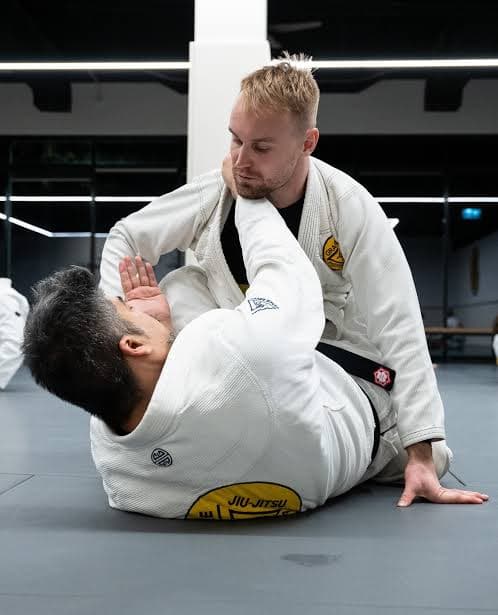
10 BJJ Submissions Every Beginner Should Know
Quick answer: The best beginner BJJ submissions are the high-percentage fundamentals: the rear naked choke, armbar, triangle choke, kimura, guillotine, americana, cross-collar choke, straight ankle lock, bow-and-arrow choke, and the omoplata. Learn a handful of these deeply rather than collecting dozens — they work at every level, from your first week to the black-belt divisions.
You don't need fifty submissions. You need a small set of reliable ones drilled until they're automatic. Flashy moves you saw online will fail you under pressure; clean fundamentals won't. Here are ten submissions every beginner should know, roughly in the order you'll actually use them, plus how to learn them safely.
1. Rear naked choke
The most reliable submission in all of grappling. From your opponent's back, you wrap the neck and squeeze — no gi grips required, which is why it works in gi, no-gi, and self-defense alike. If you master only one finish in your first year, make it this one, because the back is the most dominant position in BJJ and the rear naked choke is what makes it so feared.
2. Armbar
An armbar hyperextends the elbow joint. The classic versions come from mount and closed guard, and learning it teaches you the hip-and-leg positioning that quietly unlocks dozens of other attacks and sweeps. The armbar is a rite of passage — the move that makes a beginner realize legs can be as dangerous as arms.
3. Triangle choke
A choke using your legs around the opponent's neck and one of their arms. It looks intimidating and complicated, but it's pure leverage — the cleanest example of a smaller person strangling a larger one with almost no strength. Expect it to take a while to feel natural; the angle and the squeeze are subtle.
4. Kimura
A shoulder lock using a figure-four grip on the wrist. The kimura is endlessly versatile — available from guard, side control, half guard, and turtle — and even when you don't finish it, the grip is a powerful control and sweeping tool. It's one of the best "two-for-one" techniques for beginners.
5. Guillotine
A front headlock choke, often caught when an opponent shoots in for a takedown or drops their head while trying to pass. It's high-percentage, available from several positions, and genuinely useful in self-defense, which makes it a favorite first choke for many beginners.
6. Americana
A shoulder lock from side control or mount, sometimes called a keylock. It's mechanically simple and pins the arm to the mat, which makes it one of the very first submissions most beginners actually land in live rolling. A great confidence-builder.
7. Cross-collar choke
A gi choke using both of your opponent's lapels from inside guard or from mount. Beyond the finish itself, it teaches grip fighting and the core principle of attacking the neck with the collar — a skill that underpins a huge chunk of the gi game.
8. Straight ankle lock
A beginner-legal leg lock and your safe introduction to lower-body attacks. Learn it carefully: leg locks can damage a joint before you feel real pain, so apply slowly, never jerk, and always follow your gym's rules about which leg locks are allowed at your level.
9. Bow-and-arrow choke
A powerful gi choke from the back using the collar and one leg for leverage. It's one of the highest-percentage finishes in gi competition because it's extremely hard to defend once locked in — a natural next step after you're comfortable taking the back.
10. Omoplata
A shoulder lock applied with your legs from guard. Even when it doesn't finish, the omoplata is a superb sweep and control position, so it pays off twice. It also deepens your understanding of using your legs as arms — the heart of guard play.
How to actually learn these
Don't try to learn all ten at once. Pick two or three, drill them every session, and actively try to hit them in live rolling — even if you fail, the attempts teach you the setups. Depth beats breadth: a beginner with a genuinely good armbar and rear naked choke is far more dangerous than one who "knows" thirty moves but can't finish any of them under resistance.
A word on safety
Submissions are joint locks and chokes — they can hurt people. As you learn them, apply slowly and give your partner time to tap, especially with newer or smaller training partners. And learn to defend as much as you attack: recognizing a choke or armbar early and escaping it is what keeps you safe and makes you hard to finish. Position before submission, always — chasing a finish from a bad spot just gets you swept.
The takeaway
A small, sharp toolbox of fundamental submissions will carry you from your first month to your black belt. Drill the rear naked choke, armbar, and a couple of others until they're reflexes, respect the tap, and let the flashy stuff come later. The basics never stop working.
Find a gym with great fundamentals
Search BJJ gyms near you → — look for a real beginner curriculum where these get taught properly, in a logical order, and safely.
FAQ
What is the easiest BJJ submission for beginners? The americana (keylock) from side control and the rear naked choke from the back are usually the first finishes beginners land in live rolling, because they're mechanically simple.
Are leg locks safe for beginners? The straight ankle lock is beginner-legal, but leg locks can injure quickly and quietly. Apply them slowly, learn the mechanics from a coach, and always respect the tap.
How many submissions should I focus on? Two or three at a time. Drilling a small set until they're automatic beats dabbling in many you can't finish under resistance.
Should I learn submissions or escapes first? Escapes and survival first. A beginner who can't be submitted is ahead of one who only hunts finishes — defense buys you the time to develop your offense.
Related Posts

Mikey Musumeci gives up the belt to make room for MMA
Musumeci is vacating his UFC BJJ title to focus on MMA training. What he is leaving, what continues, and why the transition matters.
IBJJF membership: finish the paperwork before the deadline
IBJJF membership and tournament entry are separate steps. Plan documents, professor approval, renewals, and junior accounts before registration closes.
Choosing a BJJ seminar worth your time and travel
Choose a BJJ seminar by the subject, teaching format, access, and total cost. Know what to ask the host before buying a ticket.
Comments (0)
Loading comments...