
Is pulling guard bad for jiu-jitsu? Start with the rules.
Quick answer: Pulling guard is not automatically good or bad jiu-jitsu. Its value depends on the rules, the position you establish, and what you can do next. A competition strategy can be sensible while still leaving a training gap if you use it to avoid every standing exchange.
A guard pull can be legal, tactically useful, and boring to one spectator at the same time. Those statements do not cancel one another out.
The argument becomes unhelpful when legality, effectiveness, and entertainment are treated as the same question. Add a fourth question, what a student should practice over the next year, and an entire comment section can disagree without actually discussing the same thing.
Separate the decisions. First determine what the event rewards. Then examine the position you are choosing and the work you are neglecting. You can have a strong preference without pretending that preference is a universal rule of grappling.
The rule set puts a price on the choice
Under the IBJJF rule book, sitting or pulling guard without establishing a grip is a serious foul. A guard pull also interacts with the timing of an opponent's takedown and, in the gi, a pants grip. The useful lesson is that getting to the floor first does not settle every scoring question.
ADCC creates a different calculation. Its championship rules specify a negative point for voluntarily going from standing to a nonstanding position and remaining there for three seconds or more, subject to the applicable scoring phase and listed situations. Finals and qualifying rounds do not have identical negative-point timing.
These rule references were checked on October 10, 2026. Use the event's current rules and your specific division when preparing to compete; do not transfer a slogan about one organization to another tournament.
A tactic is partly a response to its price. If choosing bottom position costs a penalty, your plan must account for that cost. If the route is legal without that automatic cost, you still have to make the resulting position useful. Permission to sit is not a guarantee of a good guard.
The pull and the guard are separate skills
A student can have useful attacks from an established guard and still struggle to arrive there. In drilling, the partner begins within reach. In a match, the opponent may be moving away, changing angle, or attempting to pass before the position feels settled.
Treat the entry as something to practice in its own right. With a coach's guidance, identify the connection you need, the distance you want, and the response you expect when the other person resists. Keep the practice controlled; a surprise drop or jump is not a substitute for an agreed exercise.
Then inspect the first moment on the ground. Can you manage the opponent's distance? Are your frames or grips doing a job? Can you recover if the opponent circles rather than stepping into your preferred position?
This is where a broad argument becomes a useful lesson. Instead of asking whether pulling is respectable, ask whether your particular pull reliably creates a position you understand. If it does not, the problem may be the entry rather than the entire idea of playing guard.
Choosing bottom should lead somewhere
A tactical guard pull should connect to a next action. That does not mean forcing an immediate submission attempt. It means knowing what response you are trying to create and how you intend to make progress from it.
For example, a training goal might be to establish a particular open guard, disrupt balance, and come on top when the partner gives the relevant reaction. Another session might focus on retaining that guard while the passer changes direction. Those are different tasks, and both are more informative than simply surviving the round underneath.
If the opponent refuses the exchange you want, your plan needs an alternative. That may involve changing grips, changing guard, or standing back up when the situation permits. A chosen position does not have to become a permanent address.
Have your coach watch the first exchange after the pull. Ask what the opponent is free to do that you have not accounted for. The answer may be a small positional correction. It may also reveal that your preferred entry is poorly matched to this opponent or this scoring situation.
A competition plan can conceal a training omission
There is a difference between selecting a strong option for Saturday and using that option to avoid a difficult skill indefinitely. A tournament allows you to concentrate on winning the match in front of you. A training program has a longer responsibility.
If you always pull before anyone can establish standing contact, you may be giving yourself very few opportunities to practice that contact. The solution does not have to be abandoning guard. It can be a separate block in which the start and objective require standing work.
Agree on that block with your partner. One possibility is a supervised exchange that resets after a controlled takedown or a clearly defined entry. Another is beginning from a particular grip or clinch position so the practice addresses one problem rather than an unrestricted contest.
Keep the distinction visible in your notes. Your competition preference can remain guard while your training priorities include standing defense and entries. A favorite position is useful. A favorite position that becomes an excuse never to learn anything before it is less useful.
The top player has an assignment too
A guard pull does not end the technical conversation. It gives the top player a passing problem. Complaining about how the exchange began does not explain how to manage the legs, grips, and distance now in front of them.
That does not require the top player to accept every invitation or enter every entanglement. They can make tactical choices of their own within the rules. But the choices should be trained, not replaced by an assumption that the bottom player has somehow forfeited the right to a difficult position.
A useful practice arrangement gives both partners an objective. The guard player works to establish a meaningful connection; the passer works to deny it and progress. Reset when the agreed condition occurs, rather than letting every repetition drift into a different exercise.
This also makes feedback more precise. A passer can say which grip was difficult to clear or which recovery stopped the pass. The guard player can identify where distance was lost. Both leave with something to investigate, which is considerably more useful than winning the argument about who should have wrestled.
Entertainment is a separate design question
A viewer is entitled to prefer standing exchanges. Another may enjoy a long guard battle. Neither preference requires a technical defense disguised as a declaration about the sport's purity.
If an organizer wants a different pattern of matches, the relevant tools include rules, scoring, match length, and how the event is presented. Athletes then make decisions inside those conditions. Asking them to ignore a legal advantage for an unwritten entertainment standard creates a vague assignment.
For a spectator, learning the scoring situation can make a choice more intelligible even when it does not make the choice more enjoyable. You can understand why an athlete accepted a cost and still wish the exchange had developed differently.
Keep that distinction when discussing a local teammate's match. Their event is not a personal obligation to produce the kind of highlight you prefer. Ask what they were trying to accomplish and whether it worked. Technical criticism becomes much sharper once it addresses the actual decision instead of an imagined duty to entertain everyone watching.
Test your preference with a small training comparison
You do not need to settle the sport-wide debate before improving your own start. Ask a coach to help compare two approaches over a few controlled rounds: one built around your preferred guard entry, the other requiring a standing exchange before the next phase.
Record a limited set of observations:
The first position you actually established, rather than the one you intended.
The scoring or penalty consequence under the rules you are practicing.
The point where your next action became unclear.
Do not turn a handful of rounds into a scientific verdict. Partners, starting conditions, and fatigue can vary. The purpose is to identify a training problem you can describe clearly enough to work on.
If you are preparing for a specific event, find it through the tournament listings, then read the organizer's rules directly. Build the comparison around that assignment. The most useful answer may be that pulling remains your best match option while your standing work deserves more deliberate practice during the rest of the month.
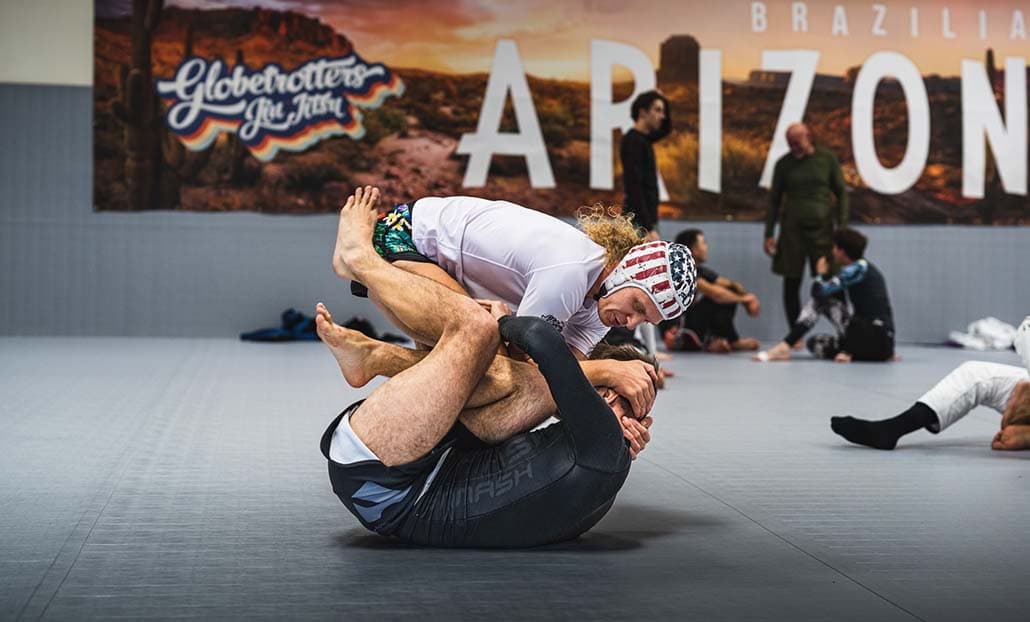
Main photo: BJJ Globetrotters; archive training photograph, illustrative.
The takeaway
Pulling guard is a decision whose quality depends on its context. Check the rules, practice the entry, and know what you want to do after reaching the floor. A legal route into a weak position is still a weak plan.
Keep competition strategy separate from long-term training. You can choose guard for a match and continue learning to stand, defend, and come on top. The sport does not need your entire identity declared before the next round starts.
Find a room for the work you need
Use the gym directory to explore training options, then ask about the instruction and practice format available for your goals.
FAQ
Is pulling guard illegal in BJJ? Not universally. The rules governing the entry, grips, penalties, and scoring vary by organization and division. Check the rule book for the event you plan to enter.
Does ADCC always penalize a guard pull immediately? The applicable phase and match format matter. ADCC's published rules distinguish negative-point timing in qualifying rounds and finals, so a blanket statement about every moment is misleading.
Should beginners avoid guard pulling? Beginners should learn controlled entries and the positions that follow under instruction. A preference for guard should not eliminate all practice of standing skills, but the coach can organize those tasks separately.
Does a good guard make takedown practice unnecessary? No. A strong guard can support a competition plan while standing exchanges remain a useful training priority. Choosing an option for a match is different from excluding a skill from your development.

Nina Okada
Nina Okada explains positions the way a good training partner does: one problem at a time, with the limits of the explanation said out loud. She is careful about the difference between what footage shows and what it only suggests.
Related Posts

Mikey Musumeci gives up the belt to make room for MMA
Musumeci is vacating his UFC BJJ title to focus on MMA training. What he is leaving, what continues, and why the transition matters.
IBJJF membership: finish the paperwork before the deadline
IBJJF membership and tournament entry are separate steps. Plan documents, professor approval, renewals, and junior accounts before registration closes.
Choosing a BJJ seminar worth your time and travel
Choose a BJJ seminar by the subject, teaching format, access, and total cost. Know what to ask the host before buying a ticket.
Comments (0)
Loading comments...