
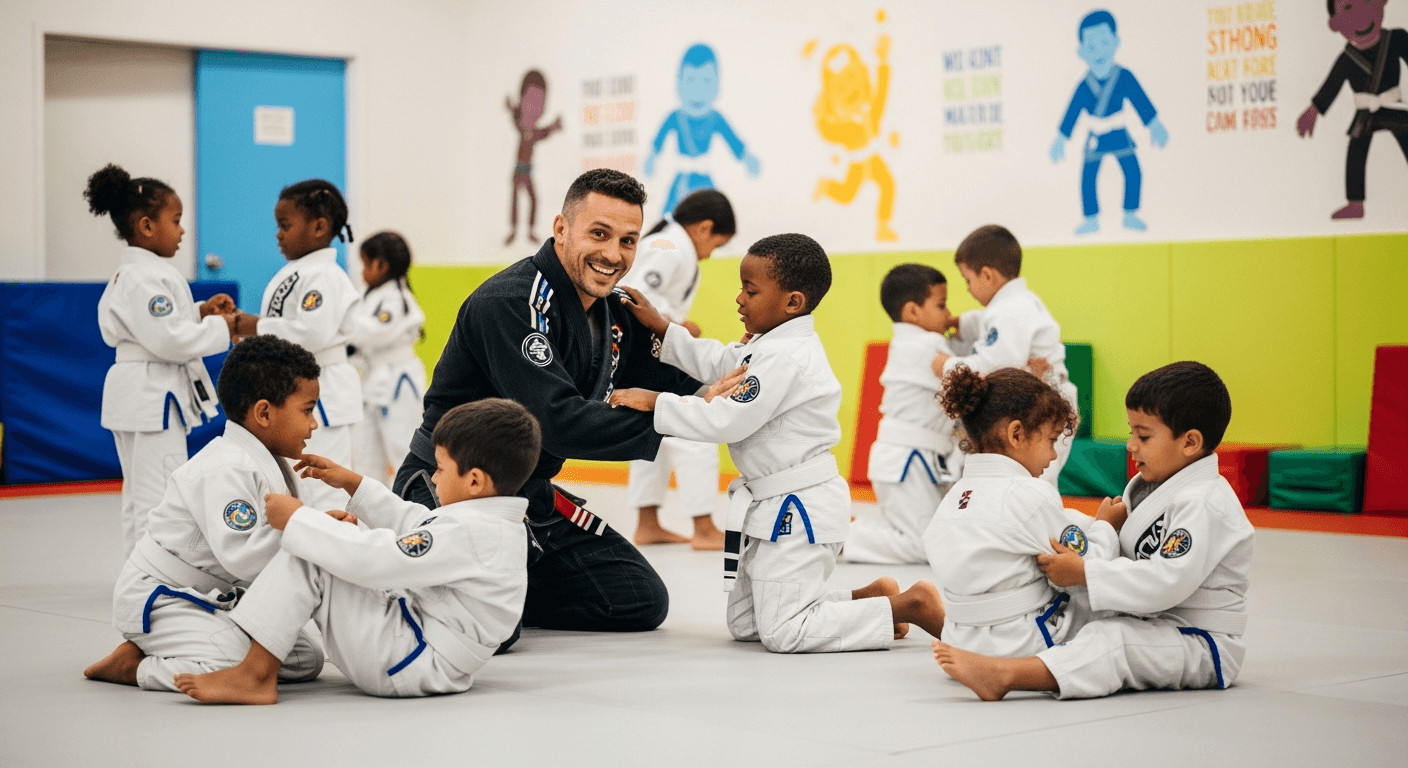
Kids BJJ — How to Pick a Program That's Actually Good
I've put my kids through BJJ at three different gyms across two cities. The differences between programs are enormous. The marketing material is identical. This is what to actually look for.
What a kids BJJ program is supposed to do
A good kids BJJ program produces:
A child who can defend themselves if a bigger kid puts hands on them in a hallway. Realistic, not theatrical.
Comfort with physical contact. Most kids today are touch-averse in ways that don't help them at recess. Grappling fixes that fast.
A specific kind of confidence — the quiet kind that comes from knowing you can handle yourself, not the loud kind from being praised.
Friends, ideally a few who are not the same friends from school.
A long arc through teenage years where they have a sport that doesn't require running fast or being tall.
What a kids BJJ program is not supposed to do:
Make your child a world champion at age 9
Replace your parenting
Be daycare with mat space
If a program's pitch is "we'll instill discipline and respect in your child" with a slideshow of kids saluting their instructor, that's a karate-school sales template overlaid on BJJ. Be skeptical.
What the schedule should look like
A real kids BJJ program offers, at minimum:
Three classes a week (more is better, but three is the floor)
Age divisions: typically Little Tigers (4–6 or 5–7), Kids (7–10 or 8–11), Teens (12–15). A program that puts a 5-year-old in the same class as a 13-year-old is not a real kids program.
Belt-promotion criteria visible somewhere — wall, website, parent handbook. If you can't find out how kids advance, that's a flag.
A trial week or first-class-free policy. They want you in the door; you want to see the room before committing.
The single biggest schedule mismatch: programs that only run kids classes once or twice a week. Twice a week is fine for a hobby. It's not enough for actual skill development. If your child likes it, they'll want to go more — and "we only run kids on Tuesdays" caps that.
What a good class actually looks like
Show up early and watch a class before signing your child up. Things to look for:
Warm-up that the kids actually do. Five-year-olds running in a circle and falling down is normal. Twelve-year-olds standing around while one coach lectures is a yellow flag.
Drilling that's age-appropriate. Little Tigers should be playing structured games that teach a single position or movement. Kids 8–11 should be drilling specific techniques. Teens should be drilling techniques and doing structured rolling. If everyone is doing the same thing regardless of age, the curriculum isn't real.
Rolling for older kids. By age 8 or 9, structured rolling (with time limits, weight-matched partners, supervised) is normal and important. A program that only does drilling and never lets kids roll isn't producing practitioners — it's producing kids who know moves on a cooperative partner.
Discipline that's calm. Good kids coaches correct behavior firmly but without yelling. Yelling instructors are a red flag in any martial art. Kids learn to grapple from quiet, patient, consistent coaches.
Parents on the wall, not on the mat. Healthy programs keep parents off the training area. You watch from the side. You don't coach from the side. (This will be hard. Do it anyway.)
The belt system for kids
Kids' BJJ has its own belt progression — white, gray, yellow, orange, green — that runs separately from the adult system. Most kids cycle through stripes within each color before earning the next belt. The full kids' curriculum typically goes from ages 4 to 16.
A few realities:
The IBJJF kids' belt sequence is the standard. Most other gyms recognize it. Some gyms invent their own kids' belts — fine, but the IBJJF standard is more portable.
Promotions happen more often than adults. A young child might pick up a stripe every 3–6 months. That's intentional — kids need more visible progress markers.
Transition to adult belts at 16. When a teen crosses 16, they're moved into the adult system. A 15-year-old green belt becomes a 16-year-old blue belt (or in some lineages, a white belt who graduates faster). The transition is a coaching call.
Red flags
Things that should make you walk out:
A "no-contact" BJJ program for kids. BJJ is a contact sport. A program that's been sanitized into a series of cooperative drills with no real grappling isn't BJJ.
A program that promotes children to high belts very quickly. A 6-year-old green belt is suspicious. A 12-year-old "junior black belt" is invented (the adult system doesn't promote to black under 16).
An instructor who isn't visibly engaged with the kids. If the coach is on a phone behind the desk while an assistant runs class, the program quality is whatever that assistant brings.
Long-term contracts (12-month minimum) for kids' programs. Skip these. Kids change minds about activities — month-to-month is the right commitment level.
A "Black Belt Club" upsell that costs significantly more than the regular program. This is a karate-school revenue model that some BJJ gyms have copied. Skip it.
How long it takes
Kids' BJJ progression is slower than adult BJJ in calendar time, but the cumulative learning is enormous. Realistic expectations:
After 6 months: comfortable in a basic position, can demonstrate a simple submission, knows mat etiquette
After 1 year: rolling under supervision, has a few favorite techniques, knows partner safety
After 2 years: competing in local tournaments if interested, working through the kids' belt system
After 4 years (assuming continuity): solid kids/teen practitioner, ready to start cross-training with adult classes around age 14–15
The kids who stick with it through teenage years often become some of the best adult competitors. The early years compound.
Will my child be safe?
Safer than at the playground. Two relevant facts:
BJJ has the lowest injury rate of any major combat sport. The whole framework is built around tapping out before damage happens.
Kids' BJJ specifically excludes the riskier techniques (no heel hooks, no neck cranks, no spinal twists). Submissions are taught carefully and supervised.
What does happen: mat burn, occasional bumps, very occasional minor sprains. Comparable to any group sport.
What rarely happens: concussions, broken bones, serious joint injuries. Compared to football, soccer, or wrestling at the same age, BJJ injury rates are dramatically lower.
Picking the program
Two practical filters:
Drive time matters. A great program 45 minutes from home is worse than a good program 15 minutes from home. You'll attend the closer one consistently. Closer beats marginally better.
Watch a class. Every BJJ gym worth choosing will let you observe a class. Take 30 minutes, sit on the parent benches, watch one full class. You'll know within 20 minutes whether this is a real program.
Once your child is enrolled, your only job is to bring them and watch quietly. Don't coach. Don't grade their technique afterward. Don't pump them for what they learned. Let the room work.
If you're hunting for a program, find kids programs by city — gym profile pages list age divisions and kids-class schedules. Reading the how to choose your first BJJ gym guide also helps; many criteria translate to picking a kids' program.

Elena Torres
brown Belt
Brown belt and former sports journalist covering the BJJ competition circuit and gym culture.
Related Posts

Craig Jones's Mexico gym: the Zamaya plan in Tulum
Craig Jones's Mexico gym announcement places B-Team at Zamaya in Tulum. Read the July 2026 plans and the details visiting grapplers should confirm.
Cobrinha's 2017: five major titles at 37
Cobrinha's 2017 season brought five major titles at age 37. Follow his gi and ADCC results, the Mendes rivalry, and the wrestling work behind that run.
Rafael Mendes: six Worlds titles and a life after competing
Rafael Mendes won six featherweight Worlds titles and retired at 27. Explore his ADCC rivalry with Cobrinha and the academy he helped build.
Comments (0)
Loading comments...