
How BJJ Community Actually Works (And How to Find Yours)
The first time someone calls you "their training partner," you'll notice the word change. It's not "friend from the gym" or "guy I roll with." It's a category of its own. Welcome to the strange, durable, low-key social structure of jiu-jitsu.
What a "team" actually is
In BJJ, "team" is a loaded word. It can mean three different things depending on who's talking.
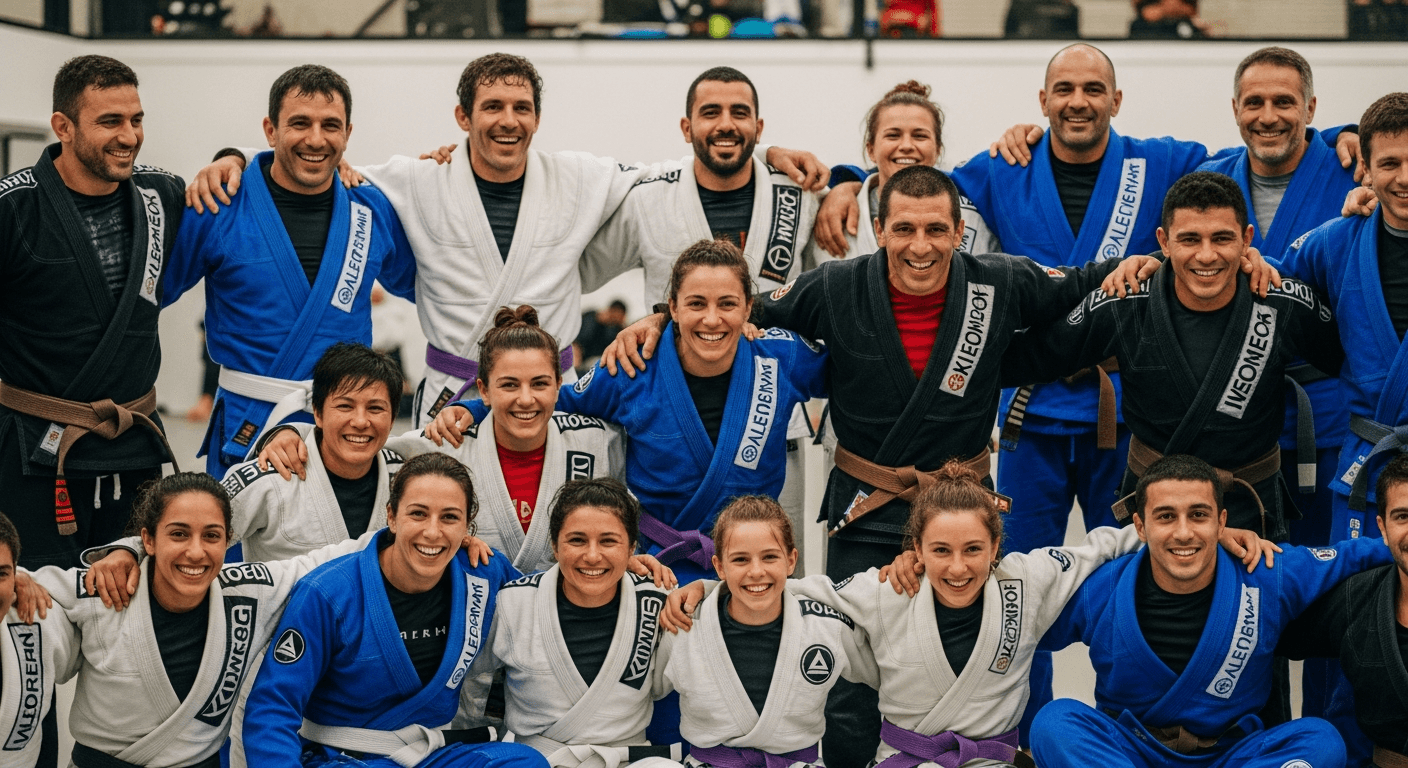
The smallest unit is the people you regularly train with at your home gym. Forty to a hundred practitioners across all schedules. You won't know all of them, but you'll see the same forty faces in your usual classes. These are your training partners — the ones whose grips you learn, whose triangles you anticipate, whose injuries you ask about.
The next level out is the affiliation. If you train at a Gracie Barra school, you're part of GB worldwide. That means seminars, competitions where you wear the team patch, and — practically — that you can drop in at almost any GB gym anywhere and be treated as family. Alliance, Atos, Renzo Gracie, Carlson Gracie, Checkmat, and 10th Planet all work similarly.
The largest sense is the whole BJJ community — strangers you've never met who train this thing you train. The mat acquaintance you make in your first year is fundamentally similar to the mat acquaintance someone made in 1995 at the original Gracie Academy. The bond crosses generations.
How friendships form on the mats
Mat friendships work differently than other friendships. They start without small talk. They start with a roll.
You'll meet someone who is bigger than you, or older than you, or younger than you, or from a wildly different professional background, and within thirty minutes of grappling each other you'll know each other better than coworkers do after a year. There's no faking it. Either you're trying or you're not. Either you're being safe with your partner or you're not.
After the roll you have something concrete to talk about — what worked, what didn't, what they did that surprised you. The conversation has built-in subject matter. That's why mat friendships skip the awkward first phase.
Most BJJ practitioners can name 5–10 people they consider real friends who they met through training. Many can name more. It's why people don't quit even when their bodies hurt and their schedules are wrecked — the social cost of leaving the room is higher than the physical cost of staying.
Why community matters more than instruction
This is a contrarian take, but I'll defend it: at most gyms, the community matters more than the instruction.
The "best instruction" gap between gyms — between a great coach and a merely competent coach — is real but smaller than you'd think after the first year. After your first 18 months, most of your progress comes from training partners, not from technique demonstrations. The training partner who shows you what they figured out yesterday at lunch is teaching you more than the formal class often does.
A gym with okay technique and an excellent community will produce better practitioners over five years than a gym with world-class technique and a cold culture. The community is what keeps you on the mats long enough for the technique to compound.
Finding your community
A few practical things that help build mat friendships faster:
Show up consistently to the same class times. Even at a big gym, the noon class and the 7pm class draw mostly different rosters. Pick one or two windows and become a regular face. Familiarity does most of the work.
Go to open mat. Open mat is the most social hour at most gyms — looser, more cross-belt-mixing, more time to actually talk. If you only do scheduled classes, you'll know the technique but not the people.
Travel and visit other gyms. Drop-in etiquette gets covered elsewhere, but the social benefit is huge — every drop-in is a chance to add 2–3 mat contacts you'll keep up with online.
Compete (even locally). A weekend competition trip with three teammates does what a year of polite class chat couldn't. Shared travel + shared nerves + shared celebration = bond.
Don't network. Train. People who show up at a gym hoping to "make connections" stand out negatively. The friendships form when you're focused on the training, not on the networking. Trust the format.
When you find the right room
You'll know when you're in the right gym. Signs:
You skip a class for a legitimate reason and three different teammates text you to ask where you were.
You travel for work and a fellow gym member messages you about gyms to visit in the city you're going to.
You get hurt and someone visits you at home unprompted.
You find yourself defending your gym to outsiders without thinking about it.
You start dating someone and want to bring them to a tournament.
If none of that has happened after a year at a gym, you might be at the wrong gym. The community signals are honest — they're either there or they aren't.
The dark side, briefly
A few honest realities about BJJ communities:
Gyms have politics. Some are healthy, some aren't. Personality conflicts, instructor splits, ex-couples training together — all real. Watch how the room handles tension.
Cliques exist. Most gyms have a competition team that's tighter than the rest. If you're not on the competition team and you're not making friends, sometimes that's the explanation.
Some gyms are cults. A small minority of BJJ schools fall into "you can only train here, no visiting other gyms, the head instructor is god" territory. Avoid. Healthy gyms encourage cross-training.
Sexual harassment happens. Less than in many industries, but it's not zero. Gyms with good cultures handle it visibly. Gyms with bad cultures hide it. Pay attention.
The community is the best part of BJJ when it works. When it doesn't, leaving is the right answer.
What to do this week
If you're new and haven't found your people yet:
Pick your next four classes. Same time, same day each week. Become a regular face.
Find a Saturday open mat in your city. Even at a different gym. Go once a month.
After a roll, ask your partner one specific question about what they did. Most mat friendships start with one specific technical question.
Show up to the next gym social event. Tournament viewing party, post-promotion dinner, whatever. The team is partly built outside the mat.
If you're still picking a gym and community matters to you (it should), read the how to choose your first BJJ gym guide — the section on culture is where the actual filter is.

Elena Torres
brown Belt
Brown belt and former sports journalist covering the BJJ competition circuit and gym culture.
Related Posts

Craig Jones's Mexico gym: the Zamaya plan in Tulum
Craig Jones's Mexico gym announcement places B-Team at Zamaya in Tulum. Read the July 2026 plans and the details visiting grapplers should confirm.
Cobrinha's 2017: five major titles at 37
Cobrinha's 2017 season brought five major titles at age 37. Follow his gi and ADCC results, the Mendes rivalry, and the wrestling work behind that run.
Rafael Mendes: six Worlds titles and a life after competing
Rafael Mendes won six featherweight Worlds titles and retired at 27. Explore his ADCC rivalry with Cobrinha and the academy he helped build.
Comments (0)
Loading comments...