

How Often Should You Train BJJ? A Practical Guide
This is the question I get asked more than any other: "Coach, how many times a week should I train?" The answer isn't a number. It's a framework.
I've seen two-day-per-week hobbyists develop beautiful BJJ over years of patient, consistent work. I've also seen six-day-a-week grinders burn out inside of a year, their bodies wrecked and their motivation gone. Frequency matters less than sustainability, and sustainability depends on your goals, your recovery capacity, and the rest of your life.
Training Frequency by Experience Level
Absolute Beginners (0–6 Months)
Two to three sessions per week is the sweet spot. Your body is adapting to a completely new type of physical stress — muscles you didn't know existed will be sore, your grip will fatigue after ten minutes, and your nervous system needs time to process new motor patterns.
At this stage, more isn't better. Three high-quality sessions with adequate recovery will develop your skills faster than five sessions where you're exhausted and sloppy by Wednesday. Your body needs time between sessions to repair tissue and consolidate learning.
Intermediate (6 Months – 2 Years)
Three to four sessions per week. Your body has adapted to the baseline physical demands, and you can handle more volume without breaking down. This is the stage where adding a fourth day — especially a drilling-focused or open mat session — accelerates progress noticeably.
If you train four days, make at least one a lighter session focused on technique review and positional drilling rather than hard sparring. Your connective tissue — tendons, ligaments, cartilage — takes longer to adapt than muscle, and overloading it too early leads to chronic issues.
Advanced (2+ Years)
Four to six sessions per week, depending on intensity management. Advanced practitioners can train at higher frequencies because they know how to moderate their rolling intensity. A five-day training week might include two hard sparring days, two drilling-focused days, and one open mat with flow rolling.
The key at this level is periodization — varying intensity across the week rather than going 100% every session. Even professional competitors don't go hard every day. They alternate between technical sessions, hard rounds, and recovery days.
Factors That Affect Your Optimal Frequency
Age
Recovery slows with age. A 22-year-old college student can train five days a week and bounce back by Monday. A 45-year-old professional with family obligations might find three days sustainable and four days risky without careful intensity management.
This isn't a limitation — it's reality. Adjusting frequency to match your recovery capacity prevents burnout and injury.
Training Intensity
Not all sessions are equal. A 90-minute session with thirty minutes of hard sparring taxes your body differently than a 60-minute drilling class. If you're training high-intensity sessions, you need fewer of them per week. If your sessions are technique-heavy with light rolling, you can train more frequently.
Other Physical Activity
If you're also lifting weights, running, playing other sports, or doing physically demanding work, your BJJ frequency needs to account for total training load. Your body doesn't distinguish between stress sources — a hard deadlift session on Monday and a hard rolling session on Tuesday create cumulative fatigue.
Sleep and Nutrition
Recovery happens during sleep and is fueled by nutrition. If you're sleeping six hours a night and eating poorly, three sessions per week might be your ceiling. Fix your sleep and nutrition, and your recovery capacity expands — allowing more training volume without breakdown.
Signs You're Overtraining
Persistent fatigue that doesn't improve with a rest day
Decreased performance — techniques you normally execute cleanly start failing
Chronic joint pain that worsens instead of improving between sessions
Irritability, mood changes, or loss of motivation to train
Frequent illness — your immune system is compromised from excessive stress
Sleep disturbances despite being physically exhausted
If you notice three or more of these signs, take a full week off. Not a reduced schedule — a complete break. Your body needs to reset, and your mind needs to remember why you train.
Signs You Could Train More
You feel fully recovered within 24 hours of your last session
You're bored or frustrated by the gaps between training days
Your technique plateaus despite consistent attendance
You have energy and motivation to spare after class
If these describe you, consider adding one session per week. A drilling-focused class or an open mat session is a low-risk way to increase volume without dramatically increasing intensity.
The Consistency Principle
The single most important factor in BJJ development isn't frequency — it's consistency. Two sessions per week for a year (104 sessions) will develop better BJJ than five sessions per week for three months followed by months of missed training (roughly 60 sessions).
Pick a frequency you can sustain for years. Not months — years. BJJ rewards patience and persistence more than any other attribute. The black belts you admire didn't get there through six-week training camps. They got there through decade-long consistency.
Building Your Weekly Schedule
Here's a practical template for a four-day training week:
Monday: Regular class — technique + rolling
Tuesday: Rest or light mobility work
Wednesday: Regular class — technique + rolling
Thursday: Drilling-focused session (technique review, positional sparring)
Friday: Rest
Saturday: Open mat — flow rolling and working new techniques
Sunday: Rest or active recovery (walking, stretching, yoga)
Adjust based on your gym's schedule and your personal recovery. The principle remains: alternate hard and easy days, include at least one full rest day, and listen to your body.
Active Recovery: What to Do on Off Days
Rest days don't mean complete inactivity. Active recovery — light movement that promotes blood flow without adding training stress — helps you recover faster and feel better between sessions.
Effective active recovery activities for BJJ practitioners include yoga or mobility work focused on hips and shoulders, light swimming, walking, foam rolling, and stretching routines. These activities reduce muscle soreness, maintain flexibility, and keep your body prepared for the next training session.
What doesn't count as active recovery: another hard sparring session, intense weightlifting, or any activity that leaves you more fatigued than before. The purpose of recovery is to come back stronger for your next training day, not to squeeze in extra work.
Some practitioners use their off days for mental training — watching competition footage, studying instructional content, or visualizing techniques. This keeps your mind engaged with BJJ without adding physical stress. Even ten minutes of focused video study on a rest day can accelerate your learning curve.
The best rest day routine is one you actually do consistently. Elaborate recovery protocols that you abandon after a week are less valuable than a simple ten-minute stretching routine you maintain for months. Start small, build habits, and let your recovery practice grow alongside your training.
To find the right training schedule and explore gyms near you, use our academy search tool. And keep track of your training consistency with the BJJ passport — seeing your session history is a powerful motivator.
Supplement your regular training with open mat sessions on weekends for additional volume without the structure of a full class.
Nutrition and Training Frequency
Your diet significantly impacts how often you can train effectively. BJJ demands both endurance and strength, which means your body needs adequate protein for muscle repair, carbohydrates for energy, and healthy fats for joint health and hormone production. Under-eating is a common mistake among practitioners who train frequently — it leads to fatigue, poor recovery, and increased injury risk.
As a general guideline, practitioners training four or more times per week should prioritize a post-training meal within two hours of rolling. This meal should include protein (twenty to forty grams) and carbohydrates to replenish glycogen stores. Hydration is equally critical — most grapplers underestimate how much fluid they lose during a hard session, especially in heated training rooms. A simple rule: weigh yourself before and after training. For every pound lost, drink sixteen ounces of water to rehydrate fully.
Signs You're Overtraining
BJJ is addictive, and overtraining is common among enthusiastic practitioners. Watch for these warning signs: persistent fatigue that doesn't improve with a night's sleep, decreased performance despite consistent training, irritability and mood changes, frequent minor injuries or lingering soreness, and loss of motivation for something you normally love.
If you recognize three or more of these signs, reduce your training volume by fifty percent for one to two weeks. Most overtraining symptoms resolve quickly once you give your body adequate recovery time. The hardest part isn't the physical rest — it's the psychological discomfort of feeling like you're falling behind. You're not. You're investing in sustainable, long-term training capacity.
Many experienced practitioners build deload weeks into their schedule proactively — every fourth or fifth week, they reduce intensity and volume regardless of how they feel. This preventive approach avoids the crashes that reactive rest addresses.
The Role of Periodization
Serious practitioners can benefit from periodization — structuring training in cycles of varying intensity and focus. A simple approach divides your training into three phases that repeat every eight to twelve weeks.
During the building phase (four to six weeks), you increase training volume gradually. Add an extra session per week, drill more aggressively, and push your conditioning. During the peak phase (two to three weeks), you're at your highest volume and intensity. If you compete, competitions fall here. During the recovery phase (one to two weeks), you reduce volume significantly. Light rolling, drilling, and flexibility work replace hard sparring.
This cyclical approach prevents the slow accumulation of fatigue that leads to overtraining and injuries. Without periodization, many committed practitioners train at the same moderate-to-high intensity year-round, which eventually produces diminishing returns. Your body adapts to constant stimulus. Periodization introduces the variation needed to keep making progress.
You don't need a formal plan or a sports science degree to periodize. Simply being aware of your energy levels, adjusting training intensity week to week, and building in deliberate recovery periods puts you ahead of most recreational grapplers in terms of training sustainability.
Frequently Asked Questions
Can I train BJJ every day?
Physically, some advanced practitioners do train six or seven days a week — but they carefully manage intensity, alternating between hard sparring, drilling, and recovery sessions. For most people, daily training without intensity variation leads to overtraining, burnout, or injury within months.
Is twice a week enough to improve?
Absolutely. Two consistent sessions per week is enough to make meaningful progress, especially for beginners. The key is consistency over months and years. You may progress more slowly than someone training four times a week, but you'll still develop a strong foundation.
Should I supplement BJJ training with weightlifting?
Strength training can benefit your BJJ by improving power, injury resilience, and overall athleticism. Keep it focused on compound movements — deadlifts, squats, pull-ups, rows — and avoid excessive volume that interferes with your recovery from BJJ. Two to three lifting sessions per week is usually sufficient.

Marcus Delgado
black Belt
Black belt with 18 years on the mats. Head instructor and lifelong student of the gentle art.
Related Posts

Evening BJJ and bedtime: make room for both
Late BJJ class does not have to consume the whole night. Plan the commute, food, laundry, and screen time around the sleep window you actually have.

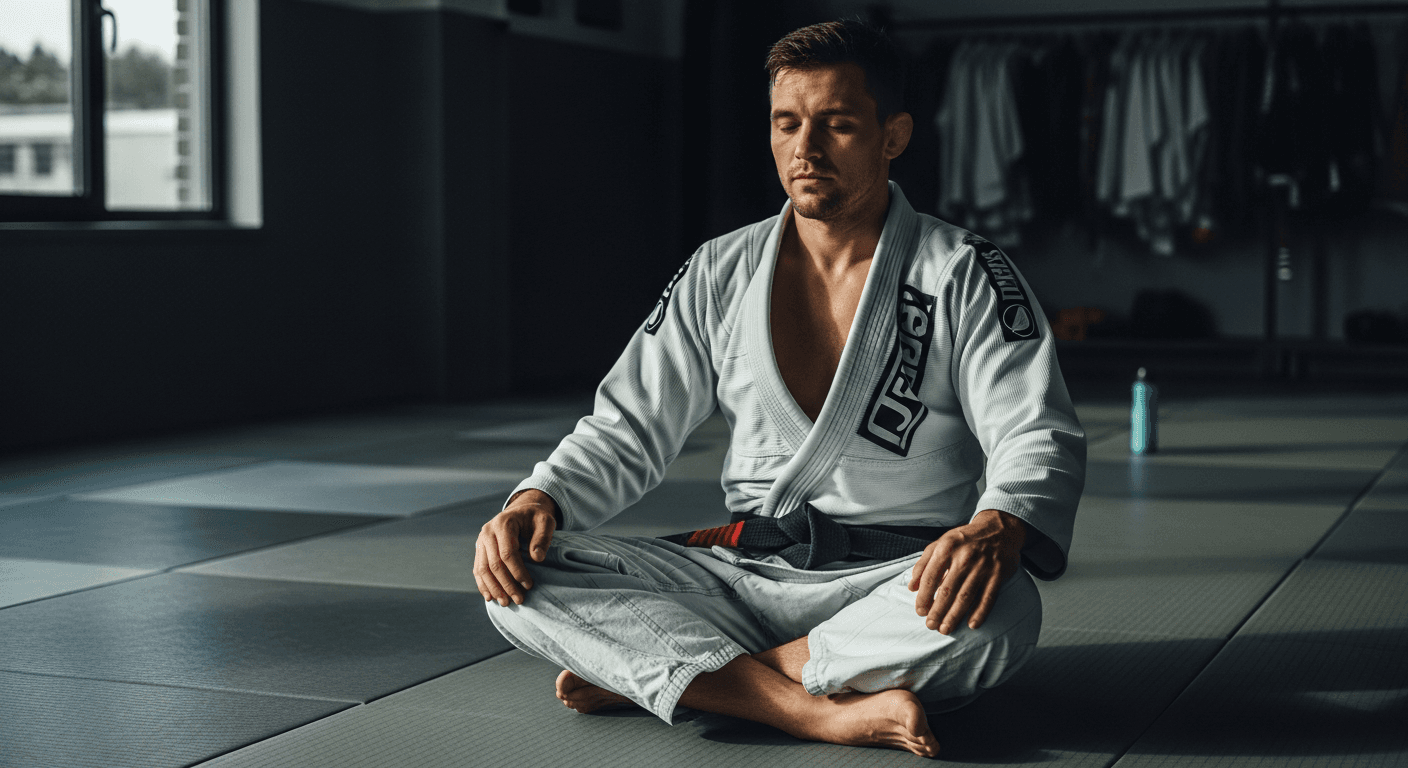
Two quiet minutes before BJJ, without the meditation hype
Try a modest attention practice before BJJ class. Two quiet minutes, natural breathing, and no promise of perfect calm or better competition results.
The Physical and Mental Health Benefits of Brazilian Jiu-Jitsu
BJJ is more than a martial art — it's a full-body workout, a stress reliever, and a mental health practice wrapped in a community. Here's what the research and real-world experience reveal.
Comments (0)
Loading comments...