
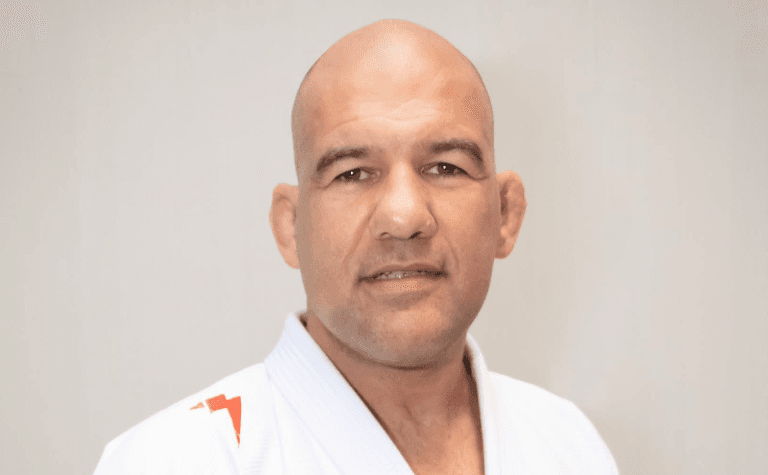
Fabio Gurgel: when a champion becomes responsible for a team
Quick answer: Fabio Gurgel is a four-time IBJJF World champion and an Alliance co-founder whose coaching career extends the story beyond his own results. His record offers a useful way to examine a harder question in jiu-jitsu: how a successful competitor helps other people succeed without becoming the center of every achievement.
Four World titles would be enough to introduce most athletes. With Fabio Gurgel, they introduce only one part of the work. The other part appears beside different names on result sheets, in academies operating far from the original room, and in the ordinary problem of keeping a team useful to the people inside it.
That makes Gurgel an interesting subject even for a reader who never expects to coach. His career sits at the point where personal excellence meets shared responsibility. Winning your own match and building an environment in which someone else can win are related skills. They are not the same assignment.
Begin with the competitor, then widen the frame
The IBJJF's interview with Gurgel identifies him as a four-time World champion and Hall of Fame member. It also lists athletes he has coached, including Rubens Cobrinha Charles, Bruno Malfacine, Gabi Garcia, Luanna Alzuguir, and Marcelo Garcia. The second list changes the scale of the first.
A competitive record is relatively straightforward to present. An athlete enters a division, faces opponents, and receives a result. Coaching credit is more complicated. A champion can learn from several instructors, train with many partners, and make decisions that belong to the athlete alone. A responsible account should leave room for all of those contributions.
Gurgel's importance does not require pretending he authored every result associated with Alliance. The more useful observation is that his career includes sustained responsibility for a setting in which exceptional athletes could work. That is a different kind of achievement from collecting another personal medal.
For the reader, the distinction improves how a team history is understood. Look at the competitors individually, then ask what the shared organization made possible. Neither view has to erase the other.
Alliance began as a coordination problem
In Gurgel's own account of Alliance's history, the team formed in 1993 after connected academies sought a common competition identity. He describes schools that continued operating independently while joining under one banner. Read this as a founder's retrospective, with the perspective and limits that implies.
The detail matters because it is more concrete than the familiar image of a large team appearing fully formed. Before an organization has international recognition, people have to agree on what they are sharing. A name on a registration form, a coaching relationship, and the ownership of an academy are different arrangements.
That early problem remains recognizable at a smaller scale. Two instructors can value cooperation while needing clarity about who teaches, who makes decisions, and how students represent the group. Good intentions do not automatically supply those answers.
The lesson is not that every academy should reproduce Alliance's structure. It is that organizational choices belong in the history of a sport. A technique can change a match. An agreement about how people train and compete together can change which matches become possible for an entire group.
The academy has to open again tomorrow
Gurgel's historical account also recalls teaching in a garage during his early period in São Paulo and later establishing a more permanent academy. The setting is worth noting without turning it into a romantic requirement. Financial uncertainty is not a training method, and an inconvenient room does not automatically produce better jiu-jitsu.
What the detail exposes is the work hidden by the word coach. Somebody needs a place to teach. Somebody has to arrange the schedule, communicate with students, and make the next class possible. Competitive ambition exists alongside those tasks rather than replacing them.
A reader who wants to teach can take that seriously without copying the circumstances. Start by distinguishing the technical responsibility from the operating responsibility. Demonstrating a pass well does not answer how beginners are introduced, how a substitute instructor is prepared, or how students learn about a timetable change.
This is where a long coaching career becomes more interesting than a motivational slogan. The question is not whether the coach cares enough. It is whether the work can continue clearly enough that other people can organize their own lives around it.
Team results contain several individual stories
The IBJJF's 2022 Worlds recap records Alliance's thirteenth adult male team title. That is a historical result from that event, not a claim about the team's current total. It provides a useful example of how an organization can be measured without reducing every athlete to an interchangeable part.
A team score brings individual results together. The athletes still reach those results through different divisions, opponents, bodies, and technical choices. Reading only the team ranking hides that variety. Reading only the individual finals hides the shared affiliation.
For a coach, those two views suggest different questions. Which athlete needs a particular training partner? Which student needs a clearer competition plan? Which part of the room serves several people well, and which requires individual attention? A strong team cannot be understood solely as a collection of identical routines.
For a fan, the same distinction makes coverage richer. Follow an athlete's specific decisions, then look at the environment around them. The team name can help explain context without becoming a complete explanation of why one competitor succeeded.
Coaching should make the athlete more legible
There is a temptation in sports storytelling to explain every result through a commanding figure at the edge of the mat. The coach becomes the central character; the athlete becomes proof that the method works. That framing is easy to write and too small for the actual relationship.
A better way to examine a coach's influence is to ask what becomes clearer for the athlete. Can the athlete identify a problem, choose an appropriate response, and understand why a plan changed? Does instruction help them make decisions when the coach is not close enough to speak?
Gurgel's range of coaching associations invites that question. It does not establish that every athlete learned in the same way, and it should not be used to claim access to private training conversations. The public record gives a reason to investigate the coaching career; it does not reveal every mechanism behind it.
This distinction also protects ordinary students from an unhelpful comparison. A recreational practitioner does not need to imitate a World champion's schedule to benefit from clear instruction. The relevant standard is whether the teaching helps that student understand and use the material appropriate to their goals.
Read a coaching career through specific questions
A famous name can make an academy seem self-explanatory. It is more useful to approach the history with questions that lead to observable details. When reading about Gurgel or another long-serving coach, consider:
Which achievements belong to the coach as an athlete, and which concern students or the team?
Which parts of the history come from official results, and which come from personal recollection?
How did the training organization change as more people became involved?
What can an ordinary student learn from the example without copying an elite athlete's life?
These questions do not diminish achievement. They make it more specific. Four World titles and a long coaching career deserve better treatment than a single label that makes everything sound inevitable.
They also improve how a prospective student evaluates a gym. A celebrated history is useful context. The class you can attend, the instruction you receive, and the way the academy answers practical questions are the experience you will actually have. Our guide to questions before signing a BJJ gym contract addresses that second part of the decision.
A legacy can be measured without becoming a slogan
Gurgel's career offers several legitimate subjects: the competitor, the instructor, the Alliance co-founder, and the person responsible for keeping an academy operating. None needs to absorb the others. Treating them separately reveals how much work is hidden inside a familiar name.
It also changes what counts as evidence. A medal confirms a result. A founder's account explains how he remembers an early decision. A team championship shows a collective outcome. Each source answers a different question, and a careful reader should resist asking any one of them to answer everything.
For people who train, the most useful implication is modest. Jiu-jitsu depends on more than the ability to win an exchange. Someone has to teach the next student, arrange the next class, and make cooperation possible among people with different ambitions. Those tasks deserve attention even when they do not produce a highlight.
That is why Gurgel's story remains worth reading after the title count has been stated. The record leads toward a larger responsibility: making a personal skill useful to other people, repeatedly, over time. It is demanding work precisely because the result no longer belongs to one person.
Main photo: BJJ Fanatics Brasil; archive portrait of Fabio Gurgel.
The takeaway
Fabio Gurgel's four World titles establish the competitor. His role in Alliance and his coaching associations widen the account into the work of building and sustaining a team. The interesting part is how those responsibilities differ, not how easily they can be compressed into one grand description.
Read the results, read the history with its sources in view, and keep the athletes' own contributions visible. A strong account of a coach should help readers understand more people, not make everyone else disappear behind the coach's name.
Find the room where you can learn
Use Let's Roll's gym finder to explore academies, then ask about the classes, instructors, and training arrangements that would shape your own week.
FAQ
How many IBJJF World titles did Fabio Gurgel win? The IBJJF identifies Gurgel as a four-time World champion. That competitive record is separate from the titles won by athletes he coached and from Alliance's team results.
Was Fabio Gurgel involved in founding Alliance? Yes. Gurgel is an Alliance co-founder, and his published history describes the team's formation in 1993 through a shared identity among connected academies.
Which famous athletes has Fabio Gurgel coached? The IBJJF names Cobrinha, Bruno Malfacine, Gabi Garcia, Luanna Alzuguir, and Marcelo Garcia among his coaching associations. Those athletes also have their own histories and other contributors to their development.
Does a famous team history tell me whether a gym suits me? It provides context, but you still need to evaluate the actual classes, commute, instruction, costs, and expectations. A strong personal fit depends on the training experience available to you.

Miles Serrano
Miles Serrano writes about competitors and the decisions that shaped their careers. He is more interested in the adjustment someone made in the third minute than in the medal count afterward.
Related Posts
Competing in gi and no-gi on the same day takes two plans
Prepare for gi and no-gi competition on the same day with separate rule checks, complete outfits, schedule coordination, and a realistic second-bracket plan.
Jiu-jitsu in Montreal: build the visit around a real class
Plan BJJ training in Montreal around confirmed classes, language arrangements, winter travel, visitor policies, and equipment that is ready to use.

BJJ gi pants that fit standing up can still fail on the mat
Check BJJ gi pants at the waist, rise, knees, and cuffs so a good-looking size label becomes a uniform you can actually move in.
Comments (0)
Loading comments...