
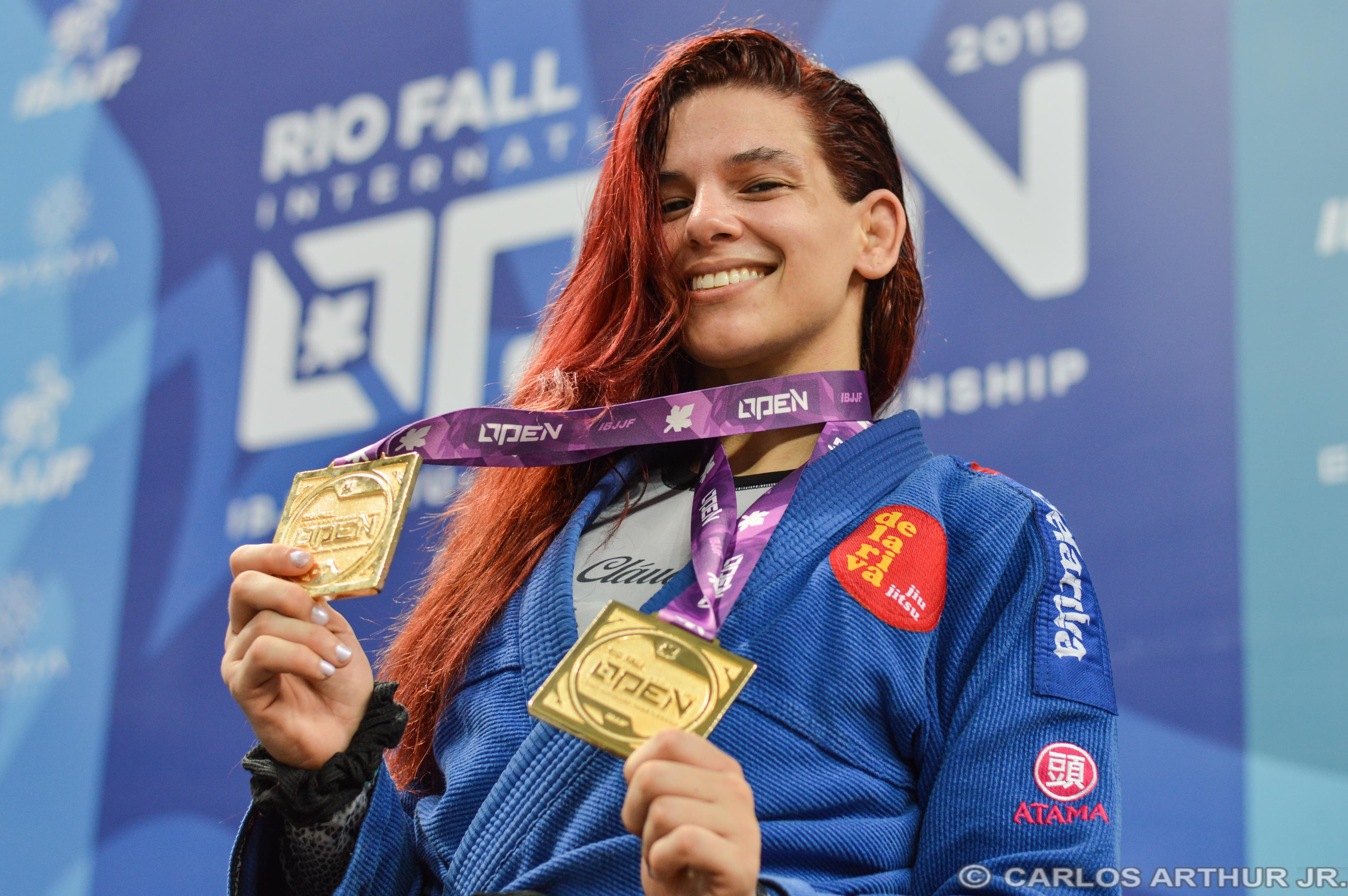
Claudia do Val: three world titles, three weight classes
Quick answer: Claudia do Val won adult black-belt world titles in three different weight classes across 2017, 2018, and 2019. Her record also extends through the international open circuit and masters competition. The interesting detail is the range of that work, not simply the number of medals in a photograph.
Three consecutive world titles can look like one repeated line on a résumé. Claudia do Val's sequence is more particular: heavyweight, medium-heavyweight, then super-heavyweight.
The distinction changes how the record should be read. This was not three editions of precisely the same bracket. It was a run across different divisions, accompanied by a much wider competition calendar than one annual trip to Worlds.
Heavyweight was the first adult black-belt world title
FloGrappling's 2017 Worlds final coverage identifies do Val as the women's heavyweight champion. That gives the sequence a clear first point: the adult black-belt title in 2017, at heavyweight.
The division belongs in the description. A vague reference to a world title leaves too much work for the reader, especially in a sport with separate belt ranks, age groups, and formats. Naming the category makes the achievement easier to understand without diminishing anything else she won.
It also gives a viewer somewhere useful to start. The final is a specific match to investigate rather than an invitation to search indefinitely through highlight videos. Look for the positions and decisions that belong to that contest, then compare them with later material.
A first title can be presented without inventing a private moment of destiny around it. The public evidence is already strong: an athlete reached the top of that division. What followed made the result part of a sequence rather than an isolated entry.
The next title came in a different division
The official 2018 Worlds results list do Val first at adult female black-belt medium-heavyweight, with Monique Elias second. It is a new category in the sequence, and the official record supplies the distinction directly.
Reading the two years side by side is more useful than compressing them into a claim that she simply retained the same title. The repeated outcome was gold. The division changed.
That observation does not authorize speculation about her reasons for changing weight classes or the details of her preparation. Results establish where an athlete competed and finished. They do not reveal a training plan, nutritional decision, or personal calculation unless the athlete has explained it elsewhere.
For a reader studying careers, this is a worthwhile habit: keep the verified change visible and leave the unknown explanation unknown. A record can be interesting without a sentence pretending to enter the athlete's mind. In do Val's case, the next year's result would extend the pattern once more.
Super-heavyweight completed the three-year sequence
At the 2019 Worlds, do Val finished first in the adult female black-belt super-heavyweight division. Venla Luukkonen was second, with Alison Tremblay and Jessica Flowers sharing third. The category was different again.
The resulting sequence is easy to state and worth keeping intact:
Heavyweight world champion in 2017.
Medium-heavyweight world champion in 2018.
Super-heavyweight world champion in 2019.
Those are adult gi world titles. They should not be combined carelessly with masters results, no-gi medals, or regional open victories under a single unexplained total. Each belongs to its own competitive setting.
The distinction helps a newer fan follow the sport. It also respects the athlete by describing the actual achievement rather than relying on a large number with missing labels. Three titles across three divisions is already an arresting fact. It becomes less informative, not more impressive, when the details are removed.
The finish had more than one stage
A podium tells you who finished first. Contemporary match reporting can add how a particular final ended. Graciemag's account of the 2019 finals describes do Val establishing a triangle against Luukkonen, sweeping while maintaining it, and finishing with an armbar from the position.
That sequence is more useful to a technical viewer than a general label such as aggressive or well-rounded. It identifies connected actions that can be located in the match footage. The initial attack did not have to remain a single attempt with one possible ending.
This is an observation from the reported match, not a claim that the same sequence defines every part of her game. A profile should not build an entire technical identity out of one finish. It can, however, use that finish to direct attention toward a concrete exchange.
When watching, keep the opponent's responses in view. The transition matters because another athlete is resisting it. Studying both sides preserves the competitive problem that a short finishing clip can make disappear.
The season included more than Worlds
In its 2018–19 season ranking report, Graciemag identified do Val at the top of the adult women's black-belt standings and connected that result with an extensive calendar of IBJJF events. The report provides a different view of the career from a single championship weekend.
A season ranking and a world title answer different questions. One records accumulated performance under the ranking system; the other names a winner of a particular championship division. Treating them as interchangeable erases the work each measure is intended to describe.
For a fan, following the wider calendar also changes which matches seem worth watching. An open tournament may contain a technical exchange that never becomes the defining image of the year. Its smaller place in the public conversation does not make it irrelevant to the athlete's season.
Do Val's record invites that wider reading. There is the concentrated visibility of Worlds, and there is the repeated work of appearing elsewhere on the circuit. Both belong in the account.
The open division changed the available test
Graciemag's report from the 2019 Rio Fall Open makes an important distinction within a double-gold result. Do Val had no opponent in the heavyweight bracket, then competed in the open division, where the report records wins over Mayra Mazza and Rafaela Bertolot.
That detail should stay attached to the medals. Describing both golds as though they came through identical brackets would make the story less accurate. The open division supplied the contested matches that the weight division did not.
There is no need to turn that into a complaint about the event or an opponent. It is a feature of the record that helps explain what happened on the day. Precision allows the athlete's actual competitive work to remain visible.
The same discipline is useful when reading any tournament résumé. Check the division, bracket, and result before deciding what a medal count tells you. You may find a more interesting story in the distinctions than in the total alone.
Masters results belong beside the adult record
The 2018 World Master results list do Val first in female master 1 black-belt medium-heavyweight and first in that age group's open class. These are additional achievements, with their own labels, in the same broad period as her adult titles.
Keeping the categories separate does not create a hierarchy of personal worth. It makes the sporting record readable. An athlete can compete across eligible categories, and a profile can describe each without letting one result stand in for another.
For someone choosing matches to study, the wider record provides more material. Different opponents and competitive settings may reveal different exchanges. Select a complete match where possible and identify a narrow question before treating the footage as an instruction manual.
The partner-feedback guide offers a practical next step if a sequence raises a training question. Describe what you observed, ask a coach to help interpret it, and avoid presenting your first reading of a champion's match as a universal technical rule.
A career also has work outside the bracket
In an April 2019 interview with UOL, do Val explained that teaching seminars, private lessons, and workshops helped fund her life in the sport. That is her account at that time, not a statement about her current finances.
It adds a practical dimension to the tournament calendar. A competitor's travel can involve teaching as well as competing, and a public title does not by itself describe how the work is supported. The interview allows that point to be made without inventing figures or assuming a particular sponsorship arrangement.
For readers interested in learning from accomplished competitors, the useful question is what an event will actually teach. Check the subject, experience expectations, and format of a seminar. A medal establishes a competitive achievement; the session still needs to fit the student attending it.
That distinction leaves both forms of work intact. Competition and instruction can be connected without becoming the same job, and the record of one should not replace a clear description of the other.
Main photo: Carlos Arthur Jr. / Graciemag; 2019 Rio Fall Open.
The takeaway
Do Val's three-year world-title sequence is strongest with the categories left visible. The move through heavyweight, medium-heavyweight, and super-heavyweight sits beside a broader record of open tournaments and masters competition. Read those results together, while keeping their meanings distinct.
The career also offers specific matches and a documented teaching life to explore. Begin with the verified event, follow the actual exchange, and resist reducing the athlete to either a medal total or a single technical label. The details carry enough interest of their own.
Look for a focused learning opportunity
Browse seminars and confirm the instructor, topic, and experience requirements before booking a session.
FAQ
Which adult world titles did Claudia do Val win? She won the gi black-belt heavyweight title in 2017, medium-heavyweight in 2018, and super-heavyweight in 2019. Keeping the divisions attached explains what makes the three-year sequence distinctive.
Who finished second to do Val at the 2019 Worlds? Venla Luukkonen finished second in the adult female black-belt super-heavyweight division, according to the official IBJJF results. Contemporary reporting describes do Val finishing the final with an armbar from a triangle sequence.
Did do Val also compete at World Master? Yes. The 2018 official results list her first in master 1 black-belt medium-heavyweight and open class. Those titles should be identified separately from her adult world championship results.
Why look beyond a champion's medal count? Division, age group, format, and bracket details explain what each result represents. They also help you find specific matches to watch instead of relying on an unlabeled total or a general reputation.

Miles Serrano
Miles Serrano writes about competitors and the decisions that shaped their careers. He is more interested in the adjustment someone made in the third minute than in the medal count afterward.
Related Posts
Mikey Musumeci gives up the belt to make room for MMA
Musumeci is vacating his UFC BJJ title to focus on MMA training. What he is leaving, what continues, and why the transition matters.
IBJJF membership: finish the paperwork before the deadline
IBJJF membership and tournament entry are separate steps. Plan documents, professor approval, renewals, and junior accounts before registration closes.

Choosing a BJJ seminar worth your time and travel
Choose a BJJ seminar by the subject, teaching format, access, and total cost. Know what to ask the host before buying a ticket.
Comments (0)
Loading comments...