

Good jiu-jitsu in a small town needs more than a famous coach
Quick answer: A small-town BJJ program can offer worthwhile training without a famous name or a large competition team. Evaluate instruction, supervision, partner access, and the schedule you can sustain, then discuss how occasional outside training might complement the local room.
A nearby class that you can attend twice a week has something a famous academy three hours away does not: a realistic place in your Tuesday. That does not settle which program is better for you. It does put distance back into a decision that can otherwise become a comparison of names.
Small-town training deserves the same careful evaluation as training anywhere else. It should not be romanticized as automatically friendlier or dismissed as automatically behind. Look at the actual room, the people running it, and the practice available to you.
Judge the teaching you can observe
Start with the instructor’s approach to the students in front of them. Are the tasks explained clearly? Can beginners ask questions? Does the coach help partners understand the exercise and adjust when they are confused? Those observations matter regardless of the town’s population.
Ask about the instructor’s background and the program’s structure without turning the conversation into a hunt for the most impressive association logo. Qualifications and affiliations are useful context. You still need to know how the regular classes work and who will teach the sessions you can attend.
A smaller room may have students of several levels training together. That can work when the instructor has a clear plan for different experience levels. Ask how a new student is introduced and how more experienced students receive appropriate challenges.
Do not infer quality from the absence of polished promotional material. Equally, do not treat limited resources as a reason to ignore unclear instruction or poor communication. The standard is the training experience, and it should be examined with the same care you would bring to a larger academy.
Treat the timetable as part of the program
A small program may offer fewer sessions than a large urban gym. Compare those sessions with your actual availability. A timetable that contains exactly the classes you can attend may be more useful than a long schedule you can rarely reach.
Ask how cancellations and changes are communicated. If one instructor teaches most classes, travel or other commitments may affect the calendar. That does not automatically make the program unreliable, but you need to know how to check before making the trip.
Think about the full journey in different seasons and at the times you would travel. Avoid building a weekly plan around the best possible conditions. A route that works comfortably on a free Saturday may be difficult after a late workday.
The consistency guide begins with what you can repeat. In a smaller town, the choice may involve fewer options, but the same principle holds: a workable week provides a better starting point than an ideal schedule you cannot maintain.
Learn from familiar partners without becoming dependent on them
A small group gets to know one another quickly. You may recognize a partner’s preferred entry before they begin it, or know which grip they tend to abandon. That shared history can make practice efficient and comfortable.
It can also make a skill seem more reliable than it is. If you always receive the same response, you may be solving the partner’s habit rather than the broader position. Discuss that possibility with the coach instead of treating familiarity itself as a problem.
Vary the assignment where appropriate. Start from a less familiar position, ask a partner to offer a different coached response, or change which person has the initial advantage. The variation should have a clear purpose and remain within the class plan.
You do not need to surprise teammates with unannounced intensity to make training more honest. A useful challenge is one both people understand. The aim is to broaden the problem while preserving the trust that makes a small group worth returning to.
Discuss outside training as a practical option
Occasional visits, seminars, or camps can add partners and instruction that are not available locally. Ask your coach how those options fit your development and check the host’s visitor policy before traveling. A useful visit should complement the work you are already doing.
Be realistic about frequency and cost. A monthly journey might be manageable for one person and difficult for another. There is no universal number of outside sessions that makes a local program legitimate. Choose an arrangement that fits your resources and goals.
Before booking, clarify:
What you want the visit to add to your training.
Whether the session accepts your experience level.
The full travel and participation cost.
How you will bring questions back to your regular coach.
Outside training does not have to become a comparison in which one academy loses. Different rooms can provide different useful experiences. Describe what you learned without presenting a single visit as proof that everyone at home has been doing things incorrectly.
Let ambitious students have specific plans
A student who wants frequent high-level competition may eventually need access to partners, coaching, or schedules beyond what the local room can provide. That is a question of fit and resources, not a reason to belittle the academy that introduced them to the sport.
Discuss the actual goal. Which events, training demands, and practical commitments does it involve? A general wish to become very good is difficult to plan around. A more defined objective lets the coach explain what the current program can support and where additional help may be useful.
The answer might involve occasional travel, a different session, or a larger change later. It does not have to involve an immediate relocation or a dramatic break with the local team. Compare the options with the rest of the student’s life.
Other members may want something different. A recreational student should not feel that the room’s value depends entirely on whether its most ambitious competitor leaves. An academy can provide worthwhile instruction and community while recognizing that some goals require additional resources.
Help the room in ways that do not blur responsibilities
Small programs often benefit from members who are considerate about ordinary logistics. Arrive on time, keep equipment out of the way, communicate absences when the coach needs to plan, and welcome a newcomer who does not yet know how the class works.
That support should remain distinct from taking on roles you are not qualified or authorized to perform. Being a regular student does not automatically make you an instructor, supervisor, or person responsible for solving every problem in the room.
If you want to help with an event or administrative task, ask what is needed and agree on the scope. Clear roles make volunteering easier to sustain. Vague expectations can turn goodwill into a second job that nobody explicitly accepted.
The same clarity protects friendships. A small group may know each other outside training, but membership, teaching, and personal relationships still involve different expectations. Direct conversations about schedules and responsibilities are kinder than assuming everyone will infer what needs doing.
Evaluate progress without borrowing another gym’s identity
A smaller academy does not need to imitate the social media output of a professional competition team. Its useful milestones may include a student becoming comfortable with partner work, a stable class schedule, or a coach making a difficult concept easier to understand.
Those outcomes do not replace technical standards. They broaden the evidence you consider. Look for students receiving feedback, practicing with purpose, and understanding the limits of what they know. A medal count can add information, but it cannot describe every part of the program.
Reassess your own fit periodically. If the timetable changes, your goals develop, or you need a different training environment, discuss it. Staying out of loyalty alone can become uncomfortable for both the student and the coach when the practical arrangement no longer works.
You can appreciate a local academy without claiming it is the best place for every person at every stage. That is a more durable form of respect. It allows the room to be valued for what it actually provides rather than for a reputation it must continually defend against somewhere else.
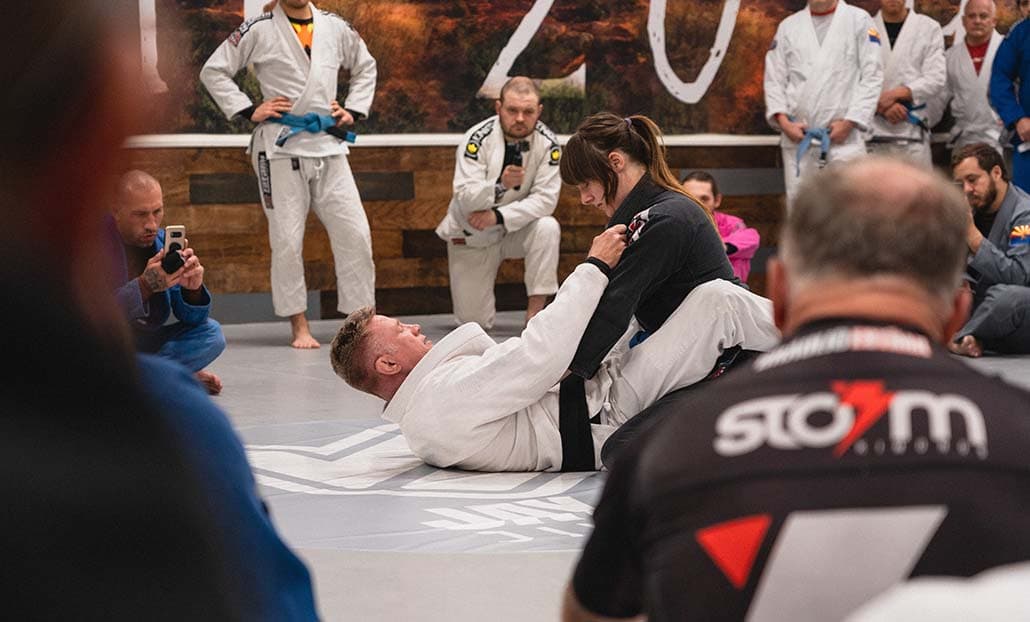
Main photo: BJJ Globetrotters; illustrative archive academy photograph, not a claim about its town size.
The takeaway
Evaluate a small-town BJJ program through its actual teaching, supervision, partners, and timetable. Distance and consistency belong in the comparison alongside qualifications and competitive goals. Neither a famous name nor a familiar room should escape practical questions.
Use outside training where it adds something useful and remains affordable. A local academy can be the center of a worthwhile practice without having to contain every possible partner, technique, or future ambition under one roof.
Compare the options you can reach
Use the gym directory to identify local and regional academies, then compare real travel times and confirm visitor options with the hosts.
FAQ
Can I get good at BJJ in a small town? The useful factors are instruction, suitable practice, feedback, and consistency, not population alone. Evaluate the actual program and discuss any gaps between what it offers and your goals.
Do I need to travel to a famous academy? Not automatically. An outside visit should address a specific need and fit your resources. A recognizable name alone does not tell you whether the session will suit your experience or schedule.
What if my local class has only a few regular partners? Work with the coach to vary positions and tasks appropriately. Occasional outside training may add useful experience, but avoid replacing clear practice with surprise intensity against familiar teammates.
Is changing academies disloyal? Training needs can change. Discuss the practical reasons respectfully and make a decision that fits your circumstances. Appreciating a former academy does not require staying indefinitely when the arrangement no longer works.

Rafael Moura
Rafael Moura profiles competitors as people with lives outside the bracket. Some of those stories are comebacks. Most are not, and he does not force them.
Related Posts

Mikey Musumeci gives up the belt to make room for MMA
Musumeci is vacating his UFC BJJ title to focus on MMA training. What he is leaving, what continues, and why the transition matters.

IBJJF membership: finish the paperwork before the deadline
IBJJF membership and tournament entry are separate steps. Plan documents, professor approval, renewals, and junior accounts before registration closes.
Choosing a BJJ seminar worth your time and travel
Choose a BJJ seminar by the subject, teaching format, access, and total cost. Know what to ask the host before buying a ticket.
Comments (0)
Loading comments...