
BJJ shorts: fit, closures, and the rules before the print
Quick answer: Good BJJ shorts stay secure while allowing you to move, and they avoid hardware or openings that conflict with your academy's rules. Compare the actual size chart and construction rather than buying by print or a generic small-to-large label. If you compete, check the organizer's uniform requirements before choosing the color and length.
The dragon on the leg has no opinion about whether the waistband stays up. It may look excellent in the product photograph while the shorts themselves require constant adjustment whenever you sit down. That is a disappointing amount of administration for something sold as training equipment.
Buying no-gi shorts becomes easier when the decorative decision comes last. First establish what the garment needs to do, which rules it must meet, and how it fits your body during movement. Once those questions are answered, the dragon is welcome to apply for the remaining position.
Begin with the class you actually attend
Ask the academy what it requires for no-gi training. Some schools specify colors or branded kit; others focus on construction and suitability. A product sold as grappling gear still needs to fit the rules of the room where you will use it.
If you are preparing for a first class, describe what you already own before ordering replacements. The instructor may be able to tell you whether a pair is suitable or identify a particular feature that rules it out. A clear photograph of the waistband and pockets can help if the description is ambiguous.
Do not assume that approval for ordinary gym training means approval for a tournament. Competition organizers may have requirements beyond what your academy uses during class. Keep those two decisions separate from the start so you do not buy twice for a reason you could have checked once.
The guide to what to wear to BJJ covers the wider first-class question. For shorts, focus on the details that affect the actual garment: fit, openings, closures, and the event or academy rules that apply to it.
Read past the word stretch
Stretch is useful information only when you know where it is and how the shorts are constructed. Look at the fabric description, the waistband, and any separate panels. A broad claim about movement does not tell you whether a particular size will fit your hips and thighs comfortably.
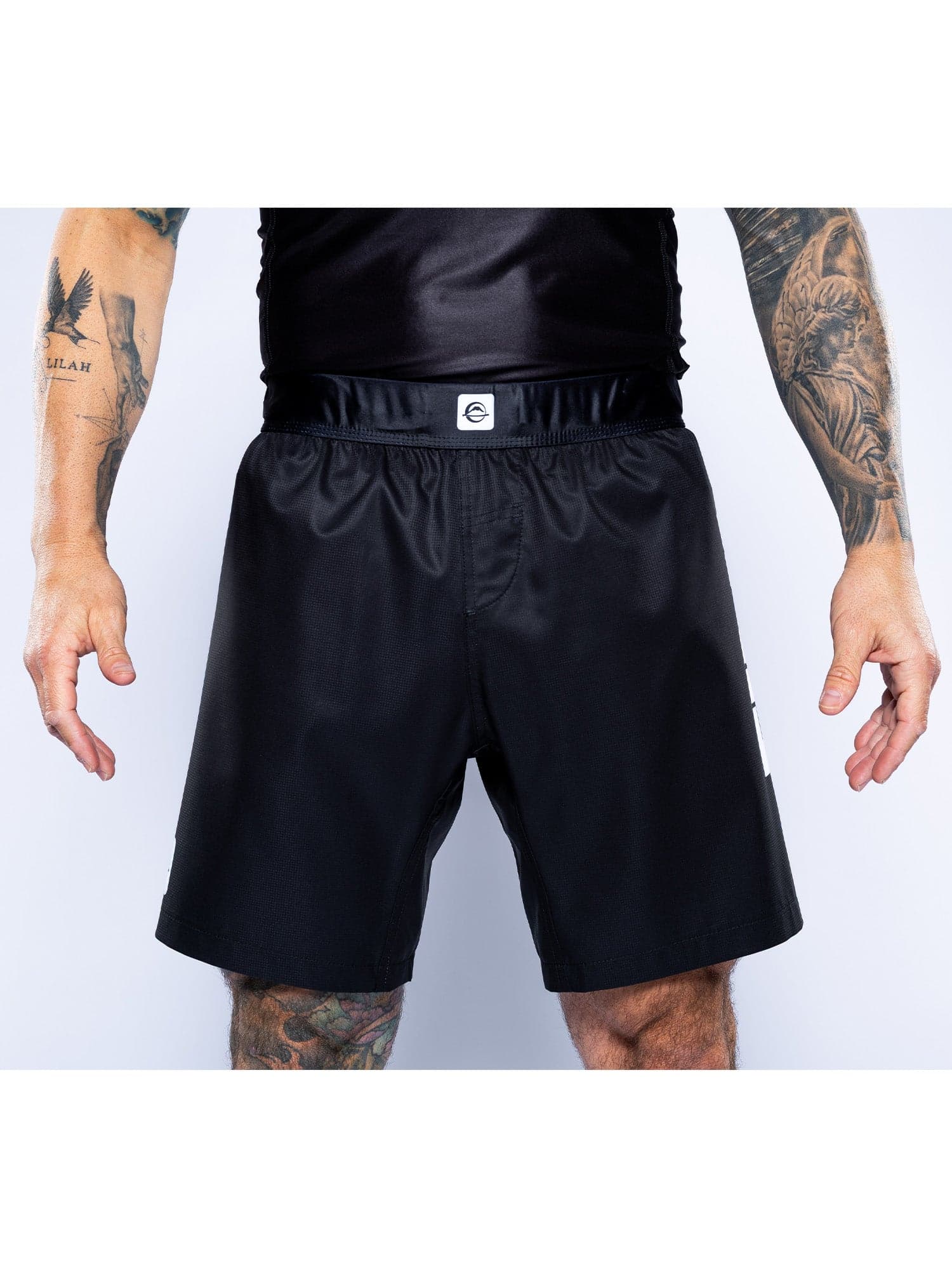
The FUJI Competition Ranked Shorts listing, for example, specifies an internal drawstring and includes both waist and outside-length measurements in its chart. Those are details you can compare with your needs. The product's performance adjectives are less useful for deciding which size to order.
Measure a pair of shorts you already like, following the retailer's stated method where one is provided. If the chart does not say whether a measurement refers to the body or the garment, ask. Comparing two different types of measurement can produce a very confident wrong answer.
Ignore the temptation to treat your usual clothing label as a personal category that must remain consistent. The purpose of the label is to help select a garment. If another size fits better in this model, the garment has not won an argument with you.
Test the waistband before a full round
Try the shorts with whatever underlayer you intend to wear, while following the seller's conditions for a returnable try-on. Secure the waistband normally rather than pulling it as tight as possible to rescue a poor fit. Then sit, stand, and move through a comfortable range of motion.
Check whether the waistband stays where you expect and whether the fabric restricts movement at the hips or thighs. A pair that looks fine while standing still may behave differently when you lift a knee or sit on the floor. You do not need a sparring session to notice an obvious problem.
If the waist fits but the legs do not, consider another cut rather than assuming you must accept one half of a good fit. Sizing up may solve the leg issue while creating a waistband issue. A different model can be the cleaner answer.
Leave the tags attached until you are satisfied, if the return policy allows that kind of try-on. Washing and training in the shorts can change the available options. Discovering a poor fit at home is inconvenient; discovering it after making the item nonreturnable is more expensive.
Inspect pockets and closures directly
Check every opening rather than relying on the front photograph. Look for side pockets, rear pockets, hidden storage, and exposed fastening hardware. A feature designed for running or everyday convenience may not suit close-contact grappling or the rules of your event.
Ask for another image if the listing does not show the closure clearly. An internal drawstring and an exposed external one are different details. The same applies to a smooth waistband and one with a fastening surface that remains uncovered when secured.
For IBJJF men's board shorts, the published uniform rules address pockets, exposed drawstrings, buttons, zippers, and potentially risky hardware, as well as permitted colors and a hem between mid-thigh and knee. Women's options have their own stated requirements. Read the relevant category in full rather than applying a shortened shopping checklist as the rulebook.
A retailer's approval label is a useful starting point, not a substitute for checking the current rules and the way the garment fits you. The event inspector sees the shorts on the athlete, not the marketing photograph in the listing.
Decide what you want from the liner
Some shorts have an integrated compression layer; others are intended to be worn with a separate underlayer. Either arrangement can be worth considering, but the decision should match how you prefer the clothing to fit and how you manage your kit.
FUJI's Ultimate Grappling Shorts description identifies a two-layer construction. That tells you something materially different from a plain outer short. It does not establish that the design is more comfortable for every athlete or legal under every event's rules.
Think about replacement and washing as well as the first try-on. With separate layers, you can choose each fit independently. With an integrated garment, the whole item needs to work as one purchase. Neither option deserves a universal ranking without knowing the person using it.
If you already own an underlayer you like, check whether the new shorts accommodate it comfortably. Avoid buying a more complicated arrangement simply because the product page presents the extra layer as an automatic upgrade. More fabric is a feature. Whether it helps is the question you still need to answer.
Compare the total purchase, not only the sale price
A discounted pair can become an expensive experiment if returning it costs nearly as much as keeping it. Read the exchange conditions and shipping charges before ordering several sizes. International purchases deserve particular attention because the cheapest item price may not produce the cheapest usable result.
Keep a short buying record:
The model and size, including the chart used.
The waistband and leg measurements relevant to your fit.
Any academy or competition requirements you checked.
The return deadline and condition requirements.
For a first purchase, one suitable pair is often enough to test the model. Buying several designs at once commits you to the same uncertain fit repeatedly. The second pair can wait until the first has made it through an ordinary class and the recommended care routine.
If you train often enough to need more kit between washes, build the rotation deliberately. Count usable clean sets rather than the number of items in the drawer. A drawer containing several pairs you avoid wearing is not solving the laundry problem.
Let the design be the final decision
Once fit and rules are settled, personal preference can have the rest of the conversation. Choose the color or print you enjoy wearing. There is no technical virtue in pretending that appearance never matters, and no obligation to buy the loudest version because the sport's advertising sometimes favors it.
Check whether a design changes the garment itself. A ranked version may use a different color arrangement, while another product with a similar name may have a different cut or closure. Compare the specifications rather than assuming the artwork is the only difference.
After training, follow the care label and inspect the shorts when you put them away. If a seam, closure, or drawstring needs attention, deal with it before the next session. Equipment maintenance is easier when the problem is found beside the laundry rather than during warm-up.
Save the details of the model that works. If it changes or disappears from stock, you will have something concrete to compare with a replacement. The most useful review you can keep for yourself is a short explanation of why a pair fits, not merely that it was your favorite.
Main photo: FUJI Sports; product photograph.
The takeaway
Buy BJJ shorts in the order you will depend on them: suitable construction, workable fit, secure closure, and compliance with the rules that apply to you. Check the actual product chart and try the garment before washing or training in it.
Then choose the design. A good pair should let you spend the class thinking about the position rather than the waistband. The print can contribute to your enjoyment, but it cannot take over the practical work of the shorts.
Check the room's requirements
Find your academy in the gym directory and confirm its no-gi clothing policy before buying new training kit.
FAQ
Can I wear ordinary gym shorts to no-gi BJJ? Ask your academy about the particular pair. Pockets, hardware, closures, and fit may make ordinary exercise shorts unsuitable even if they are comfortable for another activity.
Should I buy shorts with a built-in liner? Choose based on the fit and underlayer arrangement you prefer. An integrated liner is a construction option, not proof that the shorts will work better for everyone.
Does IBJJF-approved labeling guarantee inspection approval? Check the current rules and the garment's actual fit and condition. A listing cannot guarantee that every athlete will meet the event requirements in every size.
How many pairs should I buy first? Start with one model you can evaluate unless you already know its fit. Add to the rotation after confirming that it works in training and suits your washing schedule.

Kit Langford
Kit Langford covers the louder parts of jiu-jitsu — the marketing claims, the arguments, the gear that promises more than gear can deliver. The jokes are expected to survive a fact-check.
Related Posts

Mikey Musumeci gives up the belt to make room for MMA
Musumeci is vacating his UFC BJJ title to focus on MMA training. What he is leaving, what continues, and why the transition matters.
IBJJF membership: finish the paperwork before the deadline
IBJJF membership and tournament entry are separate steps. Plan documents, professor approval, renewals, and junior accounts before registration closes.
Choosing a BJJ seminar worth your time and travel
Choose a BJJ seminar by the subject, teaching format, access, and total cost. Know what to ask the host before buying a ticket.
Comments (0)
Loading comments...