
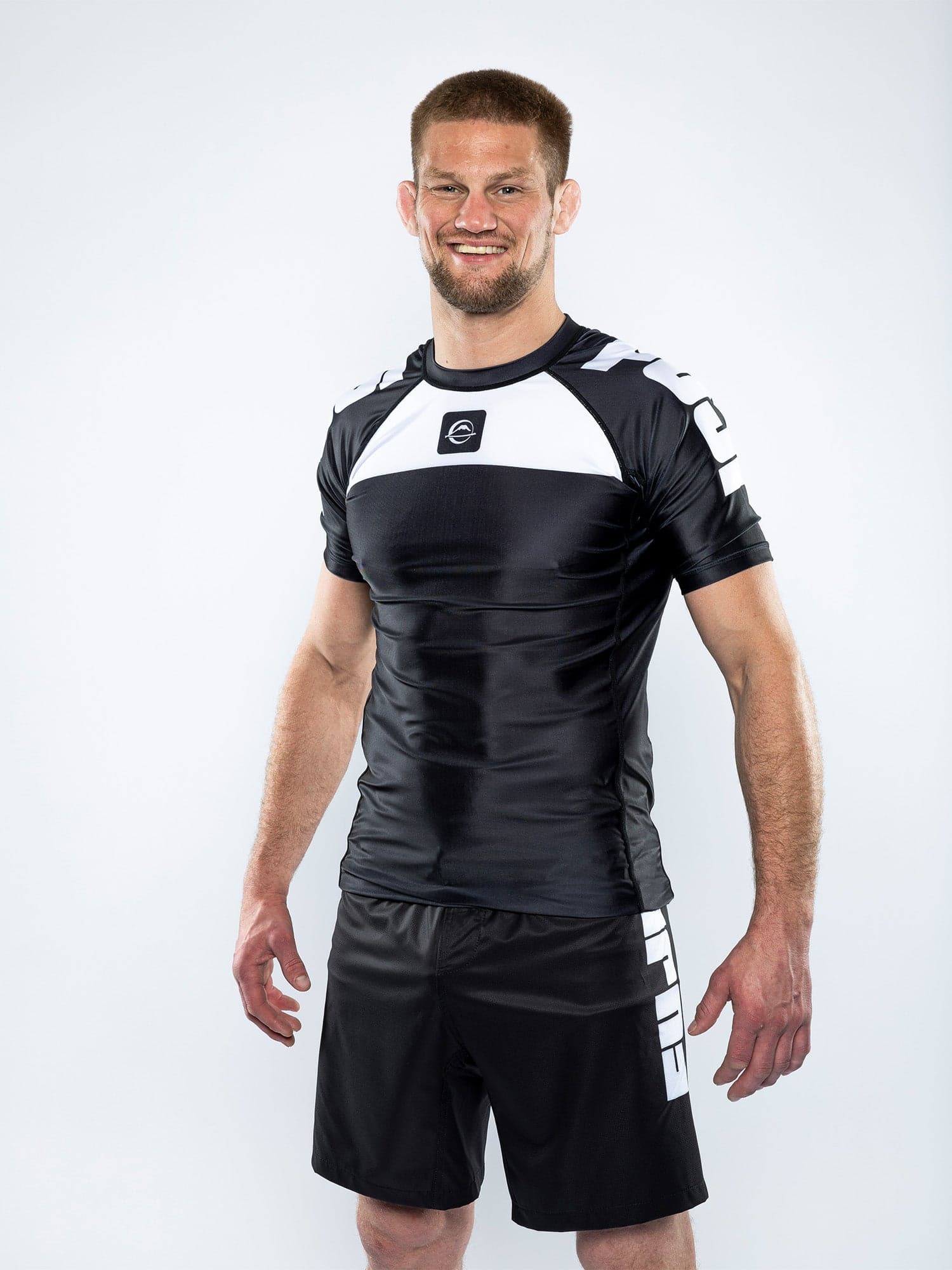
How a BJJ rashguard should fit when you actually move
Quick answer: A BJJ rashguard should stay close to your body while allowing comfortable breathing and unrestricted movement. Use the exact product’s measurements, test the fit before washing, and check academy or tournament requirements separately from size.
A rashguard that looks correct in a mirror can spend an entire round climbing toward your ribs. Another can stay neatly in place while making every overhead movement feel like a disagreement with the seam under your arm.
The useful fit test happens in motion. You do not need a garment that proves how committed you are to tight clothing. You need one that works through the positions you practice, fits the rules of the room, and survives the care routine you can actually follow.
Start with the product’s measurements
Small, medium, and large are labels within a sizing system, not universal dimensions. Check the chart for the exact model you intend to buy. A size that works in one brand, or even one cut within a brand, does not settle the next purchase.
The FUJI men’s rashguard size chart is an example of a manufacturer-specific reference. Use a chart like that alongside the individual product description and ask the seller how to interpret any measurement that is unclear. Do not assume a number describes the garment rather than the person wearing it.
Measure carefully using the method the seller specifies. If a chart asks for chest circumference, a measurement taken across a shirt laid flat is a different quantity. Mixing those methods can produce a confident order in the wrong size.
If your measurements fall between categories, describe the actual issue to the seller. Torso length, shoulder width, and the intended fit may point toward different options. A blanket rule to always size down or always size up cannot account for every cut and body shape.
Check movement before judging appearance
Try the rashguard on before washing it or taking it to training, following the return conditions. Move your arms overhead and across your body, bend at the hips, and sit in a position you would use on the mat. Notice where the fabric pulls and where the hem moves.
A fitted garment will feel different from a loose T-shirt. That does not mean discomfort is evidence that it is doing its job. If the neck, underarms, or torso feel restrictive, investigate the fit rather than deciding that you should get used to it.
Look for consistent coverage as you move. A hem that looks long enough while standing may rise substantially when your arms reach forward. A sleeve may bunch at the elbow or pull through the shoulder. These observations are more useful than whether the shirt photographs well in a neutral pose.
Keep the test clean and gentle so you preserve the seller’s return options. You do not need a hard sparring session to discover that a seam presses uncomfortably when you extend an arm.
Separate close fitting from excessively tight
The point of a close fit is to avoid unnecessary loose material during grappling. It is not to choose the smallest size you can physically put on. Fabric stretched to its limit can distort the cut and leave you adjusting the garment instead of concentrating on practice.
Check whether you can breathe comfortably and move normally. If you cannot, stop the fitting experiment and choose another option. A clothing purchase is not a test of tolerance. Any persistent symptoms or health concerns belong with an appropriate clinician, not a sizing argument online.
At the other end, a shirt with large folds or a loose neckline may not suit the contact and movement of grappling. Ask your coach what the academy expects. A top sold for surfing, running, or general exercise may fit differently from the equipment students commonly use in that room.
You do not need to make the distinction by guessing how much compression is scientifically ideal. This is a practical garment check: usable movement, coverage, and a fit that does not create obvious loose material or restriction.
Match the sleeves to the use
Long and short sleeves change coverage, but neither automatically makes a rashguard better. Consider what you prefer wearing under a gi, what you use for no-gi classes, and whether your academy has a stated requirement.
Try the sleeve movement rather than deciding from the hanger. A long sleeve can pull when you bend the elbow or reach overhead; a short sleeve can bunch around the upper arm. The cut matters as much as the category.
If you plan to wear the top under a jacket, test that combination before committing. A garment that feels comfortable alone may bunch differently beneath the gi. The jacket should still fit appropriately, and you should be able to move without having to keep rearranging layers.
Avoid treating a preferred sleeve length as a hygiene guarantee. Follow the academy’s cleanliness expectations and the garment’s care instructions regardless of coverage. More fabric does not excuse bringing yesterday’s unwashed kit back onto the mat.
Check competition rules as a separate step
Fit and eligibility are related but different checks. A comfortable rashguard may still fail an event’s uniform requirements because of color, design, or another specification. Read the organizer’s rules before buying something specifically for competition.
For an IBJJF event, use the official uniform guidance and its linked updates. Do not infer acceptance from the fact that a product is marketed as a ranked rashguard. A sales description is not the organizer’s inspection process.
Confirm which division and rules apply to you. The requirements for wearing a layer under a gi are not necessarily the same as those for a no-gi uniform. Other organizers may use different standards again, so a garment accepted at one tournament is not a universal pass.
Keep a suitable backup if the event instructions and your packing space allow it. That is a practical precaution, not a reason to buy several items before checking whether the first one meets the requirements. Start with the rule and work toward the product.
Look at seams, hems, and the complete outfit
A rashguard works with the rest of your kit. Test the waistband overlap with the shorts or spats you expect to wear. Check whether the hem stays where you need it during a squat, a seated position, and a forward reach.
A short fitting checklist is more useful than repeatedly pulling the shirt down in front of the mirror:
The neckline sits comfortably without large loose gaps.
Arm movement does not create obvious pulling or uncomfortable seams.
The torso allows comfortable movement and breathing.
The hem maintains suitable coverage with your usual lower-body kit.
The fabric returns to a sensible position after ordinary movement.
If one area fails while the rest fits, consider a different cut. Moving up a whole size may create excess fabric elsewhere. A different model can be a better answer than trying to negotiate permanently with a shirt designed around different proportions.
The BJJ shorts guide covers the other half of the outfit. Choose the combination you will actually train in rather than assessing each item as though it will never meet the other.
Buy for the laundry week you have
Read the care instructions before purchasing. Your available washing and drying routine affects how many usable tops you have between sessions. A favorite rashguard is less helpful if it is never clean and ready when your next class begins.
Do not guess that every synthetic top can handle the same drying method. Follow the label, and avoid using heat or stretching as an improvised way to correct fit. A return or exchange is more predictable when the garment is still eligible.
After finding a model that works, save its name, size, and a note about the fit. Product lines change, so that record is a starting point rather than a permanent guarantee. It is still better than remembering only that the old one was black and seemed slightly longer.
Replace a garment when its condition no longer suits training. Inspect it for damage and ask your coach if you are unsure whether a worn area is acceptable. Keeping a shirt because it has become part of your gym identity is understandable; asking a failing seam to honor that identity is less practical.
Main photo: FUJI Sports; illustrative product photograph.
The takeaway
Choose a rashguard by its actual fit in motion. Use the manufacturer’s chart, test the complete outfit, and treat restriction or repeated bunching as information about the cut. Tightness alone is not a quality standard.
Then check the academy and event requirements independently. A comfortable, appropriate garment that fits your care routine is a better purchase than one selected entirely for the size label, sleeve trend, or promise on the product page.
Confirm the kit for your next class
Use the gym directory to contact your academy and ask what it expects for gi and no-gi sessions before ordering new equipment.
FAQ
Should a BJJ rashguard feel tight? It should fit close to the body without restricting comfortable breathing or ordinary movement. Test the garment through several training-related positions rather than judging it only while standing still.
Should I size up if the hem keeps riding up? Check torso length and cut as well as overall size. A larger size may help, but it may also add loose fabric elsewhere. Ask the seller for measurements before choosing an exchange.
Are long sleeves required for no-gi BJJ? Requirements vary by academy and organizer. Confirm the applicable policy. Your personal coverage preference is a separate decision from whether an event accepts the garment.
Can I wear the same rashguard under a gi and in no-gi? It may suit both uses, but check the fit with each outfit and the rules for each session or division. Acceptance in one setting does not automatically establish acceptance in another.

Kit Langford
Kit Langford covers the louder parts of jiu-jitsu — the marketing claims, the arguments, the gear that promises more than gear can deliver. The jokes are expected to survive a fact-check.
Related Posts

Mikey Musumeci gives up the belt to make room for MMA
Musumeci is vacating his UFC BJJ title to focus on MMA training. What he is leaving, what continues, and why the transition matters.
IBJJF membership: finish the paperwork before the deadline
IBJJF membership and tournament entry are separate steps. Plan documents, professor approval, renewals, and junior accounts before registration closes.
Choosing a BJJ seminar worth your time and travel
Choose a BJJ seminar by the subject, teaching format, access, and total cost. Know what to ask the host before buying a ticket.
Comments (0)
Loading comments...