
The open-mat clock is not in charge of your afternoon
Quick answer: Decide what you want from an open mat before the timer decides how long you stay. Choose a training purpose, a realistic stopping point, and room for rest or questions. An open session gives you options; it does not require you to take every round offered.
The open-mat timer has excellent job security. It can finish a round, make a noise, and immediately suggest another one. It has no school pickup, lunch reservation, or clean laundry waiting at home.
You do. Yet it is surprisingly easy to let a clock designed to organize rounds become the authority on when your afternoon is over. A better session begins with a decision made before the first beep.
Bring one purpose that fits the session
An open mat can serve several purposes. You might want ordinary rounds, time with a particular partner, or a chance to revisit something from class. Pick the main reason you are attending. That gives you a way to decide what to do when several options appear.
If the plan is technical work, confirm that the host and a willing partner can accommodate it. Some sessions are organized mainly around continuous rounds. Others leave more room for drilling or discussion. Neither arrangement is wrong, but arriving with the wrong expectation can waste the opening you have.
Keep the purpose modest. Working on one starting position is a plan. Fixing your guard before lunch is a declaration with poor scheduling. You can leave with a useful question even if you do not leave with a solved problem.
Tell the partner what you are hoping to do before the round. They may want a different session, which is information worth having early. A shared timer does not automatically create a shared training objective.
Count the time that happens between rounds
A session includes more than live grappling. There is changing, greeting people, finding partners, resting, and the conversation that begins with one technical question and acquires a small audience. None of that is necessarily wasted time. It still belongs in the calendar.
Choose a departure time with those activities in mind. If you need to leave at noon, the last possible round is not the one that starts at noon. Allow time to gather your things and follow the academy's closing or cleaning routine if it applies.
This is especially useful when someone is waiting for you. Give them the time you expect to be available, rather than the nominal end of a round you may or may not take. A precise promise is easier to keep than a generous estimate made while still wearing a rash guard.
If you share transport, settle the return arrangement before arriving. The BJJ carpool guide covers that conversation. Your partner's sudden interest in another round should not become the driver's unplanned appointment.
Sitting out can be part of the plan
An empty interval does not need to be filled simply because another person is available. You can rest, watch an exchange, or ask a short question. The open-mat clock is a scheduling tool, not a report card on your willingness to work.
Make the choice according to what you need from the session. If you are too tired to train in the way you and a partner agreed, taking a break may preserve the quality of the next exchange. You do not have to turn that into a speech about your condition.
A straightforward refusal is enough. Say that you are sitting this one out or that you have finished for the day. Avoid accepting a round out of politeness and then resenting the partner for offering it. They cannot act on a limit you have not communicated.
Hosts can make this easier by leaving room for different participation patterns. A visitor who sits out a round is not automatically disengaged. They may be managing their time, waiting for a suitable partner, or simply enjoying a session that includes watching other people train.
The last round needs a name
Decide what will make a round the last one. It might be the clock, the completion of your planned positional work, or the point at which you are no longer training as intended. The decision can change, but it should remain yours.
Tell the next partner if it is your final round. That helps you make a clean departure afterward and avoids leaving them expecting a rematch. It also makes the boundary more concrete than privately promising yourself that you will stop eventually.
A few workable stopping points are:
The last round that leaves enough time for your return trip.
The end of the specific practice block you arranged with a partner.
A planned number of rounds followed by time for questions.
An earlier stop when you no longer feel able to train appropriately.
These are options, not a prescription for how much anybody should train. A short session can be deliberate, and a long one can be deliberate too. The useful distinction is whether you chose it or drifted into it while repeatedly accepting the next invitation.
A technical conversation also needs agreement
Open mats are good places for questions, provided the other person has time for them. Ask before turning the pause between rounds into an impromptu private lesson. A partner may be happy to explain one detail and still want to catch the next round.
Keep the first question close to the exchange you just had. Ask where your frame disappeared or why the attempted pass stalled. A broad request to explain an entire guard is harder to answer while both people are trying to decide what comes next.
If the discussion becomes useful, agree to continue it. You can miss a round on purpose. That is different from discovering twenty minutes later that neither person knew how to end the conversation. The timer is allowed to beep without either of you responding.
For unfamiliar technical material, bring the coach into the discussion when appropriate. Two training partners can share observations without appointing one of them the final authority. A useful open mat can end with a better question for the next class rather than an improvised answer to everything.
Do not let the best partner rewrite every limit
Sometimes the person you hoped to train with becomes available just as you are leaving. That is a real choice, not a moral test. You can stay if the rest of your day permits it. You can also say that you need to catch them next time.
Consider what the extra round actually changes. If staying requires another person to wait, contact them and get agreement rather than assuming the delay is trivial. A few minutes on the mats can become a longer delay once changing and travel are included.
Avoid treating rarity as an automatic instruction. A visiting black belt, an old friend, or a partner you rarely overlap with may make an extra round appealing. The appeal does not erase a commitment outside the academy. You are allowed to miss an opportunity without deciding that you have failed at taking BJJ seriously.
If this happens often, adjust the plan for future sessions. Ask when the partner usually arrives or arrange a specific time. A little coordination can replace the recurring ceremony of reaching for your shoes and immediately putting them down again.
Leave the room in a way that makes returning easy
A good departure does not need to be elaborate. Thank your partners, follow the host's expectations, and take your belongings. If you borrowed equipment, return it where it belongs. If the academy has a cleanup routine, understand how visitors fit into it.
Do not begin a final conversation in the doorway with someone who is also trying to leave. The hallway can become an unofficial second open mat, with less grappling and exactly the same difficulty ending. Suggest continuing another day if the subject deserves more time.
For a new location, make a brief note afterward. Record whether the session suited your experience, how visitor access worked, and whether the timing was realistic. That is more useful for planning a return than remembering only the hardest round.
You can use the gym directory to investigate other locations if the available session does not fit your week. Choosing a different time or room is not a criticism of the host. It is an attempt to make training fit the life that has to get you there.
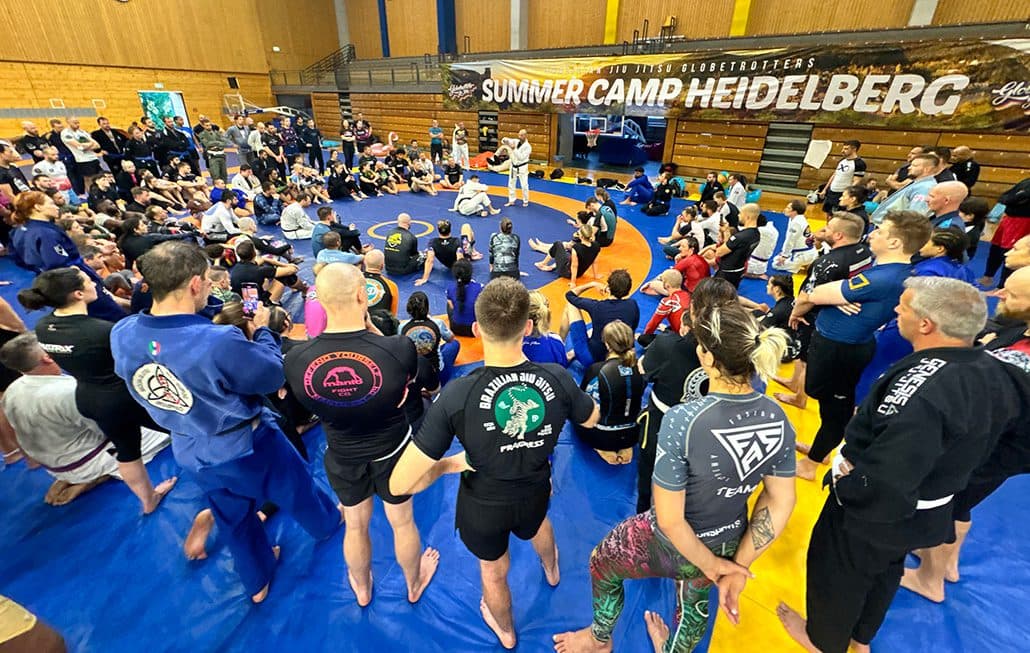
Main photo: BJJ Globetrotters; illustrative archive photograph.
The takeaway
Open mat gives you more choices than a tightly structured class. Use them. Decide why you are going, leave space for rest and questions, and choose a stopping point that respects the rest of your day. The most useful session is not automatically the one with the latest departure.
The timer will continue after you put your shoes on. That is evidence that the academy still has a working timer, not that you owe it another round. Thank your partners and go where you said you would be.
Find a session that fits your afternoon
Browse open mats, then confirm the current time, visitor policy, and session format with the host before attending.
FAQ
How long should I stay at a BJJ open mat? Choose a duration that fits your training purpose, experience, and other commitments. There is no required number of rounds in this guide. Confirm the host's session format and leave enough time to change and depart properly.
Is it okay to skip rounds at open mat? Yes. Tell potential partners that you are resting or sitting out. Use the time as you need, while following the academy's rules and staying clear of active training space.
Can I drill instead of rolling at open mat? Ask the host and find a willing partner. Some sessions make room for technical work, while others are organized mainly around rounds. Agree on the task before starting rather than assuming your partner wants the same practice.
How do I leave without seeming rude? Say you have finished, thank your partners, and follow the academy's departure or cleanup expectations. A clear goodbye is usually more considerate than repeatedly accepting rounds while worrying about a commitment elsewhere.

Kit Langford
Kit Langford covers the louder parts of jiu-jitsu — the marketing claims, the arguments, the gear that promises more than gear can deliver. The jokes are expected to survive a fact-check.
Related Posts

Mikey Musumeci gives up the belt to make room for MMA
Musumeci is vacating his UFC BJJ title to focus on MMA training. What he is leaving, what continues, and why the transition matters.
IBJJF membership: finish the paperwork before the deadline
IBJJF membership and tournament entry are separate steps. Plan documents, professor approval, renewals, and junior accounts before registration closes.
Choosing a BJJ seminar worth your time and travel
Choose a BJJ seminar by the subject, teaching format, access, and total cost. Know what to ask the host before buying a ticket.
Comments (0)
Loading comments...