
Getting better at BJJ, or just learning your teammates?
Quick answer: Learning a teammate's habits is a real part of training, but it does not prove that every skill will transfer to a new partner. Change one condition at a time, practice with a reasonable range of partners, and notice whether you can explain why a technique works. An unfamiliar reaction can reveal a useful gap without invalidating your progress.
You know the pass before your partner finishes tying the belt. You know which side they like, the grip they reach for, and the point at which they usually abandon plan A.
That familiarity can make a round feel wonderfully clear. It can also leave a small question sitting beside the progress: did you learn the position, or did you learn the person who keeps giving you the same version of it?
The answer may be both. There is no need to throw away your regular partners or turn every open mat into an examination. A few deliberate changes can help you find out what travels beyond the comfortable rhythm of your usual rounds.
Familiarity is useful information
Recognizing a partner's preference is not cheating. Grappling happens against people who have habits, and noticing those habits is part of paying attention. You would not deliberately forget a grip just because you have seen it before.
The useful distinction is between recognizing an opening and requiring a particular person to create it. If the technique depends on one teammate making the same unnecessary movement every time, your success may be narrower than you think.
That does not make the rounds worthless. They give you a repeatable place to work. You can use the familiarity to test a detail, compare two responses, or practice a transition without having to solve an entirely new problem on every repetition.
Keep the benefit and add a question. What exactly did you recognize? Was it a positional cue that another partner could also give, or a personal habit that exists mostly in this pairing? Being able to describe the difference is more helpful than deciding the whole session either counts or does not count.
Change the start before changing the whole room
If a familiar round has become predictable, begin somewhere else. Ask the partner and instructor about a controlled positional start that interrupts the usual opening. You can keep the same person while removing the sequence both of you know by heart.
For example, start just before the point where your preferred pass normally succeeds. Let the partner begin with a slightly different defensive connection that the coach considers appropriate. Now you have a specific question: can you still reach the next position when that familiar opening is absent?
Keep the change small enough to interpret. If you change the partner, position, intensity, and rules simultaneously, a difficult round will tell you very little about which variable mattered. You may simply spend five minutes discovering that everything is harder when everything is different.
A single altered start gives you something to discuss afterward. Ask where the sequence changed and whether you noticed it in time. The round becomes a manageable experiment instead of a referendum on your entire ability.
Tell the partner what you are trying to learn
There is a temptation to keep a new idea secret until it works. Surprise feels satisfying. But a regular teammate who knows the question can help you learn more than a teammate who has unknowingly been assigned the role of test subject.
Ask for a realistic response rather than a cooperative ending. You might request that they try a different escape when the position appears, or that they begin the drill with the grip you find awkward. Keep the task within what both of you understand and what the instructor permits.
The partner should also have a useful assignment. They are not a piece of equipment hired for your personal research department. Agree on when to switch roles or how their own training goal fits the exercise.
This conversation can be short. The point is to make the work clear, not to hold a meeting before every round. A sentence about the start and a sentence about the objective will often give both people enough information to begin productively.
Look for the skill underneath the successful move
A technique working is an event. Understanding why it worked gives you a better chance of recognizing when to use it again. After a familiar success, identify the condition that made the action possible.
Did your partner's weight move somewhere useful? Did a grip prevent the recovery you were expecting? Did you maintain a connection through the transition? Those are questions about the position. They help separate transferable information from the fact that you happen to know this person's favorite escape.
Write the answer plainly. If you cannot explain it without saying that your partner always does a certain thing, you may have found the boundary of your current understanding. That is an excellent question to take to your coach.
Do not demand a perfect explanation of every successful action. Training includes things you can do before you can describe them neatly. The aim is to choose one recurring success and understand it better, not to turn your notebook into a technical manual that delays you from actually practicing.
Add different partners without collecting verdicts
A reasonable range of partners can expose you to different timing, movement, and preferences. Ask the instructor for suitable pairings rather than treating variety as a reason to ignore differences in experience or the purpose of the session.
Begin with curiosity about the exchange. If your usual sweep does not appear, notice why. Perhaps the partner never supplies the grip you expect. Perhaps they move earlier, or keep a different posture. Those observations are more useful than deciding immediately that your home-room success was imaginary.
An unfamiliar partner does not have to be a harsher partner. You can agree on a controlled round and still learn a great deal from a different response. More intensity is not the only way to change the information coming back to you.
If you plan an outside visit through the open-mat listings, follow the host's procedures and explain your experience honestly. You are there to train with people, not to extract a final verdict about whether your academy's jiu-jitsu is real.
Keep a record that fits in two minutes
A training note should help you return to the question next time. It does not need to reproduce the whole round, including the moment someone on the neighboring mat knocked over a water bottle.
For one position, record three things:
What you expected the partner to do.
What they actually did instead.
The next response you want to ask about or practice.
This is enough to make the following session more specific. You can show the coach where the familiar sequence stopped making sense instead of announcing that your entire game has stopped working.
Review the notes after several sessions. Look for repeated uncertainties, not a score of good and bad days. If the same defensive response confuses you across different partners, you have a clear training priority. If the problem appears only in one pairing, investigate that pairing without assuming it represents the whole position.
The notebook should make the next conversation easier. If maintaining it becomes another reason to feel behind, shorten it. One useful sentence beats an abandoned system with color-coded categories.
Return to the regular partner with a better question
After trying the position elsewhere, come back to the familiar teammate. Their consistency can help you examine what changed. You already know the usual exchange, so a new reaction may be easier to isolate together.
Explain the problem you encountered without turning the visitor or outside room into a mysterious higher authority. A different partner gave you a different response. That is enough. You do not need to declare that everything at home has been too easy.
Ask to recreate the relevant moment under the instructor's guidance. If the partner cannot reproduce it exactly, work with the closest clear version you can establish. The aim is to understand the decision, not stage a forensic reenactment of Tuesday's third round.
Then allow normal training to continue. Familiar partners remain valuable for reasons that extend beyond technical novelty: they know the exercise, understand your requests, and can share a long-running problem with you. Variety should enrich those relationships rather than make you suspicious of every round that feels comfortable.
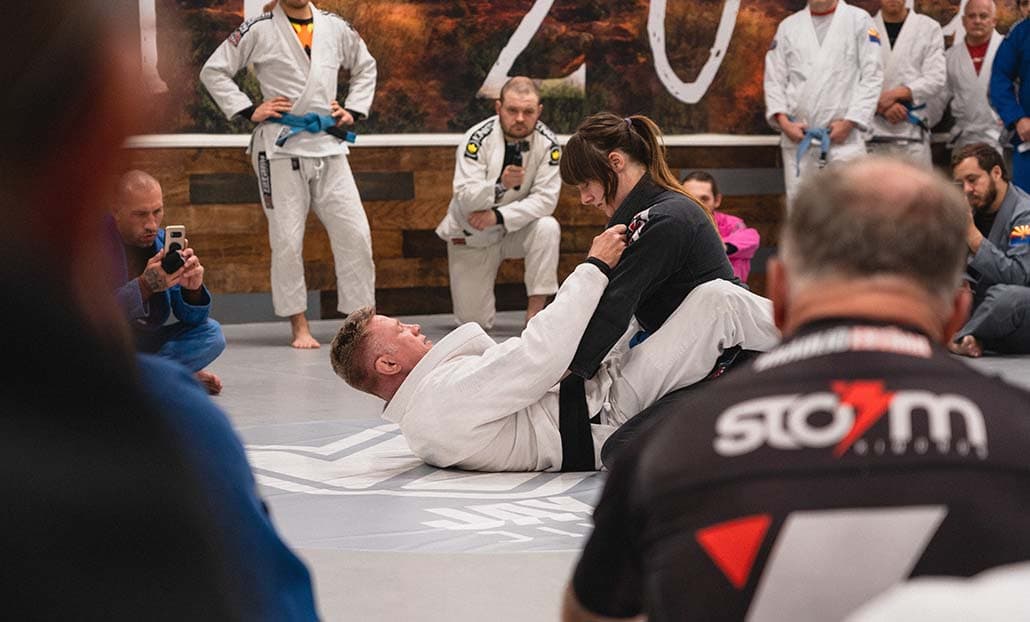
Main photo: BJJ Globetrotters; archive training-camp photograph.
The takeaway
Knowing your teammates and improving your jiu-jitsu can happen at the same time. The question is whether you understand the conditions behind a successful action and can adapt when those conditions change.
Alter one starting point, ask for a different response, or try a suitable new partner. Then bring the information back to your regular room. You do not need to abandon familiar training; you need to make sure familiarity is helping you notice more rather than allowing you to stop noticing.
Find a suitable room for an occasional visit
Explore the gym directory, contact the host, and make the purpose and pace of your visit clear before joining a session.
FAQ
Does beating the same training partner mean I am improving? It may reflect better technique, better knowledge of that partner, or both. Look at the specific action and whether it still works when the relevant response changes.
Should I stop rolling with familiar teammates? No. Familiar partners can make practice more precise. Add different starts or responses, and use suitable partner variety to investigate what you are learning.
Does a difficult drop-in prove my home gym is bad? No. One visit contains many unfamiliar conditions and cannot fairly establish that conclusion. Identify the particular problems you encountered and discuss them with your instructor.
What should I write after a round? Note one expectation, the response that differed from it, and the next question you want to investigate. Keep the record short enough that you will actually use it.

Owen Bellamy
Owen Bellamy writes for the person training twice a week around a job. Nothing he suggests requires quitting the job.
Related Posts

Mikey Musumeci gives up the belt to make room for MMA
Musumeci is vacating his UFC BJJ title to focus on MMA training. What he is leaving, what continues, and why the transition matters.
IBJJF membership: finish the paperwork before the deadline
IBJJF membership and tournament entry are separate steps. Plan documents, professor approval, renewals, and junior accounts before registration closes.
Choosing a BJJ seminar worth your time and travel
Choose a BJJ seminar by the subject, teaching format, access, and total cost. Know what to ask the host before buying a ticket.
Comments (0)
Loading comments...