
BJJ Grips and Grip Fighting: A Beginner's Guide
Quick answer: Grip fighting is the battle for control of your opponent's gi, wrists, and collar before and during every exchange. Whoever wins the grips usually wins the position. Beginners should learn a few core gi grips (collar, sleeve, pant), basic no-gi grips (wrist control, underhooks, two-on-one), and how to break the other person's grips.
In BJJ, the fight often starts before any submission or sweep — it starts with the hands. Grip fighting is the quiet, constant battle for control that decides who gets to attack and who's stuck defending. Master it early and the whole game gets easier.
Why grips matter so much
A grip is a connection point that lets you control, off-balance, and attack your opponent — or stops them from doing the same to you. In nearly every BJJ exchange, the person who establishes strong grips first dictates what happens next: they can sweep, pass, or submit, while the other person is one step behind. That's why high-level players obsess over grip fighting that beginners barely notice.
Essential gi grips
In the gi, you grip the cloth itself, which gives you powerful, reliable control:
Collar grip — gripping the lapel near the neck, used for chokes, control, and breaking posture.
Sleeve grip — gripping the end of the sleeve to control an arm, set up sweeps, and shut down their attacks.
Pant grip — gripping the trouser at the knee or ankle to control the legs for passing or sweeping.
Collar-and-sleeve — the classic combination from guard, controlling one arm and the collar to off-balance and attack.
Essential no-gi grips
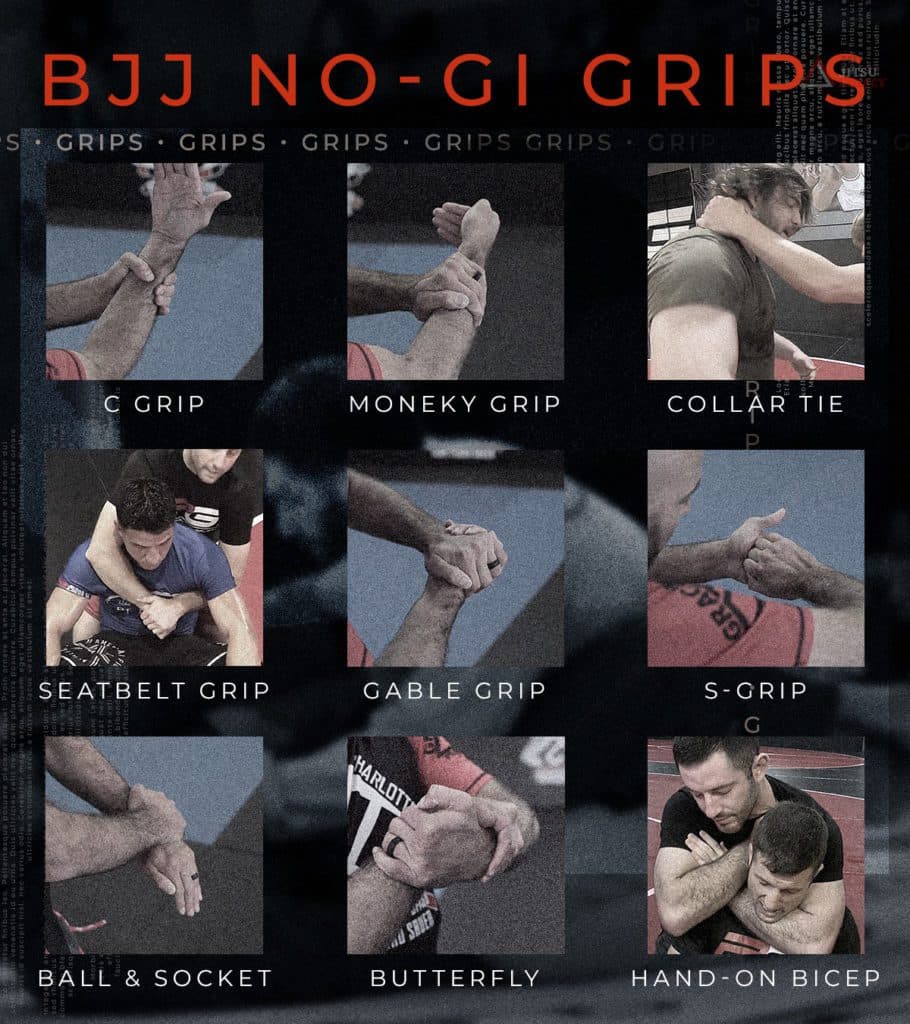
Without cloth to grab, no-gi grips rely on the body and friction:
Wrist control — gripping the wrist to manage an arm, the no-gi equivalent of the sleeve grip.
Underhooks — threading your arm under your opponent's arm to control their torso; one of the most important controls in all of grappling.
Two-on-one (Russian tie) — both hands controlling one of their arms, a powerful tool for takedowns and back-takes.
Collar tie and overhook — controlling the head and neck in the clinch.
How to break grips
Just as important as making grips is breaking your opponent's. A few beginner principles:
Use your whole body, not just your hand. Strip a sleeve grip by driving your hips and turning, not arm-wrestling their fingers.
Attack the weak part of the grip — the thumb. Grips are weakest where the thumb meets the fingers, so direct your force there.
Break the grip, then immediately act. A broken grip only helps if you pass, sweep, or re-grip before they re-establish. Don't break and pause.
Grip-fighting strategy for beginners
You don't need dozens of grips — you need a few you trust and the habit of fighting for them. Start every exchange thinking: Whose grips are winning right now? If theirs, break and replace; if yours, attack. Simply paying attention to grips puts you ahead of most beginners, who flail with their hands without a plan. As you develop, grips tie directly into your guard, passing, and positions.
The takeaway
Grip fighting is the hidden layer that decides most BJJ exchanges. Learn a handful of core gi grips (collar, sleeve, pant) and no-gi grips (wrist control, underhooks, two-on-one), get good at breaking grips with your whole body, and always know whose grips are winning. Win the grips, and you win the position.
Train your grip endurance
Grip strength and endurance fade fast in long rounds, and tired hands lose the grip battle. You can build grip-specific endurance with simple work: dead hangs from a pull-up bar, towel or gi hangs, and farmer's carries all translate directly to holding collars and sleeves deep into a roll. Just as important is gripping efficiently — don't death-grip everything constantly, or your forearms burn out in minutes. Grip with intent when it matters, relax when it doesn't, and your hands will last the whole class. Smart gripping beats white-knuckling every time.
A common grip mistake
The biggest grip mistake beginners make is gripping with no purpose — grabbing whatever cloth is nearest and holding on for dear life. A grip should always set up something: a sweep, a pass, a submission, or breaking your opponent's posture. If a grip isn't helping you do one of those, it's just tiring your hands. Grip with a plan, and let go the moment the grip stops serving you.
Put grips into practice
Find a BJJ gym near you on Let's Roll → — a good fundamentals class drills grip fighting alongside positions and submissions.
FAQ
What is grip fighting in BJJ? The constant battle to control your opponent's gi, wrists, or body with your grips while denying theirs. Winning the grips usually decides who controls the exchange.
What are the most important BJJ grips for beginners? In the gi: collar, sleeve, and pant grips. In no-gi: wrist control, underhooks, and the two-on-one. Plus knowing how to break your opponent's grips.
How do you break a grip in BJJ? Use your whole body and hips rather than just your hand, attack the grip at its weakest point (the thumb), and immediately move to attack before your opponent re-grips.
Why do I keep losing the grip battle? Usually because you're reacting instead of fighting for grips first. Establish your grips proactively and pay attention to whose grips are winning at all times.
Related Posts

Mikey Musumeci gives up the belt to make room for MMA
Musumeci is vacating his UFC BJJ title to focus on MMA training. What he is leaving, what continues, and why the transition matters.

IBJJF membership: finish the paperwork before the deadline
IBJJF membership and tournament entry are separate steps. Plan documents, professor approval, renewals, and junior accounts before registration closes.
Choosing a BJJ seminar worth your time and travel
Choose a BJJ seminar by the subject, teaching format, access, and total cost. Know what to ask the host before buying a ticket.
Comments (0)
Loading comments...