
BJJ Positions Explained: Guard, Mount, Side Control, and More
Quick answer: BJJ is built on positions. The main ones are guard (you're on your back controlling with your legs), side control, mount, and back control (dominant top positions), plus half guard and turtle (transitional). The golden rule is "position before submission" — control a dominant position first, and the finish follows almost on its own.
If submissions are the punchlines of BJJ, positions are the grammar. Once you understand them, rolling stops feeling like random chaos and starts looking like a map you can navigate. Here's the beginner's tour of every position you need to know, who's winning in each, and why the positional hierarchy is the backbone of the whole sport.
Guard
Guard is the position that makes BJJ unique: you're on your back (or sitting up), using your legs and hips to control someone in front of you. Far from being helpless, a good guard lets you defend, sweep your opponent over, and attack submissions. "Closed guard" wraps your legs around their waist and locks them in place; "open guard" uses your feet, shins, and grips to control at range. Learning to fight off your back in guard is, in a real sense, learning BJJ — it's the skill that separates the art from plain wrestling.
Mount
Mount is sitting on top of your opponent's torso, knees on the mat — one of the most dominant positions in grappling. You have gravity, control, and a buffet of submissions like the armbar and collar chokes, while they have very few good options. Because mount is so dominant, escaping mount is one of the first survival skills every beginner has to drill, usually via bridging and shrimping back to guard.
Side control
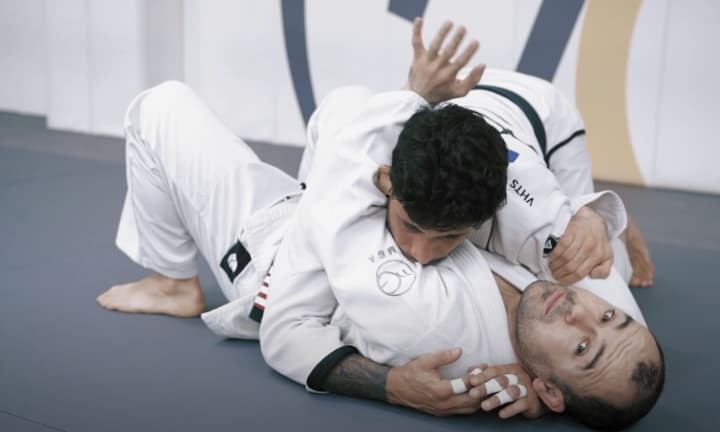
Side control is pinning your opponent perpendicular to you, chest-to-chest, after you've passed their guard. It's a strong, heavy control position and, just as importantly, a hub: from side control you can advance to mount, take the back, or attack submissions like the kimura and americana. Learning to maintain it on top — and to recover guard from underneath it — is core beginner curriculum.
Back control
Back control — taking someone's back with your "hooks" (your heels) inside their thighs and an arm working toward their neck — is the single most dominant position in BJJ. Your opponent can't see you, can't easily defend, and the rear naked choke is right there. So much of high-level jiu-jitsu revolves around getting to the back and defending against people trying to take yours.
Half guard
Half guard is the in-between position where you control one of your opponent's legs with both of yours. It used to be considered a bad spot to be stuck in, but modern BJJ treats half guard as a rich position in its own right — full of sweeps, back-takes, and ways to recover full guard. For many smaller or older grapplers, a strong half guard becomes the center of their whole game.
Turtle
Turtle is when someone is on their hands and knees, tucked into a defensive ball. It's transitional — somewhere you pass through, attack from (often on your way to taking the back), or escape from — not a place anyone wants to stay. Knowing how to attack and defend the turtle fills an important gap in a beginner's understanding.
Passing the guard
One concept ties the top positions together: guard passing. To get from facing someone's guard to a dominant pin like side control or mount, you have to get past their legs — that's "passing the guard." A big part of the top game is learning to pass safely without getting swept or submitted on the way through.
The positional hierarchy
Here's the rough ranking of control, worst to best for the top player: in someone's guard → past it into side control → mount → back control. The bottom player's job is to climb that ladder back the other way — escape to guard, then sweep or stand up. Understanding this hierarchy tells you, at any moment, whether you're winning the exchange and which direction you're trying to go.
Why position matters more than submissions
The phrase you'll hear constantly is "position before submission." Chasing a flashy finish from a bad spot gets you swept, passed, or smashed. Control a dominant position first, make your opponent defend, and the submission opens up almost by itself. This principle is the single most important strategic idea in BJJ, and internalizing it early will make you better faster than memorizing any individual move.
The takeaway
Learn the positions and who's winning in each, and rolling transforms from chaos into chess. Guard keeps you safe and dangerous on the bottom; side control, mount, and back control win on top; half guard and turtle are the transitions in between; and "position before submission" ties it all together. Master the map before you chase the finishes.
Learn the positions on the mat
Find a BJJ gym near you → — a good fundamentals class teaches these positions in a logical order so they actually stick.
FAQ
What is the most dominant position in BJJ? Back control, with your hooks in. Your opponent can't see or easily defend you, and the rear naked choke is highly available.
What does "position before submission" mean? Secure a controlling position before hunting a finish. Chasing submissions from bad spots usually backfires; controlling first makes the finish far higher-percentage.
Is guard a losing position? No — in BJJ, fighting off your back in guard is a skill, not a defeat. A strong guard can sweep and submit a top opponent, which is what makes jiu-jitsu different from plain wrestling.
What's the hardest position to escape? Back control and a tight mount are the toughest for beginners. Drilling escapes from both early pays off enormously.
Related Posts

Mikey Musumeci gives up the belt to make room for MMA
Musumeci is vacating his UFC BJJ title to focus on MMA training. What he is leaving, what continues, and why the transition matters.
IBJJF membership: finish the paperwork before the deadline
IBJJF membership and tournament entry are separate steps. Plan documents, professor approval, renewals, and junior accounts before registration closes.
Choosing a BJJ seminar worth your time and travel
Choose a BJJ seminar by the subject, teaching format, access, and total cost. Know what to ask the host before buying a ticket.
Comments (0)
Loading comments...