

Does your BJJ gi color matter? Ask where you plan to wear it.
Quick answer: A BJJ gi’s color does not indicate your rank, but it can affect where you are allowed to wear it. Check your academy’s uniform policy and your tournament’s requirements before buying, especially if you want one gi to serve several purposes.
A purple gi is a clothing choice. A purple belt is a rank. The two can meet in the same outfit, but buying the first does not involve earning the second.
The practical question is less entertaining: will the academy let you train in it, and will the event let you compete in it? Answer those questions before deciding that the unusual color is either a harmless purchase or an argument you would like to have at the front desk.
The belt and the jacket have different jobs
In ordinary BJJ ranking systems, the belt carries the rank. The jacket does not become a qualification because it shares a color with one of the belts. A beginner wearing a blue gi is still a beginner, and a black belt wearing a white gi has not surrendered anything.
That distinction is useful for new students who are trying to interpret the room. You may see experienced people in several gi colors and assume the pattern is meaningful. It might reflect a school rule, a team uniform, or simply what was clean that day.
Ask before drawing conclusions from appearance. Uniform customs can be local, and the same color can have different practical significance at different academies. A matching set of gis may be part of an event or photo rather than the school’s everyday requirement.
The belt-system guide covers rank separately. Keep that subject separate while shopping. Your first gi needs to meet the school’s requirements and fit your body; it does not need to communicate a future promotion.
Ask the academy before ordering
Schools can set their own uniform policies. Some permit a broad range of colors, while others require particular colors, patches, or branded equipment. Do not assume that what you wore at a previous gym will be accepted without a conversation.
Ask a precise question. Say which color and model you want to buy and whether you are joining regularly or visiting for one class. A policy for members may include arrangements that are different from those offered to short-term visitors.
If you are starting from scratch, request the equipment instructions before making the purchase. A staff member may be able to explain approved options, ordering arrangements, or whether you need a gi for the first trial at all. That can prevent an unnecessary order.
You can disagree with a policy and still make the decision without a confrontation. Consider its cost and practical effect alongside the rest of the membership. The useful choice is whether the academy’s arrangement suits you, not whether you can win a general debate about what every gym should permit.
Competition rules are not the same as class rules
A gi accepted at training may not meet a tournament’s requirements. Color is only one possible issue; material, fit, repairs, and patches can also matter. Read the organizer’s full instructions instead of treating approval from your coach as a substitute for the event’s inspection.
For example, the IBJJF uniform guidance identifies permitted gi colors and other specifications. Check the current page and linked updates when preparing for its events. Another organizer may have a different policy, so a successful inspection at one competition does not settle the next one.
Do not rely solely on photographs of professional matches. The event in the photograph may use different rules, and an image does not tell you every detail of the uniform inspection. It is a poor replacement for the document that applies to your division.
If a seller describes a gi as competition approved, ask approved for what. The answer should identify an organizer or standard, and you should still verify that the current requirement matches the garment. A phrase on a product page cannot promise acceptance at every future event.
Choose a versatile first uniform
If you want one gi for classes, visits, and occasional competition, prioritize the overlap between those requirements. A color accepted by your regular school and likely destinations can reduce the number of separate outfits you need. Confirm the actual policies rather than assuming a universal safe choice.
Fit and availability still matter. There is little value in buying the theoretically most versatile color in a model that does not fit or cannot arrive before you need it. Compare the complete options, including size, return terms, and the academy’s instructions.
Consider the full purchase cost. A gi that requires a school patch or an additional competition outfit may not be the cheapest option overall, even if its initial price is lower. This is ordinary budgeting, not a reason to regard every uniform policy as an attempt to make you buy more.
Once you have a reliable everyday uniform, a second color can be a preference rather than a complicated strategic decision. You already know what works for the settings you use most. The interesting new jacket does not have to carry every responsibility in your training life.
Think about visiting before packing
A visit is the wrong moment to discover a color restriction. When contacting a host academy, include a short equipment question alongside the date and class you hope to attend. Tell them what you have rather than asking a vague question about whether they are relaxed about uniforms.
A useful message can confirm:
Whether your gi color is accepted for that session.
Whether outside academy patches are permitted.
Whether a loan or rental option exists if your kit is unsuitable.
Whether the class is actually gi, no-gi, or a mixed-format open mat.
Do not assume an alternative is available simply because the host welcomes visitors. Loan gis need to exist in a suitable size and condition, and staff need time to organize them. Ask before arriving with a bag full of optimism and no usable jacket.
If you visit several academies on one trip, check each one. A friendly answer from the first school does not create a policy for the rest of the city. Save the replies with your booking details so you do not have to reconstruct the conversation at the door.
Care for the garment according to its instructions
Color does not replace the care label. Follow the manufacturer’s washing and drying instructions and ask the seller about any concern specific to the fabric or dye. Avoid improvising with harsh products because somebody online said they made a different gi look newer.
Wash and maintain training clothing consistently with the academy’s hygiene expectations. A dark fabric can make some marks less visible, but that does not make the garment cleaner. The wash schedule should follow use, not whether you can still see the evidence of the last class.
Check a new garment’s instructions before washing it with other kit. If the manufacturer gives guidance about separating colors or handling the first wash, follow it. You do not need a surprise color experiment involving your partner’s white uniform.
Consider how the gi’s appearance changes over time without treating ordinary wear as a crisis. Fading and damaged construction are different issues. If the fabric, seams, or patches become unsuitable for training or inspection, address that condition rather than assuming the color itself is the problem.
Let preference remain a preference
Once the practical requirements are satisfied, you are allowed to like a color. It does not need to express your approach to guard passing or announce an opinion about tradition. Some people enjoy plain equipment; others enjoy designs that are difficult to miss from the far side of the room.
Neither preference proves technical seriousness. A quiet-looking uniform can belong to a highly expressive person, and an elaborate one can belong to somebody who mostly wants to attend class after work. Avoid using clothing as a shortcut to decide what kind of partner someone will be.
The same restraint helps when somebody asks about your choice. You can explain that the color works with your school’s policy and that you like it. You do not need to recruit them into buying the same thing or defend the garment against every possible joke.
If your preference conflicts with a setting you value, decide which matters more for that use. Wear an accepted gi there and keep the other one for a room that permits it. A wardrobe can contain a practical compromise without turning into an ideological settlement.
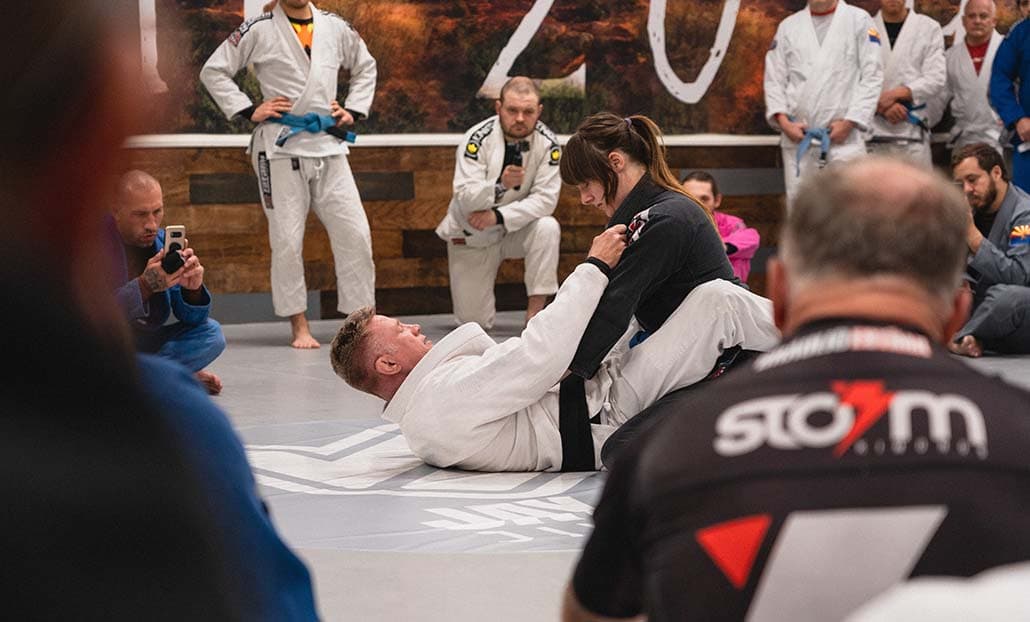
Main photo: BJJ Globetrotters; illustrative archive photograph.
The takeaway
Check the school and the event before choosing a gi color. Keep rank, training policy, and competition eligibility separate, then compare fit and total cost across the options that remain. That order makes the purchase much less surprising.
After those checks, personal taste can have its turn. A gi does not have to explain who you are. It has to fit, be maintained properly, and be welcome on the mat where you intend to wear it.
Ask before your next visit
Browse open mats, then contact the host about gi colors, patches, and visitor equipment requirements before packing.
FAQ
Does wearing a blue gi mean someone is a blue belt? No. Gi color and belt rank are separate. The academy may have a uniform policy, but a jacket color does not by itself indicate a student’s level.
Is every gi color allowed at BJJ classes? That depends on the academy. Ask for its uniform policy before buying or visiting, including any patch or branding requirements that apply to your situation.
Can I compete in the same gi I use for training? Possibly, but check the event’s material, color, fit, and patch rules. A uniform accepted in class is not automatically eligible for every tournament.
Should my first gi be chosen mainly for versatility? Versatility can be useful if one uniform must cover several settings. Confirm those settings’ requirements first, then choose a suitable fit and price rather than assuming one color solves every issue.

Kit Langford
Kit Langford covers the louder parts of jiu-jitsu — the marketing claims, the arguments, the gear that promises more than gear can deliver. The jokes are expected to survive a fact-check.
Related Posts

Mikey Musumeci gives up the belt to make room for MMA
Musumeci is vacating his UFC BJJ title to focus on MMA training. What he is leaving, what continues, and why the transition matters.

IBJJF membership: finish the paperwork before the deadline
IBJJF membership and tournament entry are separate steps. Plan documents, professor approval, renewals, and junior accounts before registration closes.
Choosing a BJJ seminar worth your time and travel
Choose a BJJ seminar by the subject, teaching format, access, and total cost. Know what to ask the host before buying a ticket.
Comments (0)
Loading comments...