
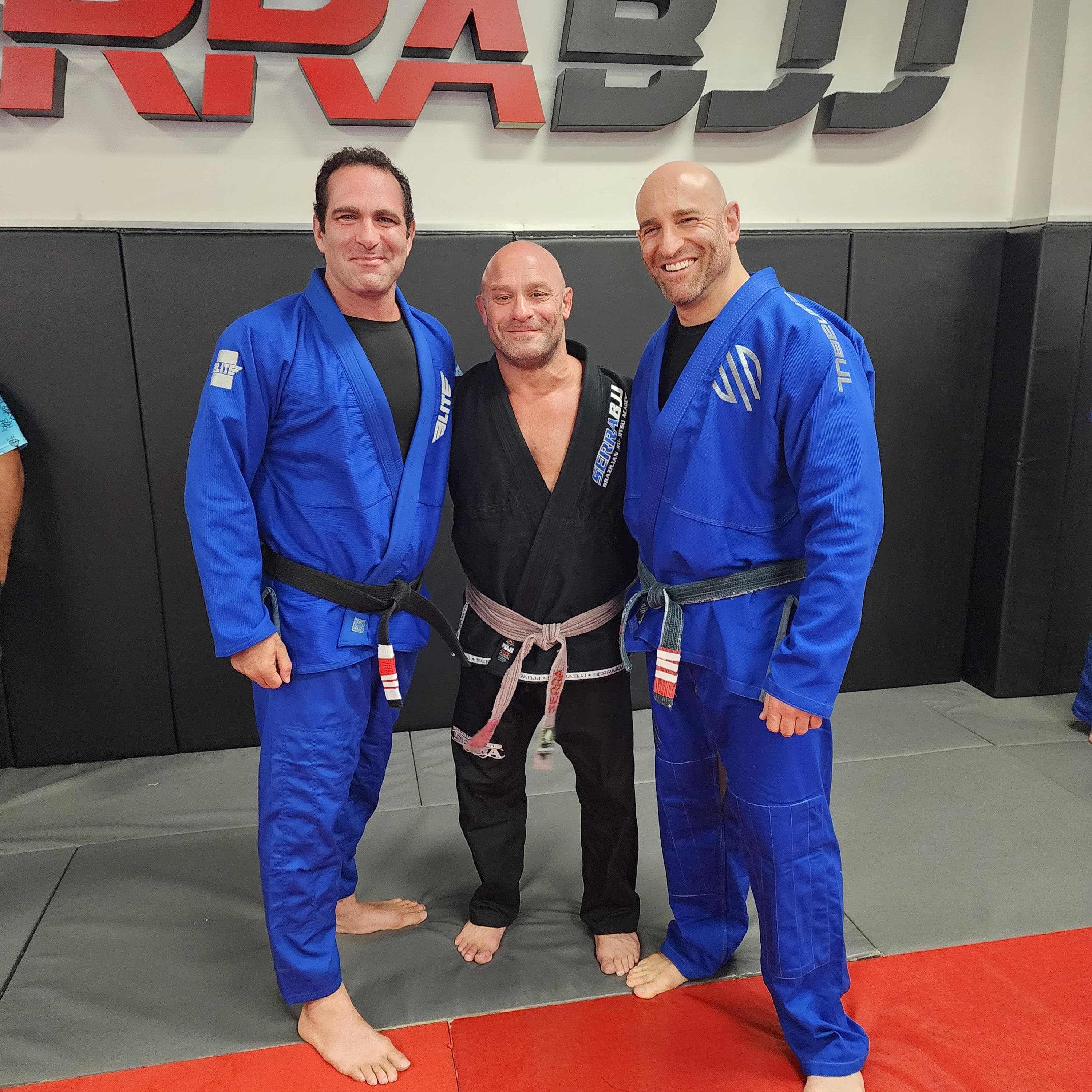
What It Really Takes to Get a BJJ Black Belt
Quick answer: A BJJ black belt takes most people around ten years of consistent training — sometimes eight, sometimes fifteen. It's slower than any other mainstream martial art because rank is tied to demonstrated ability against fully resisting opponents, not memorized curriculum. And the people who get there aren't the most talented ones. They're the ones who kept showing up through plateaus, injuries, and life.
"How long to get a black belt?" is usually the second question new students ask, right after "how much does it cost?" Most arts have a tidy answer. BJJ's answer tends to end the conversation.
Here's the honest version of that answer — the number, the reasons behind it, and what the belt does and doesn't change.
The ten-year number, honestly
The commonly cited average is about ten years, and it holds up reasonably well across academies. Gifted full-time athletes have done it in four or five; busy hobbyists routinely take twelve to fifteen. The IBJJF's formal minimums (time at brown, minimum age of 19) barely matter — almost nobody is racing the paperwork.
The more useful framing is hours, not years. Somewhere in the low thousands of mat hours is where black belts tend to live, and how fast you accumulate those hours is mostly a question of what your life allows. Three classes a week for twelve years and six classes a week for six years arrive at similar places.
Why it's slower than every other martial art
In many traditional arts, a dedicated student earns a black belt in three to five years by progressing through a curriculum: forms, techniques, gradings. BJJ takes two or three times longer, and the reason is structural, not snobbery.
BJJ rank is validated by sparring. You roll against fully resisting opponents nearly every class, so your belt reflects what you can actually do, not what you can recite. There's nowhere to hide a gap.
The art is unusually deep. Guards, passing, pins, submissions, and their endless interactions — the technical surface area simply takes longer to cover than most striking curricula.
Promotion is one person's judgment. There's no central grading board; your coach watches you for years and promotes when you roll like a black belt. Human judgment is slow and stubborn, and that's the feature.
The slowness is the credential. A BJJ black belt means roughly the same thing in Tokyo, Texas, and Trondheim precisely because it can't be bought, crammed, or tested for in a weekend.
Who actually makes it
Here's the pattern coaches will confirm: the students who reach black belt are rarely the most athletic people who walked in. The natural athletes often burn bright for two years and vanish. The ones who make it are the ones who solved the boring problem — attendance, sustained across a decade.
That means surviving the well-documented quitting cliffs at blue and purple, training around injuries instead of through them, and finding a schedule that coexists with careers, kids, and aging. Consistency is genuinely the entire game, which is why we wrote a whole piece on how to stay consistent with BJJ. Talent decides how fast the first two years go. It decides almost nothing after that.
What changes when you tie it on
The honest answer: nothing, and everything. Nothing, because you're exactly as good the day after promotion as the day before, tough rounds stay tough, and twenty-year-old blue belts will still occasionally make your life difficult.
Everything, because the room changes around you. Your rolls become other people's measuring stick, your habits become the gym's culture, and questions start coming to you. Most new black belts report the same two feelings: relief, followed within weeks by the discovery of how much they still don't know.
A black belt only covers two inches of your ass. You have to cover the rest. — Royce Gracie
The degrees, briefly
Black belt isn't the last rank — it's a track of its own. Degrees accumulate with years of continued practice and teaching, spaced several years apart under IBJJF rules, until the seventh degree brings the coral belt and, decades later, the red belt of ninth and tenth degree — that last one reserved for the art's pioneers.
Practically, you don't need the details. The takeaway is that the system assumes people keep training for thirty or forty more years, which tells you how the art views black belt: a milestone on a much longer road. (For the full ladder below black, see belt progression.)
"The belt is a beginning" — examined
Every promotion speech says it, so it's fair to ask whether it's true or just something people say. Honestly: both.
It's cliché because it flatters the moment. But it's true in a concrete way — most black belts will tell you their understanding reorganized itself in the years after promotion, when the pressure of chasing rank finally lifted and they could study the art on its own terms. The belt ends the pursuit. What's left afterward turns out to be the actual jiu-jitsu.
The takeaway
Ten years, give or take. Slower than every other art because sparring keeps the rank honest. Won by ordinary people who kept showing up rather than talented people who started fast. And on the other side: the same you, the same tough rounds, and a much longer road that finally belongs to you.
That's the deal. It's a good one.
Ten years starts with one class
Nobody plans a decade — they just find a good room and keep coming back. Find a BJJ gym near you on Let's Roll →
FAQ
How long does it take to get a black belt in BJJ? Around ten years on average, with a realistic range of roughly eight to fifteen depending on how often you train. Full-time competitors occasionally do it faster; nobody serious treats speed as the point.
Why does a BJJ black belt take so much longer than other martial arts? Because rank is validated by live sparring against resisting opponents rather than by memorized curriculum and gradings. Your belt has to survive contact with reality every single class.
Can anyone get a BJJ black belt? Most physically ordinary adults can, given consistency over a decade. The limiting factor is almost never talent or athleticism — it's sustaining two to four sessions a week through injuries, plateaus, and life.
What are the degrees on a BJJ black belt? Degrees are awarded for continued years of practice and teaching after black belt, spaced several years apart. The seventh degree brings the coral belt, and the ninth and tenth degree red belts are reserved for the art's founding generation and its most senior figures.
Related Posts

Mikey Musumeci gives up the belt to make room for MMA
Musumeci is vacating his UFC BJJ title to focus on MMA training. What he is leaving, what continues, and why the transition matters.
IBJJF membership: finish the paperwork before the deadline
IBJJF membership and tournament entry are separate steps. Plan documents, professor approval, renewals, and junior accounts before registration closes.
Choosing a BJJ seminar worth your time and travel
Choose a BJJ seminar by the subject, teaching format, access, and total cost. Know what to ask the host before buying a ticket.
Comments (0)
Loading comments...