
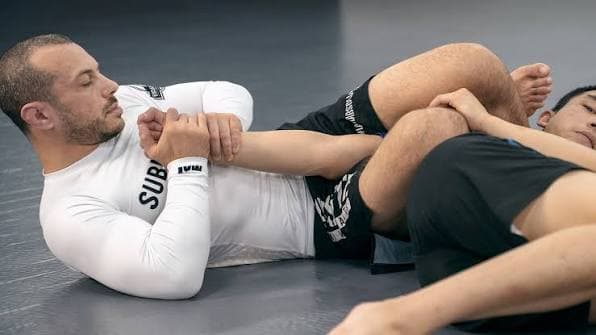
The Armbar: The First Submission Every Grappler Learns
Quick answer: The armbar is a joint lock that hyperextends the elbow by trapping an opponent's arm between your legs and pulling it straight across your hips. It's usually the first submission taught in BJJ because it appears from every major position — guard, mount, and back — and because it teaches the sport's core lesson: control the whole person before you attack the limb.
Walk into almost any BJJ gym on a fundamentals night and there's a decent chance the armbar is on the whiteboard. It's the sport's default first submission, and that's not tradition for tradition's sake — it's the technique that best teaches how jiu-jitsu thinks.
Older than BJJ itself
The armbar didn't originate in Brazil. Judo calls it juji-gatame — the cross armlock — and it was a competition staple in Japan long before the Gracies built their system around ground fighting. BJJ inherited it, refined the entries, and gave it far more time on the ground to breathe.
The wider world learned it through MMA. Ronda Rousey, a judo Olympian, ran through an entire UFC division with essentially one submission — this one — which says something about how far a deeply understood armbar can carry you.
Why it's taught first
Plenty of submissions are easier to finish. The armbar earns its place at the front of the curriculum for different reasons.
It appears everywhere. From closed guard, from mount, from back control, from scrambles — one mechanical idea recurs across the entire positional map, which makes it efficient to teach and endlessly useful to know.
It also teaches the grammar of the sport. To armbar someone you have to isolate a limb, control their posture, manage your hips, and break their grips — and those four skills are most of jiu-jitsu. Even when your armbar fails, practicing it is teaching you the game. It's the natural starting point among the fundamental submissions every beginner learns.
Where it comes from
The mechanics are identical everywhere — hips under the elbow, arm trapped tight, knees pinched — but the three classic entries feel different.
From closed guard, you're underneath. Your opponent leaves an arm extended, you angle your hips off to the side, put a leg over their head, and their posture collapses into the finish. It's the bottom player's proof that guard is an attacking position.
From mount, you're on top. You isolate an arm they've pushed into you, rotate around it, and sit back. The scary part for beginners is voluntarily giving up mount for the attempt — which is exactly the judgment call the position teaches.
From the back, it's the companion threat to the choke. When someone defends their neck too well, their arms are working — and a working arm can be taken.
Control before extension
The armbar has a strict internal hierarchy, and skipping steps is why beginner armbars fail:
Their posture is broken before anything else. A postured opponent pulls their arm out of a loose armbar every time. Head down, structure collapsed, then attack.
Your knees pinch the whole way through. The gap between your knees is the escape route. Squeeze them together and the arm has nowhere to hide.
Your hips sit under their elbow, not under their shoulder. The lever only works if the fulcrum is in the right place. An armbar finished at the shoulder is just a stretch.
Grips are broken methodically, not frantically. Yanking with your arms against their clasped hands is a strength contest. Using your whole body and hip angle isn't.
Only after all of that does the arm get extended — slowly. Extension is the last one percent of the technique, not the technique itself.
Tap early — this one's not negotiable
Chokes give you a fair warning and a graceful exit. Elbows don't. A choke you tough out puts you to sleep; an armbar you tough out can sprain or tear the ligaments in your elbow, and that can mean months off the mats.
So the rule for anyone new: when your arm is trapped, straight, and their hips are underneath it, tap — even if it doesn't hurt yet. Pain arrives after the damage with joint locks, not before. Escaping a fully extended armbar is a lottery ticket, and the prize doesn't cover the cost.
The same responsibility runs the other direction. Extend slowly, give your partner time, and release the moment they tap. Fast, snapping armbars in training are how gyms lose good people.
Mistakes that stall every beginner's armbar
Most failed armbars die the same few deaths: attacking an arm without breaking posture first, leaving space between your knees, crossing your ankles lazily instead of clamping the head down, and hauling on grips with arm strength while your hips sit idle. If your armbars keep slipping away, it's almost never the finish — it's one of these.
The takeaway
The armbar is BJJ's first submission because it's BJJ in miniature: isolate, control, break structure, then — and only then — apply force. It'll take you months to land against real resistance and years to make sharp, and that's the normal price. Respect your partners' elbows, tap early on your own, and let the technique teach you the sport.
Fundamentals are learned in person
An armbar makes sense in a video and becomes real in a room full of resisting partners and a coach fixing your hip position. Find a BJJ gym near you on Let's Roll →
FAQ
What does an armbar actually do? It hyperextends the elbow joint by using your hips as a fulcrum against a straightened arm. Applied slowly it produces a tap well before injury; applied recklessly it can damage the elbow's ligaments, which is why control matters more than speed.
When should I tap to an armbar? When your arm is isolated, extended, and their hips are under your elbow — before it hurts. Joint locks damage first and hurt second, so waiting for pain is waiting too long.
Where does the armbar come from historically? From judo, where it's called juji-gatame, and from older Japanese jujutsu before that. BJJ inherited it and expanded the entries thanks to the sport's heavier emphasis on ground fighting.
Why do my armbars always fail in rolling? Almost certainly a control problem, not a finishing problem — posture not broken, knees apart, or hips out of position. Fix the steps before extension and the finish largely takes care of itself.
Related Posts

Mikey Musumeci gives up the belt to make room for MMA
Musumeci is vacating his UFC BJJ title to focus on MMA training. What he is leaving, what continues, and why the transition matters.
IBJJF membership: finish the paperwork before the deadline
IBJJF membership and tournament entry are separate steps. Plan documents, professor approval, renewals, and junior accounts before registration closes.
Choosing a BJJ seminar worth your time and travel
Choose a BJJ seminar by the subject, teaching format, access, and total cost. Know what to ask the host before buying a ticket.
Comments (0)
Loading comments...