
Your first BJJ tournament, viewed from the cheap seats
Quick answer: Start by finding one athlete or division to follow, checking the event's spectator policy, and learning which rules it uses. Watch how competitors gain and defend position before trying to identify every technique. Keep checking the live schedule, because the time saved in yesterday's screenshot may not be the time a match begins.
The first challenge at a jiu-jitsu tournament may be identifying which of twelve nearly identical rectangles contains your friend. The second is discovering that a person can appear to be losing while doing exactly what they intended.
Both problems are solvable without enrolling in a refereeing course. A little preparation makes the day much easier to follow, especially if you have arrived because someone you care about trains and you would like to understand what they have been talking about for the last six months.
Give yourself somebody to follow
An entire tournament is a lot to absorb. Pick one person, one division, or one mat for the first part of the day. A smaller assignment gives the action continuity. You see an athlete win, wait, and return against someone whose previous match you may also have watched.
If you're supporting a friend, ask for their registered name, division, and the event's official schedule link. The nickname used at the gym may not appear in the bracket. Save the information somewhere you can find it without asking the athlete for a fresh explanation while they are warming up.
Ask what kind of support they want. They may appreciate company until their match is called, or they may prefer a few quiet minutes. Neither answer is a verdict on your friendship. Tournament nerves can make otherwise sociable people suddenly interested in staring at a wall.
If you have no personal connection, choose a division and stay with it for several matches. Familiarity develops quickly once you have seen how a few competitors approach the same problem.
Check the door policy before the drive
Spectator admission is an event detail, not a universal feature of jiu-jitsu. The IBJJF's championship help page directs visitors to the specific championship for spectator fees and guidelines. It also distinguishes photography from video recording and places restrictions on where spectators can take pictures. Another organizer may use different policies.
Check the event page for the venue, the competition day, and admission arrangements. A championship running all weekend does not mean every athlete competes on both days. Confirm food and bag rules with the venue too. You want your first impression of the sport to involve a match, not an argument about a sandwich.
Wear something comfortable for sitting and standing, and bring only what the venue permits. A phone charger is useful if the live schedule is part of your plan. If you are bringing children or someone who may need a break from the noise, think about where you can step away before the day gets busy.
Treat the schedule as live information
The number beside a match is usually an estimate, not a television appointment. Smoothcomp's match guide explains how its event pages display upcoming, current, and finished matches with updating estimates. When an event uses that system, the live view is more useful than a screenshot taken the evening before.
Look up the correct event, then the athlete or division. Check again after arriving and before leaving the stands for food. Early finishes and other changes can alter the sequence. A twenty-minute errand based on an old estimate is a surprisingly effective way to miss the only match you came to see.
Smoothcomp also offers profile and event following, with alerts that can be activated. Useful, yes. A substitute for paying attention to the event's own instructions, no. Phone settings, reception, and the organizer's use of the system still affect your day.
Agree on a meeting point with your athlete. If you lose contact, it is better to have a plan than to send twelve increasingly urgent messages to a phone sitting in their bag.
Learn the scoring language of this event
Jiu-jitsu does not have one competition format. Find out whether the event awards positional points, uses a submission-only format, or has another way of resolving matches. A scoreboard makes much more sense once you know what the organizer is measuring.
For IBJJF events, the federation provides its rulebook and rules videos. You don't need to memorize the whole document before attending. Begin with the scoring framework and the distinction between points, advantages, and penalties. Then use the official explanation when a decision puzzles you rather than treating the loudest person nearby as the final authority.
A submission ends the match when the referee recognizes it, but much of the contest concerns the positions that make an attack possible. One athlete may be working patiently to free a trapped leg or remove a grip. The absence of a dramatic finish does not mean nothing is happening.
Keep one question in mind: what does each person want next? That question is useful before you know the names. You can see somebody trying to turn, stand, or get around the legs without yet having the vocabulary for the entire exchange.
Being underneath does not settle who is winning
A new viewer can understandably assume the person on top has the advantage in every situation. Guard complicates that picture. The bottom athlete may be using their legs and grips to control distance, create an attack, or reverse the position. The top athlete may be trying to get past those legs and establish control.
Watch the relationship between the two people instead of choosing a winner by height. Can the top player move freely? Can the bottom player turn or bring their knees back between them? Does one athlete repeatedly force the other to defend? These are visible clues even when the technique name is unfamiliar.
Try watching one exchange through three simple observations:
Where are the bottom athlete's legs, and what movement do they prevent?
Which grips or body connections keep the athletes attached?
Who changes position on purpose, and who is reacting?
None of those observations is a substitute for the official score. They are ways to follow the action while you learn. You will occasionally misread an exchange. So will the person confidently narrating it two seats behind you.
Let the coach be the coach
Cheering is welcome when the event permits it. Issuing a stream of improvised technical instructions is a different activity. If the athlete already has a coach, adding another voice can make a difficult situation noisier without making it clearer.
The useful spectator contribution is often simple encouragement. You don't need to invent a tactical identity because you recognized one position from class. A shouted instruction can arrive after the position has changed, and the athlete may be hearing it alongside a different instruction from the person they asked to coach them.
Keep the same restraint around the referee. You may have a limited angle on the exchange, and some scoring decisions depend on details difficult to see from the stands. If your team believes there is a procedural issue, let the appropriate coach or representative use the event's process.
Support the athlete without making their opponent the villain of the afternoon. Two people prepared for the same contest. A good match does not require a personal grievance in the bleachers.
The camera needs a plan too
Ask about recording before the event and check the organizer's rules. Permission from your friend does not override a venue or tournament restriction. The IBJJF's published guidance, for example, treats still photography and match video differently. Don't assume that because another spectator has a phone raised, the activity is permitted.
Where recording is allowed, agree on whether the athlete wants it and where you can stand. Keep aisles and other spectators' sightlines clear. A stable, unobstructed view is more useful than a cinematic close-up that loses both athletes when they move.
Ask before posting a clip, especially after a loss. An athlete may want to watch it privately with their coach first. The fact that you were excited to capture the match doesn't create an obligation for them to make it public immediately.
Put the phone down for some of the day. Watching through a small screen can make you miss the larger room: the next match beginning, a teammate returning to the stands, or the simple relief on someone's face after their division ends.
Plan for the parts when nobody you know is competing
There will be waiting. Use some of it to watch a neighboring match and ask a knowledgeable friend one specific question. A short explanation about a grip or a referee signal is easier to absorb than a complete theory of the sport delivered over the venue's public-address system.
If you need a break, check the schedule and tell the person you came with. Eat when the venue rules and timing allow, and avoid making the athlete responsible for your entire day. They have a match to think about; you can find the restroom without adding it to their preparation checklist.
You also don't have to stay until the final mat closes. Supporting one division well can be enough. If you are exploring local tournaments as a possible future competitor, a shorter visit can answer a lot: how arrivals work, where athletes wait, and what the pace of the room feels like.
After the match, let the athlete lead the first conversation. They may want to describe an exchange, sit quietly, or find something to eat. A detailed unsolicited diagnosis is rarely the only available gift.
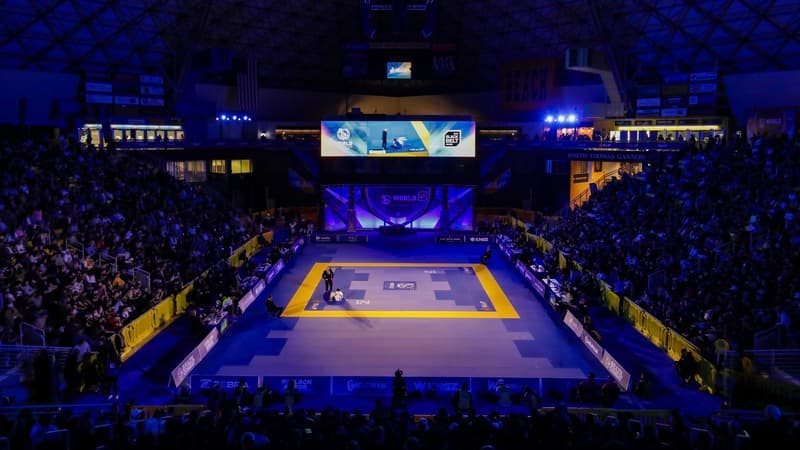
Main photo: IBJJF; 2024 Worlds arena photograph, photographer not identified on source page.
The takeaway
A first tournament is easier to enjoy when you make it smaller. Follow someone, find the correct mat, and learn enough about the rules to understand what each athlete is trying to accomplish. The details become interesting through repetition, not through pretending to know them all on arrival.
Bring patience for the schedule and curiosity for the matches. Keep your support useful, your camera within the event rules, and your tactical advice proportionate to what you actually know. The sport can provide the drama without extra production from the stands.
See the training behind the matches
Find a nearby gym if watching has made you curious about trying a beginner class yourself.
FAQ
Do I need to train BJJ to enjoy a tournament? No. Following one athlete or division and learning the event's basic scoring format is enough to get started. Ask focused questions between matches, when somebody has time to explain.
Are spectators always admitted free? No. Admission policies and fees vary. Check the specific event page and venue information before traveling, including which day the athlete you support is competing.
Can I film my friend's matches? Only where the organizer and venue allow it. Check the published policy, ask the athlete, and keep other spectators' views clear. Rules for still photos and video may differ.
Why did the person underneath seem comfortable? They may have been using guard to control distance or set up an attack. Position, grips, rules, and the score all matter; being underneath alone doesn't tell you who is winning.

Kit Langford
Kit Langford covers the louder parts of jiu-jitsu — the marketing claims, the arguments, the gear that promises more than gear can deliver. The jokes are expected to survive a fact-check.
Related Posts

Mikey Musumeci gives up the belt to make room for MMA
Musumeci is vacating his UFC BJJ title to focus on MMA training. What he is leaving, what continues, and why the transition matters.
IBJJF membership: finish the paperwork before the deadline
IBJJF membership and tournament entry are separate steps. Plan documents, professor approval, renewals, and junior accounts before registration closes.
Choosing a BJJ seminar worth your time and travel
Choose a BJJ seminar by the subject, teaching format, access, and total cost. Know what to ask the host before buying a ticket.
Comments (0)
Loading comments...