
Leg Locks in BJJ: A Beginner's Honest Guide
Quick answer: Leg locks are submissions that attack the ankle, knee, or hip — and after decades as BJJ's forbidden zone, they're now a core part of the modern game. Beginners should start with the straight ankle lock, which is legal from white belt in most rulesets, and treat everything else as material to learn defensively first. The non-negotiables: apply slowly, tap early, and put your partner's knees above your ego.
Ten years ago, pulling half guard and diving on someone's foot in class might have earned you a lecture. Today, entire gyms build their no-gi programs around leg attacks. If you're new, you've walked into the sport mid-conversation — so here's the honest version of what happened and where you fit in.
Why leg locks were taboo
For most of BJJ's history, leg locks carried a stigma that had little to do with whether they worked.
Part of it was culture. The classical game was built around passing guard and climbing the positional ladder, and grabbing a foot skipped the ladder entirely — it read as a shortcut, even a cheap one. "Going for legs" was what you did when you couldn't pass.
Part of it was fear, and not entirely unreasonable fear. Knees are less forgiving than elbows, heel hooks can injure before they hurt, and instructors who'd never been taught leg locks properly weren't equipped to teach them safely. Banning them was easier. Rulesets followed the culture: for years, most leg attacks were illegal at lower belts, and knee reaping — a leg position, not even a submission — could get you disqualified.
What changed
The no-gi submission-only scene changed it. Through the 2010s, events like EBI rewarded finishes over points, and a wave of grapplers — most visibly John Danaher's squad, including athletes like Gordon Ryan — showed that leg locks weren't a bag of tricks. They were a system, with positional hierarchies and control layers just as rigorous as the back or the mount.
Once systematized leg lockers started running through elite competition, the argument was over. Rulesets loosened, reaping restrictions eased, heel hooks entered high-level no-gi divisions, and "we don't do leg locks here" went from orthodoxy to red flag. The taboo didn't survive contact with results.
The straight ankle lock: your legal entry point
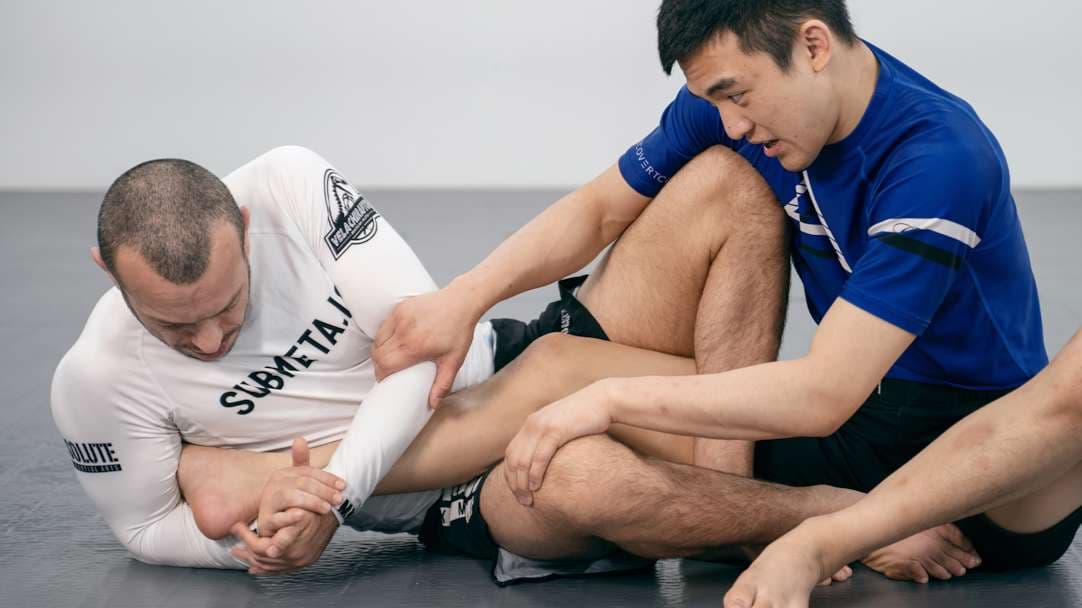
For a beginner, one leg lock matters: the straight ankle lock (also called a straight footlock). It's the leg lock equivalent of the armbar — fundamental, relatively safe, and legal from white belt in most rulesets, including IBJJF competition.
Mechanically, you trap their leg between yours and extend their ankle using your forearm under the Achilles — a lever, not a crank. It teaches you the whole grammar of leg attacks — controlling the leg above the knee line, managing your own exposed feet, finishing with your body rather than your arms — without the injury profile of the scarier stuff.
What's legal at your belt
Rules vary by organization and keep evolving, so treat this as orientation, not gospel: straight ankle locks are broadly legal for adults at every belt, more aggressive attacks like kneebars and toe holds traditionally arrive at brown and black belt, and heel hooks remain illegal in the gi almost everywhere while now being allowed in advanced no-gi divisions under IBJJF and most major no-gi rulesets.
The practical advice is simpler than the rulebook: before any competition, read the current rules for your exact division. And in the gym, your coach's rules override everything — if heel hooks aren't trained in your room, don't hunt them there.
Safety: the part that actually matters
Leg locks are only as dangerous as the people applying them. The protocol that keeps everyone training:
Apply every leg lock slowly. No snapping, no ripping. Extend gradually and give your partner time to recognize what's happening.
Tap early — earlier than feels necessary. Ankles and especially knees can be damaged before real pain shows up. If the position is fully locked and the pressure is building, the escape window has closed. Tap.
Don't spin out of twisting attacks. With rotational locks like heel hooks, panicking and spinning is how injuries happen. If you don't know the escape, tap and ask.
Catch and release while you're learning. Getting to the position was the win. Letting go instead of finishing costs you nothing in training and builds the control that matters.
Respect for training partners
Here's the plain truth: your training partners are lending you their knees. A blown ACL isn't a tough round — it's surgery, months off the mat, and sometimes a changed life outside the gym.
So match your leg game to your partner. Don't heel hook people who don't know heel hooks. Ask before adding twisting attacks to a roll. And if someone taps late to save pride, be the one who let go early anyway. In every gym, the people with the nastiest leg locks and the zero injury record are the ones everybody wants to roll with.
The takeaway
Leg locks went from taboo to table stakes because they work, and pretending otherwise just leaves holes in your game. Start with the straight ankle lock, learn defense alongside offense, keep your applications slow and your taps early, and treat your partners' joints like your own. The modern game is open to you — enter it like an adult.
Find a room that teaches this properly
Good leg locks come from gyms with a real no-gi program and a coach who drills the safety as hard as the finish. Find a BJJ gym near you on Let's Roll →
FAQ
Are leg locks legal for white belts? Straight ankle locks are legal for adult white belts under IBJJF rules and most other rulesets. Kneebars, toe holds, and heel hooks come later — traditionally at brown belt and up, with heel hooks limited to advanced no-gi divisions. Always check the current rulebook before competing.
Are leg locks more dangerous than other submissions? Applied recklessly, yes — knees and ankles can be injured before pain registers, unlike chokes. Applied slowly by trained people who tap early, they're a normal part of modern practice. The technique isn't the risk; the application speed is.
Should beginners learn heel hooks? Beginners should learn heel hook defense and positioning concepts early, but leave live heel hooking until they're experienced and in a gym that trains them deliberately. There's no rush — the straight ankle teaches the same foundations at a fraction of the risk.
Why did BJJ ban leg locks for so long? A mix of culture and caution — the classical game prized guard passing over leg entanglements, and instructors who'd never learned leg locks couldn't teach them safely. The no-gi boom of the 2010s proved they were systematic and effective, and the sport adjusted.
Related Posts

Mikey Musumeci gives up the belt to make room for MMA
Musumeci is vacating his UFC BJJ title to focus on MMA training. What he is leaving, what continues, and why the transition matters.

IBJJF membership: finish the paperwork before the deadline
IBJJF membership and tournament entry are separate steps. Plan documents, professor approval, renewals, and junior accounts before registration closes.
Choosing a BJJ seminar worth your time and travel
Choose a BJJ seminar by the subject, teaching format, access, and total cost. Know what to ask the host before buying a ticket.
Comments (0)
Loading comments...