
Jiu-jitsu in San Francisco: make the commute part of the choice
Quick answer: Choose jiu-jitsu in San Francisco around the classes you can reach consistently, then compare instruction, training format, and membership terms. Use academy websites as starting points and confirm the exact location, visitor policy, and timetable directly before making a trip.
A San Francisco gym search can begin with an impressive instructor and end with a route you do not want to repeat after work. The academy may be an excellent option. It can still be the wrong journey for the week you actually have.
The city rewards a more practical search. Put your home, workplace, and likely class times on the same map before turning a list of famous names into a shortlist. The useful question is where you can train well and return often enough for the membership to matter.
Start from the place you will leave
Your home address is not always the right starting point for a gym search. If you plan to train after work, begin with the office. If a morning class fits better, begin with home and include the trip from the academy to the next obligation. A convenient first leg can hide a difficult second one.
Make a sample week using realistic departure times. Include changing, the full class, any rolling you intend to do, and the return trip. Do not count only the minutes spent moving between map pins. The session occupies a larger piece of the evening.
San Francisco's hills and neighborhood routes also deserve attention if you expect to walk or cycle. A distance that looks modest on a map can feel different with a work bag and training gear. Check the route itself rather than treating mileage as a complete description.
For a visitor, the hotel can play the same role as a home address. Choose a session that fits the rest of the trip without requiring a perfect sequence of meetings, transport connections, and meals. One class you can reach calmly is a better plan than three that depend on everything finishing early.
Use two local academies as concrete starting points
Ralph Gracie's San Francisco contact page lists 1166 Howard Street. Romulo Melo BJJ lists 1313 Mason Street. These are research starting points in different parts of the city, not a ranked list or a claim that either is the right academy for every reader.
Put the actual addresses into your route plan. A school name can cover several locations, and a familiar affiliation does not tell you which entrance, schedule, or visitor policy applies to the branch you intend to visit.
Next, look at the classes offered at that location. Identify the sessions matching your experience and whether you want gi, no-gi, or both. Ask the academy which class it recommends for a first visit instead of choosing the most convenient label without checking eligibility.
Keep the comparison fair. A short visit cannot establish everything about an academy, and a website cannot reproduce the experience of receiving instruction. Use the published information to arrange an appropriate introduction, then evaluate what you actually observe in the class you would attend regularly.
Compare a real week rather than a whole timetable
A large timetable can create the impression of unlimited access even when only a few sessions fit your life. Highlight the classes you could realistically attend for the next month. Ignore the rest temporarily. This makes the comparison less exciting and much more useful.
Check whether those sessions are beginner, general, competition, or another category. Ask how students are introduced to live rounds and whether a first-time visitor should arrive for paperwork or orientation. The name of a class may not explain its structure.
If your work schedule changes, identify a second option. A membership that depends entirely on leaving at the same minute every Tuesday may be fragile. Another morning, lunch, or weekend session can provide flexibility if it is actually available to you.
Avoid assuming that an open mat is open to everyone. The term describes a training format, while guest access is a separate policy. Confirm permission directly, particularly if you are visiting another academy or arriving without an existing relationship. A timetable entry is not an invitation to bypass the school's check-in process.
Ask about the costs attached to your plan
Compare the cost of the training you intend to use, not just the largest number on a pricing page. A visitor needs to know the applicable drop-in or short-stay arrangement. A resident needs the membership terms, any enrollment costs, and the process for changing or ending the agreement.
Ask whether uniforms are required and whether loan or rental equipment is available for an introductory session. Do not assume that a trial offer includes everything a traveling athlete needs. The answer may differ from the arrangement for a local beginner considering membership.
Transport belongs in the calculation too. Parking, transit fares, or repeated rides can change the practical cost of attending. You do not need an elaborate spreadsheet; a realistic monthly estimate can reveal a difference that an advertised membership price misses.
The BJJ gym contract questions guide gives a fuller set of points to clarify. Get the terms in writing before committing. Clear answers protect both the student and the academy by reducing misunderstandings about what was included or promised.
Make the first message easy to answer
A useful inquiry gives the academy enough information to recommend a class. Include the date you hope to attend, your experience, whether you train gi or no-gi, and whether you are visiting or looking for a regular membership. Keep the request specific enough that staff can respond without several rounds of clarification.
Before heading over, confirm:
The exact branch, address, and entrance you should use.
The class recommended for your experience and intended training format.
Any booking, waiver, fee, or early-arrival requirement.
Uniform rules and whether equipment must be arranged in advance.
Whether visitor participation includes rolling or open mat access.
Send the message with enough notice for a reply. A request made while already outside the door can put staff in the position of improvising during class. Advance communication is especially useful when your travel schedule gives you only one chance to attend.
Save the answer. It gives you the relevant details in one place and helps avoid relying on an old schedule image. If your plans change, tell the academy rather than leaving a reserved introductory appointment unexplained.
Judge the class you would actually attend
A trial is most informative when it resembles your likely routine. If weekday evenings are your available time, an unusually quiet daytime visit may not answer every question about the classes you would use. Attend an appropriate session at a realistic time when the academy permits it.
Look for concrete teaching behavior. Can you follow the explanation? Does the instructor offer a useful correction? Are partner assignments appropriate for the task and the students? Is there a clear way to ask about something you do not understand?
Also notice your own response to the logistics. Did reaching class require a rushed exit from work? Could you change comfortably? Is the return trip manageable after training? These questions are not a judgment on the gym. They help determine whether the relationship fits your circumstances.
A demanding class can be enjoyable without being suitable for every evening. A quieter class can be useful without matching the image you had of a famous academy. Evaluate the experience against your goals rather than against a social-media version of what training is supposed to look like.
Leave room for the city outside the academy
For travelers, jiu-jitsu can become one part of a San Francisco visit rather than a schedule that consumes it. Choose the session first, confirm it, and leave enough room for meals, meetings, and the people traveling with you. A wet gi also needs a practical plan before the next day.
For residents, the same principle applies over a longer period. Training has to coexist with work, family, rest, and the ordinary unpredictability of a week. A school that fits those realities can become a dependable part of life without requiring every other activity to move around it.
Reassess after a few visits. The initial map estimate may have been optimistic, or a class you overlooked may turn out to fit better. Adjusting the plan is sensible. It does not mean the first academy failed or that you lacked commitment.
Keep the decision specific: the right place, the right class, and a route you can repeat. San Francisco offers enough possibilities that reputation should begin the search rather than finish it. The final choice should make sense on the day you are tired and still want to train.
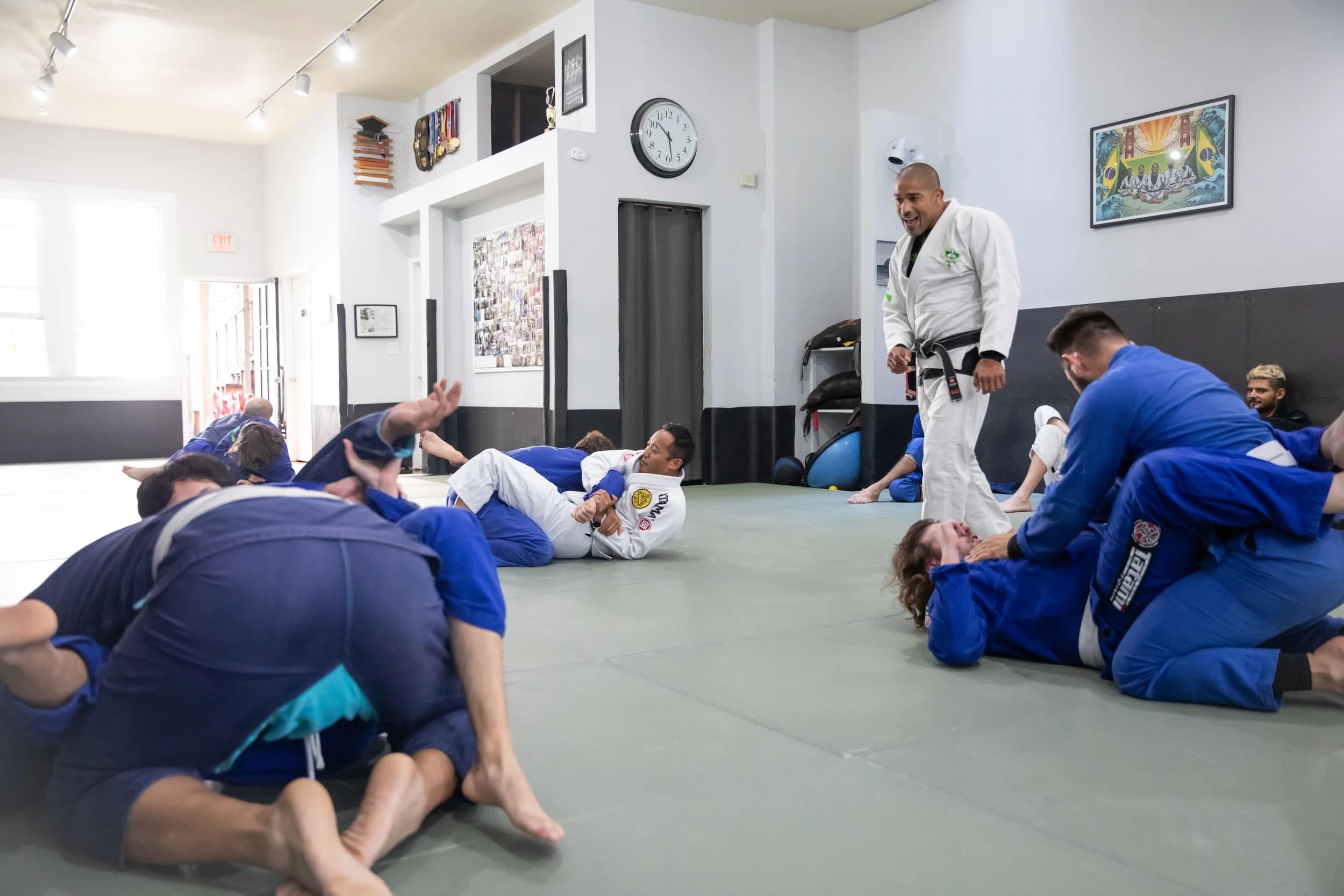
Main photo: Romulo Melo BJJ; academy photograph.
The takeaway
A useful San Francisco BJJ search begins with your actual week. Map the trip from where you will leave, compare the classes you can attend, and confirm the branch and visitor rules directly. Academy names and published schedules help you investigate; they do not make the decision for you.
Use an appropriate first visit to assess both instruction and logistics. The academy you can return to consistently, with clear expectations on both sides, is a stronger choice than an impressive option that rarely fits your day.
Build your San Francisco shortlist
Use Let's Roll's gym finder to explore San Francisco academies, then contact the schools on your shortlist to confirm the class and arrangements that fit your plans.
FAQ
How do I choose a BJJ gym in San Francisco? Start with the classes you can reach regularly, then compare instruction, training format, costs, and membership terms. Visit an appropriate session before making a longer commitment when possible.
Can I drop in while visiting San Francisco? Ask the specific academy in advance. Confirm the date, experience requirements, fee, uniform policy, and whether a booking is needed. Do not assume every listed session accepts visitors.
Does open mat mean anyone can attend? No. Guest access is a separate policy from the training format. Some open mats have membership or invitation requirements, so obtain a direct answer before arriving.
Should I choose the most famous instructor? Reputation can guide research, but the relevant class, teaching experience, commute, and terms still matter. Choose the training arrangement you can use consistently and comfortably.

Maya Corbett
Maya Corbett answers the questions you have before walking into an unfamiliar academy — what to book, what to bring, who to ask. Every detail in her guides traces back to something the gym published itself.
Related Posts

Mikey Musumeci gives up the belt to make room for MMA
Musumeci is vacating his UFC BJJ title to focus on MMA training. What he is leaving, what continues, and why the transition matters.

IBJJF membership: finish the paperwork before the deadline
IBJJF membership and tournament entry are separate steps. Plan documents, professor approval, renewals, and junior accounts before registration closes.
Choosing a BJJ seminar worth your time and travel
Choose a BJJ seminar by the subject, teaching format, access, and total cost. Know what to ask the host before buying a ticket.
Comments (0)
Loading comments...