
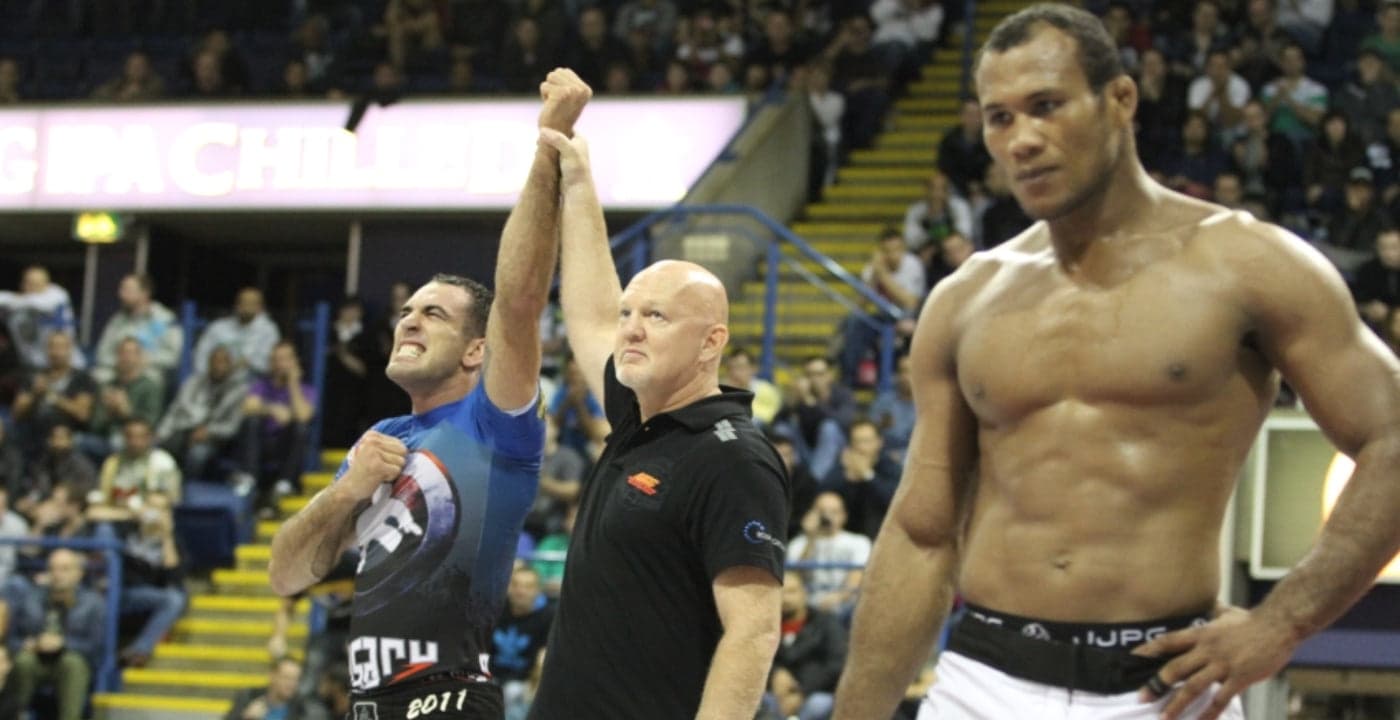
Braulio Estima: the weight title and the open-weight test
Quick answer: Braulio Estima won both the under-88kg and absolute divisions at ADCC 2009, then won the 2011 superfight against Ronaldo “Jacare” Souza. The 2009 run is worth studying because the two brackets demanded different answers against different opponents. It also shows why a medal summary cannot replace the details of how a tournament unfolded.
Two gold medals can look deceptively simple on a results page. At ADCC 2009, Braulio Estima's name occupied the first line of two divisions. The matches underneath those lines were anything but interchangeable.
The weight bracket ended with Andre Galvao. The absolute brought Marcelo Garcia and Vinny Magalhaes into the route before a final against Xande Ribeiro. That is a collection of distinct grappling problems, not one problem repeated until the photographer arrived.
Estima's Barcelona weekend offers a good way to read a major career through a specific performance. Keep the results, the methods, and the circumstances together. Each explains something the other two leave out.
The gi record was already substantial
The IBJJF's 2004 World Championship results list Estima as the adult black-belt medium-heavy champion. The 2009 Worlds results list him first at heavy. His ADCC success did not emerge from an otherwise empty competition history.
Those results establish achievement in the gi without requiring the reader to treat gi and no-gi as the same assignment. Removing the jacket changes available grips and the way some positions can be maintained. The connection between the sports is real, but a title in one is not an automatic result in the other.
That makes 2009 a more interesting year than a single-event label suggests. Estima had success under different conditions. A useful profile should preserve those conditions rather than compress every championship into an undifferentiated total.
For a student who practices both formats, this is a reason to investigate adaptation. Which parts of a game remain useful when the gripping environment changes? Which need a different entry? The record supplies the reason to ask; the technical answer still has to come from examining the training or matches.
The under-88kg bracket had its own sequence
ADCC's contemporary account of the 2009 run records Estima's weight-division route through Yuji Arai, James Brasco, Rafael Lovato Jr., and Galvao. It places the first two opponents on the opening day and the later rounds on the second.
That sequence matters. Tournament preparation has to survive more than the opponent most likely to appear in a preview. An athlete can prepare for a famous finalist and still fail before reaching that match. The bracket makes every earlier assignment part of the championship.
It also gives the viewer a sensible order for studying the run. Begin with the first available match rather than assuming the final contains the whole explanation. Look for what remains consistent and what changes when the opponent changes.
The lesson is not that every round carries equal drama. Some exchanges are more memorable than others. The lesson is that advancement is cumulative. A quiet early decision and a spectacular late finish can both be necessary parts of the same gold medal.
Different finishes belong to the same game
ADCC Latin America's retrospective on Estima describes a decision over Brasco, an Estima-lock finish against Lovato, and an inverted triangle against Galvao. Even that short selection shows why calling the performance dominant does not explain it.
A decision requires the match to be read through its full competitive conditions. A submission highlights an ending, but the ending still depends on the route into it. A technical study that begins only when the opponent is already trapped has skipped the part most students need help reproducing.
Choose one exchange and identify the preceding control. What prevented the defender from moving somewhere safer? What reaction made the next attack available? Those questions are more productive than treating the finish as a detached move to add to a collection.
Any attempt to practice a leg attack needs qualified instruction and the rules appropriate to the participants. The value of studying a famous finish is understanding the problem it solved, not assuming that a highlight gives you enough information to apply it responsibly in the next open round.
The absolute rearranged the opponent problem
The official 2009 results confirm Estima's second gold in the absolute, with Xande Ribeiro second and Vinny Magalhaes third. The contemporary report records a route that included Janne-Pekka Pietilainen, Garcia, Magalhaes, and Ribeiro.
This is why an absolute title adds a different dimension to a weight title. The field no longer asks only how an athlete performs within that weight category. The athlete has to deal with opponents arriving from other categories, each with their own competitive strengths.
There is no need to flatten those opponents into a generic size challenge. Garcia's presence and Magalhaes's presence are different assignments even before their weight divisions enter the discussion. A useful account names the people and keeps their matches distinct.
For a competitor considering an absolute division, the historical example should provoke preparation rather than bravado. Extra entry means additional matches and a different range of possible opponents. Estima's result demonstrates what was achieved at the top level; it does not make another athlete's decision automatic.
The final needs its actual ending
The ADCC Latin America retrospective records that Ribeiro's absolute final ended through medical withdrawal after an injury. That detail belongs beside the gold medal. It should not be converted into a different kind of finish because a cleaner sentence would sound more dramatic.
A result and its ending answer separate questions. Estima won the division. The account of the final explains how the decisive match concluded. Including the latter does not erase the former or the work that led to it.
This is a useful standard for sports writing more generally. A title can be impressive without every contest ending in the same idealized fashion. Byes, decisions, injuries, and other circumstances are part of tournament history. Precision is more respectful to the competitors than turning every result into a slogan.
It also changes how the footage should be discussed. Do not use an athlete's inability to continue as a prompt to speculate about their character or private thoughts. Describe what the record establishes and stop there. The achievement does not need invented certainty around it.
The next ADCC assignment was a superfight
The 2011 official results list Estima as the main superfight winner against Souza in Nottingham. The Latin America account records a 3–0 score. That adds a different competitive format to the story after the double-bracket weekend.
A superfight concentrates preparation on one known opponent. A tournament requires a plan that can survive a sequence whose later participants are not fully known in advance. Neither format makes the other irrelevant; they simply organize the problem differently.
Reading those results together shows more than a tally of three ADCC golds. In 2009, Estima had to keep advancing through two divisions. In 2011, he had to solve the designated match. The career contains both kinds of assignment.
For fans, this is a reason to resist treating every title as an identical unit. Names, formats, and the conditions of victory carry information that a count cannot. A count is useful as an index. It is a poor substitute for the actual history it points toward.
Study one decision instead of collecting the whole weekend
A double-gold run can tempt a student into an oversized project: study every match, learn every attack, and return to class with an entirely new identity. A smaller assignment is more likely to produce a useful conversation with an instructor.
Choose a single sequence and record:
The position before the decisive action, including the controls already established.
The opponent's visible response and the next option it allowed.
The part you can explain clearly and the part that remains uncertain.
Then bring the uncertainty to class. Do not hide it beneath a confident description borrowed from a highlight title. Knowing where your understanding stops is useful information for the person helping you.
You may find that the sequence is not suitable for your current training. That is still a worthwhile result. Studying an elite performance does not require copying all of it. Sometimes the transferable lesson is how an athlete connects actions, while the exact position belongs to a later stage of your own learning.
Main photo: ADCC Latin America.
The takeaway
Estima's 2009 ADCC performance is worth remembering in detail: a weight title, a separate absolute bracket, varied endings, and a final whose circumstances should be reported accurately. The 2011 superfight adds another chapter without making the earlier matches interchangeable.
For a student, the useful material lies between the medals. Pick an exchange, work out what made the next action possible, and ask for help where the footage exceeds your understanding. The record earns attention; careful viewing turns that attention into a practical question.
Find a place to ask the technical question
Explore the gym directory and look for instruction that helps you connect match study with controlled practice.
FAQ
What did Braulio Estima win at ADCC 2009? He won the under-88kg division and the absolute division. The official results list Andre Galvao as the weight-division runner-up and Xande Ribeiro as the absolute runner-up.
Did the 2009 absolute final end by an ordinary submission? The ADCC Latin America retrospective describes a medical withdrawal after Ribeiro was injured. That circumstance should remain part of an accurate account of the result.
Who did Estima beat in the 2011 superfight? He defeated Ronaldo “Jacare” Souza. The official event results confirm the winner, and ADCC Latin America's retrospective records the score as 3–0.
Should a beginner copy the Estima lock from a highlight? A highlight is not sufficient instruction. Ask a qualified coach about the technique, the appropriate rules, and controlled practice before attempting any unfamiliar leg attack.

Miles Serrano
Miles Serrano writes about competitors and the decisions that shaped their careers. He is more interested in the adjustment someone made in the third minute than in the medal count afterward.
Related Posts

Mikey Musumeci gives up the belt to make room for MMA
Musumeci is vacating his UFC BJJ title to focus on MMA training. What he is leaving, what continues, and why the transition matters.
IBJJF membership: finish the paperwork before the deadline
IBJJF membership and tournament entry are separate steps. Plan documents, professor approval, renewals, and junior accounts before registration closes.

Choosing a BJJ seminar worth your time and travel
Choose a BJJ seminar by the subject, teaching format, access, and total cost. Know what to ask the host before buying a ticket.
Comments (0)
Loading comments...