

What would a jiu-jitsu gym look like without belts?
Quick answer: A BJJ gym without visible belts would still need to communicate experience, manage pairings, and recognize progress. Removing rank markers might change first impressions, but it would not remove differences in skill or informal status. The useful question is what information a belt provides and what you are asking it to tell you that it cannot.
Take the belts away for a moment. The mats remain. So do the people who can pass your guard, the instructor who knows your name, and the person who always needs to borrow nail clippers at precisely the wrong time.
This is a thought experiment, not a proposal that academies should abandon their systems. Imagine a room where everyone arrives in plain training clothes and nobody announces rank. Then watch how much social information has to be rebuilt before the first round.
Some of that reconstruction might be healthy. Some would be inconvenient. The interesting part is that the room would still need almost everything people currently ask belts to organize.
Someone still has to identify the new person
A visible beginner's rank gives a partner an initial clue. It is an incomplete clue, but it can prompt a useful adjustment: explain the exercise, check the starting position, and avoid assuming that every term is familiar.
Without that marker, the gym needs another way to communicate experience. An introduction can do the job. So can an instructor who organizes the first partnerships. What cannot do the job reliably is guessing from confidence, age, or the price of someone's rashguard.
The new student may look athletic and still not understand when to stop. An experienced visitor may look hesitant because the class is unfamiliar. Clothing cannot resolve every uncertainty, and removing a belt does not make visual judgment more accurate.
This is the first useful result of the experiment: basic communication remains necessary either way. A belt can support an introduction; it cannot replace one. If the entire plan for welcoming a newcomer is to glance at their waist, there is room to improve the plan without changing the uniform.
Expertise would become visible through particular tasks
In the imagined room, a student's knowledge would appear while they worked. One person might explain a guard-retention problem clearly. Another might be difficult to take down. A third might be the best partner for learning how to move at a controlled pace.
Those abilities do not have to line up neatly. The person who teaches a useful detail is not automatically the best competitor, and the best competitor is not automatically the clearest explainer for a beginner.
Rank provides a broad category. Training exposes specific abilities within it. Removing the category would put more weight on those observations, although it might also make a visitor work harder to understand who can help with what.
A practical lesson survives without removing anything: ask a precise question of a relevant person. If your problem is escaping one grip, you need someone who understands that grip. You do not need a philosophical ruling on where every person in the academy belongs in a universal order of grappling importance.
Status would probably find another chair
The absence of colored belts would not prevent a gym from developing favorites, reputations, or informal authority. In this hypothetical room, competition results might become the main currency. Or years of attendance. Or proximity to the instructor.
That is a possibility to consider, not a claim that every rankless training environment behaves the same way. The point is narrower: removing a formal symbol does not automatically remove the human habit of noticing differences and arranging them into stories.
The room would still need to decide whose advice carries weight and how disagreements are handled. Ideally, those decisions would rest on the quality of instruction and the responsibilities assigned by the academy, rather than on who speaks most confidently beside the water cooler.
Belts at least make one kind of status visible and legible. Informal status can be harder for a newcomer to read. A reform that removes an imperfect signal should explain what replaces it, or it may leave the same hierarchy operating through a more confusing set of clues.
Progress would need more words
Without promotion ceremonies, the instructor would need other ways to tell students what has changed. That could be a useful discipline. Instead of pointing to a new color, the conversation might identify what the student now understands and what remains unreliable.
Consider a few possible markers:
You can recover the position after the first attempt fails.
You can explain the exercise clearly enough to help a new partner begin.
You can apply the skill against a wider range of reasonable resistance.
These are proposed observations, not a replacement grading standard. Each academy would still have to decide what it values and how it evaluates it.
The experiment also reveals something a belt ceremony does well: it gives a diffuse process a recognizable occasion. Friends can gather around a change that otherwise arrives in small, hard-to-date increments. Losing that occasion would be a real tradeoff. A useful system needs both specific feedback and some way to acknowledge the work people have put in.
Partner choice would need an honest introduction
A room without rank labels would make the pre-round conversation more important. You would need to ask about experience, the intended pace, and the task rather than treating a color as an agreement already made.
That is good practice in a room with belts, too. Two students at the same rank can want very different rounds. One may be preparing for competition; another may be practicing an unfamiliar position. Neither preference is visible in the knot.
The instructor still has a role in deciding suitable pairings and setting the class format. The experiment is not an argument for leaving everyone to negotiate everything independently. New students in particular should not have to infer the whole social contract from a handshake.
Try carrying one part of this imagined room into your next real session: state the work you want to do. A simple request for a controlled positional round gives a partner more actionable information than hoping they interpret your belt, your expression, and the way you stretched before class.
Visitors expose the limits of shorthand
An established group can learn one another's habits over time. A visitor has none of that background. They need the academy to explain the class and introduce people clearly enough that participation does not depend on already belonging.
A visible belt can help, but it can also create assumptions. The visitor might be experienced in one style of practice and unfamiliar with today's format. They may know the position but not the local name for it. Clarifying that difference is ordinary hospitality, not a challenge to their rank.
If you use the open-mat listings to visit another room, describe your background honestly and ask about the session. Do not turn an unfamiliar room into an experiment in concealing information. The hypothetical absence of belts is useful for thinking; it is not a reason to withhold relevant experience from a host.
A well-run introduction helps everyone. It gives the visitor a way to ask questions and the regular partners a better starting point than a visual inspection followed by several minutes of surprised adjustment.
Keep the belt and reduce the extra meaning
The most useful conclusion may be surprisingly modest. Keep the promotion system, the ceremonies, and the practical shorthand. Stop requiring the belt to settle questions outside its reach.
A belt does not tell a partner your preferred pace tonight. It does not establish that every piece of advice you give is correct. It does not oblige you to win every round against a lower rank or prevent you from asking a basic question when the subject is unfamiliar.
It also does not need to be meaningless just because it cannot mean everything. People can value a promotion as recognition from their instructor and still remain curious about what they do not know. The problem begins when the symbol becomes a job description that nobody can fulfill.
If you are comparing academies through the gym directory, ask how feedback and progression work in the actual classes. The answer should include more than which colors exist. You want to know how a student learns what to improve between the occasions when something new gets tied around their waist.
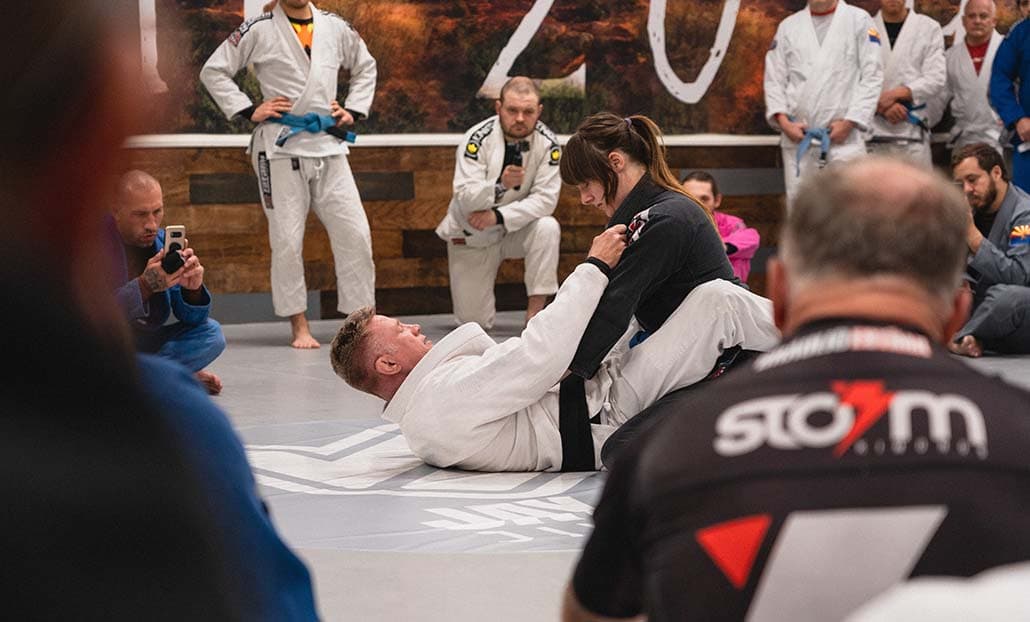
Main photo: BJJ Globetrotters; archive training-camp photograph.
The takeaway
A beltless room would still need introductions, clear instruction, suitable pairings, and meaningful feedback. It might make some assumptions harder to maintain, but it would also remove a familiar way to communicate experience and celebrate progress.
That makes the thought experiment useful without making it a campaign. Keep the symbol if it serves the room. Give the people wearing it enough information, responsibility, and freedom that a strip of fabric does not have to carry the entire conversation.
Make your next visit an informed one
Use the training passport to support your exploration of other rooms while keeping the host academy's expectations part of the plan.
FAQ
Is this an argument that BJJ should abolish belts? No. It is a thought experiment about what rank communicates and what a gym would need to explain without it. The same questions can improve a room that keeps its current system.
Would removing belts remove ego from training? There is no reason to assume that. People could attach status to competition results, attendance, or other signals instead. Clear expectations and considerate behavior still need attention.
Can a lower belt give useful technical advice? A specific observation can be useful regardless of the speaker's rank. Check it against the exercise and your instructor's guidance rather than accepting or rejecting it solely because of a belt color.
Should I hide my rank when visiting another gym? No. Give the host an honest account of your experience and follow its procedures. Clear information makes it easier to find an appropriate class and suitable training partners.

Kit Langford
Kit Langford covers the louder parts of jiu-jitsu — the marketing claims, the arguments, the gear that promises more than gear can deliver. The jokes are expected to survive a fact-check.
Related Posts

Mikey Musumeci gives up the belt to make room for MMA
Musumeci is vacating his UFC BJJ title to focus on MMA training. What he is leaving, what continues, and why the transition matters.

IBJJF membership: finish the paperwork before the deadline
IBJJF membership and tournament entry are separate steps. Plan documents, professor approval, renewals, and junior accounts before registration closes.
Choosing a BJJ seminar worth your time and travel
Choose a BJJ seminar by the subject, teaching format, access, and total cost. Know what to ask the host before buying a ticket.
Comments (0)
Loading comments...