
BJJ gi weaves: what the fabric label can actually tell you
Quick answer: A BJJ gi’s weave describes how its fabric is constructed, while GSM describes fabric mass per square meter. Neither tells you the complete garment’s weight, fit, comfort, or competition eligibility, so compare the full specification and the rules that apply to your use.
A gi can have an impressive fabric description and still fit badly. The label may tell you pearl weave, a number, and very little about whether the sleeves will reach the right place after washing.
Fabric specifications are useful when they answer a buying question. They become less useful when every number is treated as a ranking. Before choosing the lightest, heaviest, or most elaborately named jacket, decide what you need the garment to do during an ordinary training week.
Separate the weave from the weight
A weave name describes a fabric construction. GSM means grams per square meter, a measure of the fabric’s mass over a fixed area. These are related pieces of information, but they do not answer the same question. Two jackets can share a weave name and have different fabric weights.
The number is not the weight of the complete gi. A finished jacket includes different amounts of material depending on size and cut, plus a collar, stitching, reinforcement, and any patches. The trousers are another garment with their own construction. A belt adds more if you are weighing the complete uniform.
Think of GSM as one line in a specification rather than the specification itself. If you need to know what a gi adds to luggage or a competition weigh-in, weigh the actual garment or ask the manufacturer for the relevant finished weight in your size.
That distinction also prevents a common comparison error. A jacket advertised with a lower GSM is not automatically lighter as a complete outfit than every higher-GSM alternative. You need comparable information before treating the smaller number as a guaranteed saving.
Read the trousers as carefully as the jacket
A product page may place its most prominent number beside the jacket while giving the trousers only a short line lower down. Do not stop reading at the headline. Trousers affect fit, movement, packing, and the practical feel of the uniform just as directly as the top.
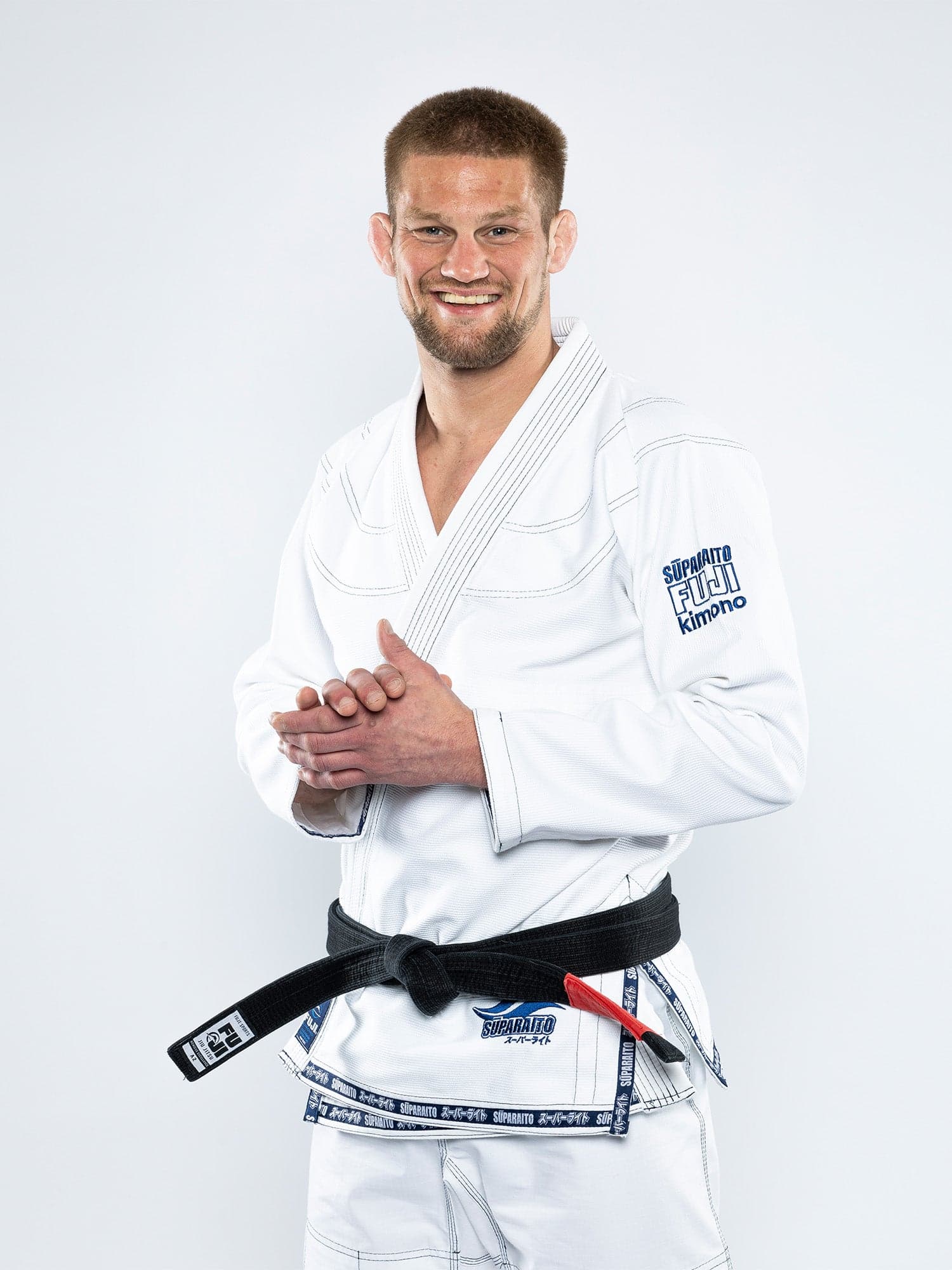
The FUJI Suparaito product description, for example, lists a pearl-weave jacket separately from ripstop trousers. That is a useful illustration of why one fabric label does not describe the whole outfit. It is a product specification, not evidence that the model is the right purchase for every student.
Check how the waistband closes, where the trousers are reinforced, and whether the seller provides actual measurements. A jacket that fits well does not guarantee that the matching trousers suit your proportions. Some buyers need a different cut rather than a different fabric weight.
Ask about separate sizing if that matters to you. Do not assume every brand offers it, and do not order a larger jacket solely to solve a trouser problem without checking what that does to sleeve length and overall fit.
Decide which problem a lighter gi would solve
A lighter garment may appeal because you travel, have limited bag space, or prefer its feel during training. Those are sensible preferences. Name the one that matters to you so you can assess whether the specific model addresses it.
For travel, packed volume and drying arrangements may matter alongside weight. For training, you may care more about the collar, sleeve shape, or how the trousers move when you squat. A single fabric number cannot predict all of those experiences.
Avoid treating lightweight as a promise about durability or comfort. Construction, use, care, and personal preference all enter the decision. A retailer’s adjective is not a controlled comparison between the models on your shortlist.
You also do not need to justify preferring a heavier-feeling jacket. If a garment fits, meets the relevant rules, and works with your routine, the fact that another model advertises fewer grams does not create an urgent replacement project. The internet will continue selling gis even if you keep the one you own.
Check competition requirements before choosing fabric
A gi sold for jiu-jitsu is not automatically accepted by every organizer. Competition rules can address material, color, measurements, patches, and other details. Check the organizer’s requirements for the event you plan to enter rather than relying on a general product badge.
The IBJJF uniform page is the appropriate starting point for its events. Read the full guidance and any linked updates. A product name or an old review cannot settle whether the specific uniform you intend to wear meets the applicable requirements.
Do this before washing, altering, or adding patches. Returns can become more difficult once the garment has been used, and a correctly fitted training gi may still be unsuitable for a particular competition. Buying with the event in mind is easier than discovering the mismatch near registration day.
If eligibility is central to the purchase and the specification is unclear, ask the seller for the exact material information and ask the organizer how to interpret its rule. Keep the response. Do not turn a vague assurance from an unrelated comment thread into the basis for your competition kit.
Compare models on the same dimensions
A useful comparison needs consistent categories. One page may lead with GSM, another with total weight, and another with a description such as lightweight or competition cut. Put those claims into separate columns in your notes before deciding which model wins anything.
For each candidate, record:
Jacket fabric and the stated GSM, if provided.
Trouser fabric, fastening, and reinforcement details.
Measurements for the size you would actually buy.
Care instructions and the seller’s return conditions.
Any event requirements you still need to confirm.
You do not need a large spreadsheet. Two or three models and a short note are usually enough to expose missing information. The purpose is to stop comparing a precise measurement from one manufacturer with an adjective from another.
If an important detail is missing, ask. The answer may eliminate a model or reveal that it is worth trying. A purchase based on a clear fit question is easier to evaluate than one based on whether the product description sounds more serious than its competitors.
Fit still gets the final vote
Try the gi on before washing it, following the seller’s conditions. Check the jacket while standing naturally, extending your arms, and moving through ordinary training positions without stressing the garment. Check the trousers independently. You are looking for usable movement and appropriate coverage, not merely whether the size label matches your previous purchase.
Pay attention to where the fabric pulls. A tight area may reflect cut rather than overall size. Going up one size can solve one problem while creating another, so compare actual measurements and ask the seller for guidance when your proportions fall between its categories.
The first-gi buying guide covers the broader purchase. Weave belongs inside that decision. It should not displace questions about the academy’s uniform policy, the garment’s fit, or whether you can maintain it between classes.
Keep the comparison practical after the gi arrives. If it does not work for you, use the return or exchange process while available. Do not convince yourself that an uncomfortable fit must be correct because you spent an evening learning fabric terminology.
Care instructions belong in the purchase decision
Read the care label before assuming the new gi will behave like an older one. Follow the manufacturer’s instructions for washing and drying. The word preshrunk does not mean you can ignore those directions or expect every dimension to remain unchanged under any treatment.
Consider your actual routine. If your laundry space and training schedule make the recommended drying method difficult, that is useful information before buying. You may need a second uniform, a different schedule, or a different garment. None of those decisions can be settled by weave alone.
Avoid using aggressive washing as an improvised tailoring service. Shrinkage is not a precise way to correct a fit problem, and altering the garment may affect return options. Start with a suitable size and maintain it according to the instructions rather than buying around a hoped-for transformation.
Once you find a model that works, record the size, measurements, and care method. That small note makes the next purchase easier. It also gives you something more reliable than remembering that the previous gi was the blue one with a promising description.
Main photo: FUJI Sports; illustrative product photograph.
The takeaway
Read weave and GSM as specifications, then connect them to a real need. Check the jacket and trousers separately, compare actual measurements, and verify competition requirements with the organizer. The complete garment has to work, not just the number attached to it.
A good purchase does not require becoming a fabric specialist. It requires enough information to predict fit, use, and care with reasonable confidence. If a product page cannot answer an important question, ask before paying.
Check the uniform before the order
Find your academy in the gym directory and confirm its uniform policy before choosing a fabric, color, or model for regular classes.
FAQ
Does GSM tell me how much the entire gi weighs? No. GSM describes fabric mass per square meter. Finished weight also depends on size, cut, trousers, reinforcement, and other components. Weigh the actual uniform when the total matters.
Is pearl weave automatically better than another weave? Not for every buyer or use. Compare the full garment, its fit, care instructions, and any competition requirements. A weave name alone cannot establish comfort, durability, or suitability.
Can I use any lightweight gi in IBJJF competition? Do not assume that. Check the current uniform requirements and linked updates for the event. Confirm unclear material details with the seller before buying or altering the garment.
Should I buy a larger gi and shrink it to fit? An exchange for a suitable size is more predictable when available. Follow the care instructions rather than relying on a precise amount of shrinkage to fix the original fit.

Kit Langford
Kit Langford covers the louder parts of jiu-jitsu — the marketing claims, the arguments, the gear that promises more than gear can deliver. The jokes are expected to survive a fact-check.
Related Posts

Mikey Musumeci gives up the belt to make room for MMA
Musumeci is vacating his UFC BJJ title to focus on MMA training. What he is leaving, what continues, and why the transition matters.
IBJJF membership: finish the paperwork before the deadline
IBJJF membership and tournament entry are separate steps. Plan documents, professor approval, renewals, and junior accounts before registration closes.
Choosing a BJJ seminar worth your time and travel
Choose a BJJ seminar by the subject, teaching format, access, and total cost. Know what to ask the host before buying a ticket.
Comments (0)
Loading comments...