
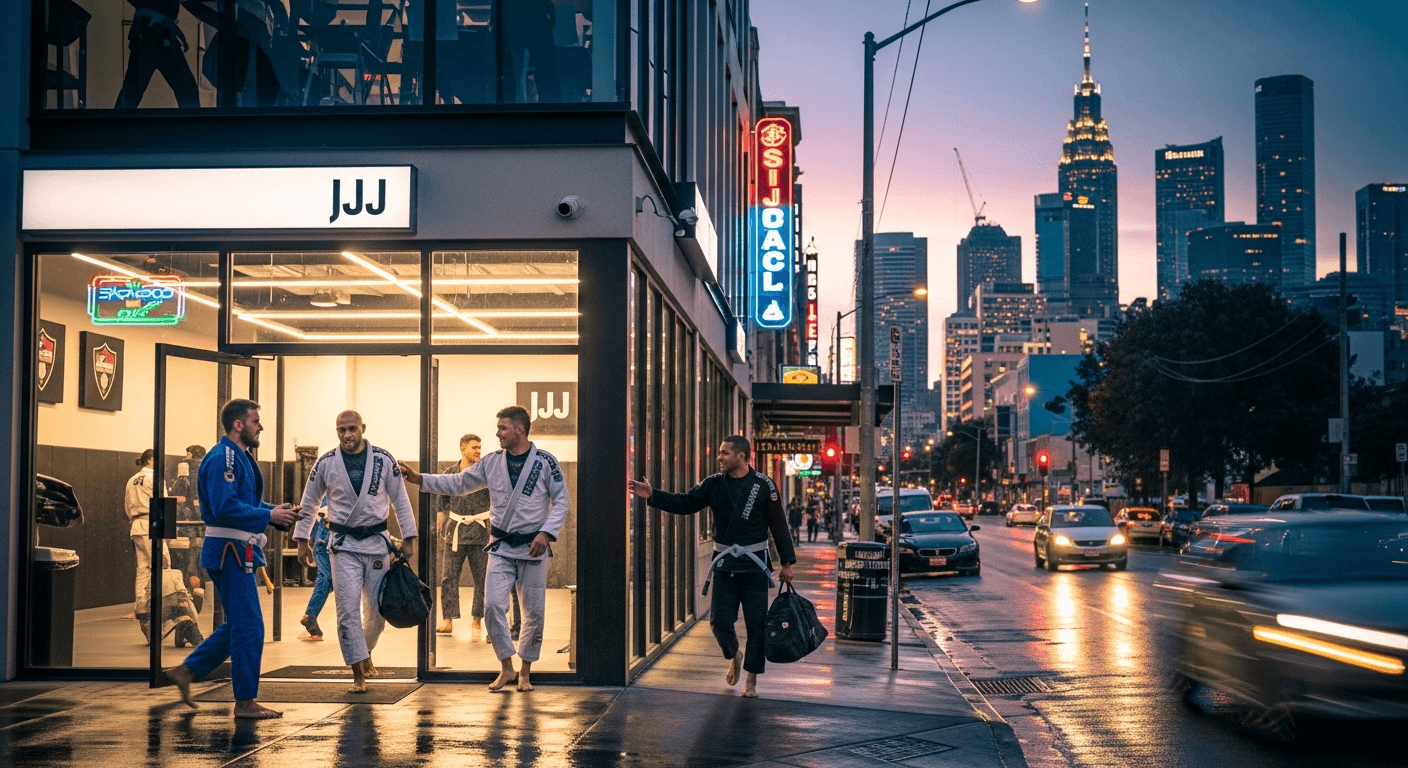
The Best Cities for BJJ Training in the United States
I've trained in 47 U.S. cities and at least one gym in each. Some were forgettable — a single academy in a strip mall with three students and a dubious purple belt instructor. Others were ecosystems — cities where you could train at a different world-class gym every day of the week and still have options left.
If you're relocating, planning a training trip, or just curious about where BJJ culture runs deepest in the U.S., this is the list. Every city on it earns its spot through a combination of gym density, coaching quality, competition scene, and the intangible thing I can only describe as "mat culture saturation" — how deeply BJJ is woven into the city's identity.
1. San Diego, California
San Diego is the undisputed capital of American BJJ. Within a thirty-minute drive, you can train at Atos, Alliance, University of Jiu-Jitsu (the Ribeiro brothers), 10th Planet, and dozens more world-class academies. The talent density is absurd — your average Tuesday night open mat might include multiple world champions and Pan-Am medalists.
What makes San Diego special isn't just the gyms — it's the cross-pollination. Because academies are so close together, students and coaches interact constantly. Seminars, inter-gym open mats, and informal training sessions create an environment where technique evolves faster than anywhere else.
The weather doesn't hurt either. Year-round sunshine and an outdoor lifestyle attract athletes who treat training as their primary activity, not a hobby squeezed between obligations.
2. New York City, New York
NYC's BJJ scene is deep, diverse, and relentless — like the city itself. Renzo Gracie Academy is the flagship, but the scene extends far beyond one gym. Marcelo Garcia's legacy lives through his former students and coaches. Unity Jiu-Jitsu has produced a wave of young competitors. Brooklyn alone has a dozen serious academies.
Training in NYC means training with people from every background, style, and intensity level. The rolls are tough, the pace is fast, and the community is surprisingly tight despite the city's size. Morning classes are packed with finance professionals in borrowed gis; evening classes bring out the grinders.
3. Austin, Texas
Austin has quietly become one of the best BJJ cities in the country. The combination of a growing tech economy, affordable cost of living relative to coastal cities, and a fitness-obsessed culture has attracted a wave of high-level practitioners.
The gym scene is balanced — strong competition gyms, welcoming hobbyist schools, and a thriving no-gi community. Weekend open mats are a social event. The city's overall vibe — active, community-oriented, slightly weird — mirrors BJJ culture perfectly.
4. Los Angeles, California
LA's BJJ scene is massive and fragmented. The best gyms are scattered across a sprawling metro area, which means your training options depend heavily on which neighborhood you live in. But if you're willing to drive, the quality is exceptional.
Cobrinha's academy, the Mendes brothers' legacy at AOJ (now based in Costa Mesa), Beverly Hills Jiu-Jitsu Club, and multiple 10th Planet locations give LA one of the broadest stylistic ranges of any city. The Hollywood connection also means you'll occasionally train next to someone you've seen on screen.
5. Miami, Florida
Miami is where BJJ's Brazilian roots are strongest on American soil. The city's large Brazilian population means many gyms operate bilingually, and the training culture retains the intensity and warmth of Rio academies. Fight Sports, Valente Brothers, and numerous other schools maintain direct connections to Brazilian BJJ lineages.
The competition scene is fierce — Miami regularly hosts major IBJJF events, and local gyms produce a steady stream of tournament competitors. Training in Miami's heat also builds a particular kind of mental toughness.
6. Houston, Texas
Houston flies under the radar but has one of the strongest BJJ communities in the country. The city's size and diversity support a wide range of gyms, from Lucas Lepri's academy to multiple Gracie Barra locations to smaller schools with unique approaches.
What sets Houston apart is the blue-collar training culture. People show up, put in the work, and don't talk about it on social media. The rolls are hard, the coaches are demanding, and the community is genuine.
7. Chicago, Illinois
Chicago's four-season climate means training happens indoors, and the gym community is tight because of it. Carlson Gracie Chicago, Redzovic Jiu-Jitsu, Comprido's academy, and a growing number of smaller schools create a scene that's competitive and collegial.
The Midwest work ethic shows up on the mats. Chicago grapplers are technical, tough, and surprisingly well-traveled — many compete on the national circuit and bring that experience back to their local training rooms.
8. Portland, Oregon
Portland's BJJ scene punches above its weight. For a mid-size city, the number and quality of gyms is remarkable. The culture is deeply no-gi friendly, influenced by 10th Planet's strong presence, and the community is unusually welcoming to visitors and cross-trainers.
Open mats in Portland are a social event — people bring coffee, hang out after training, and discuss technique with genuine curiosity. It's the most chill BJJ scene I've experienced without sacrificing training quality.
9. San Francisco Bay Area, California
The Bay Area — including San Jose, Oakland, and surrounding cities — has a deep BJJ history. Caio Terra, Ralph Gracie, and multiple Ribeiro affiliates have shaped the region's technical identity. The tech industry has also brought a wave of analytical practitioners who approach BJJ with an engineer's mindset.
Training costs are high (reflecting the overall cost of living), but the quality matches. Weekend open mats at Bay Area gyms regularly draw national-level competitors who happen to live in the region.
10. Denver, Colorado
Denver's outdoor-activity culture and growing population have fueled a rapidly expanding BJJ scene. Easton Training Center is the flagship, but the scene has diversified significantly. The altitude is a factor — visitors from sea level notice it during hard rounds — and training at elevation builds conditioning that pays dividends at competitions.
The community is young, enthusiastic, and competition-oriented. Denver's BJJ scene feels like it's still building momentum, which gives it an energy that more established scenes sometimes lack.
Honorable Mentions
Several cities narrowly missed this list and deserve recognition. Philadelphia has a gritty, wrestling-influenced BJJ scene with strong competition results. Atlanta's diverse population feeds a growing number of quality academies. San Jose's deep BJJ history and Bay Area overflow make it a hidden gem. Las Vegas, fueled by the MMA ecosystem, produces fighters who are equally dangerous in gi and no-gi.
The reality is that BJJ quality is rising everywhere. Even cities without a deep tradition are developing strong scenes as the art's popularity grows. Five years from now, this list might look completely different — and that's a sign of the sport's health.
What Makes a Great BJJ City
Beyond individual gym quality, the best BJJ cities share common characteristics: enough gym density to create healthy competition between academies, a culture that supports cross-training and open mats, an active competition scene that motivates training, and a community that extends beyond any single gym.
If you're evaluating a city's BJJ scene — whether for relocation or a training trip — look for these indicators. A city with three excellent gyms that don't interact is less valuable than a city with six good gyms that share open mats, host inter-gym competitions, and genuinely support each other's growth.
The Open Mat Culture by City
One of the best indicators of a city's BJJ health is its open mat culture. Cities like San Diego and Austin have vibrant weekend open mat scenes where grapplers from different gyms converge. These cross-gym sessions create a city-wide community that transcends individual academy boundaries and produces a shared technical identity.
The Cost Factor
BJJ gym costs vary dramatically by city, and this affects who can train and how often. In New York and San Francisco, monthly memberships commonly exceed two hundred dollars. In Austin, Denver, and Portland, you can find excellent training for one hundred twenty to one hundred sixty dollars. In smaller cities and suburban areas, quality instruction is available for under one hundred dollars per month.
When evaluating a city's BJJ scene, factor in the cost of living alongside gym quality. San Diego might have the best gyms in the country, but housing costs and gym fees create a higher total cost of training than, say, Austin or Portland, where you can access excellent instruction at a more sustainable price point. The best city for your BJJ is one where you can train consistently without financial stress — because consistency is the single biggest factor in long-term development.
International Contenders
This list focuses on U.S. cities, but BJJ has become truly global. London's BJJ scene has exploded in the past decade, with Roger Gracie's academy serving as a beacon for European grapplers. Melbourne and Sydney have some of the most competitive BJJ scenes in the Asia-Pacific region, producing international medalists with increasing regularity.
Tokyo, despite being the birthplace of jiu-jitsu, has embraced BJJ as a separate discipline. The precision and discipline of Japanese training culture combined with Brazilian technique creates a uniquely effective training environment. Competitors from Japan's BJJ scene have surprised international audiences with their technical refinement.
Abu Dhabi and Dubai, driven by the Abu Dhabi Combat Club (ADCC) tournament legacy, have invested heavily in grappling infrastructure. These cities attract elite grapplers with training camps, sponsorships, and professional competition opportunities. For the serious competitor, a training trip to the UAE offers exposure to world-class no-gi grappling at the highest level.
Planning a Training Trip
If you're visiting any of these cities specifically to train, plan ahead:
Research gyms using our BJJ academy directory — filter by location, read reviews, and check schedules.
Find open mat sessions before you arrive so you can plan your training week.
Contact gyms in advance about drop-in policies and pricing.
Pack both gi and no-gi gear — you never know what format a session will use.
Log your visits in your training passport to remember what you learned and where.
Frequently Asked Questions
Which city is best for competition-focused training?
San Diego has the highest concentration of world-class competitors and competition-focused gyms. New York and Miami are close seconds, with strong tournament scenes and gyms that regularly produce medalists at IBJJF events.
Can I find good BJJ training in smaller cities?
Absolutely. Many smaller cities have one or two excellent gyms run by dedicated coaches. The training might be less diverse, but the instruction can be just as high-quality. Smaller gyms often have tighter communities and more individual coaching attention.
Is it worth relocating for better BJJ?
If BJJ is a central part of your life — especially if you compete — relocating to a BJJ-rich city can dramatically accelerate your development. Several professional competitors have relocated specifically for training. For hobbyists, visiting these cities on training trips is a practical alternative.

Jason Park
purple Belt
Purple belt traveler who has trained at over 60 gyms across 12 countries. Always chasing the next open mat.
Related Posts
Being a BJJ Parent on the Sideline Without Taking Over
Help your child at a BJJ tournament without adding competing instructions. Agree on parent and coach roles, respect tapping, and handle the practical work.
A family BJJ calendar should count who covers the evening
The class time leaves out travel, supervision and somebody else's plans. Build the family training week around the whole commitment.
Before you post your child's jiu-jitsu tournament photos
Before sharing your child's BJJ tournament photos, ask about their preferences, other children in frame, and the event's policy. Keep difficult moments private.
Comments (0)
Loading comments...